Metrics
Full text views
Full text views help
Loading metrics...
* Views captured on Cambridge Core between #date#. This data will be updated every 24 hours.
Usage data cannot currently be displayed.
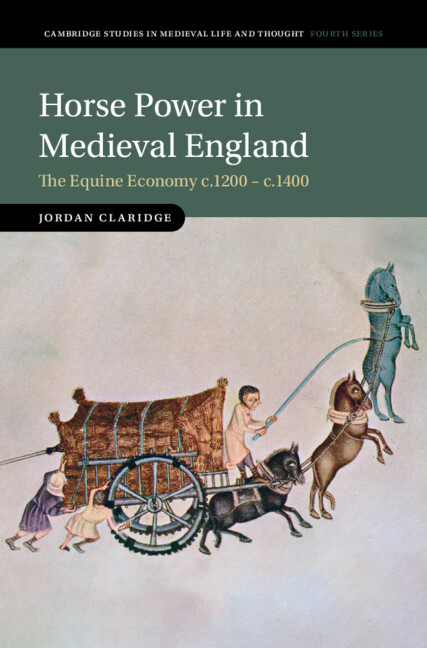
Horses were a driving force behind medieval England's agricultural and economic expansion, although little has been written about the trade in these animals or how they were supplied. In the first book of its kind, Jordan Claridge addresses this gap, revealing that although lords and their estates relied heavily on horse power, they largely failed to produce agricultural horses themselves. Instead, it was England's peasants who bred the workhorses that fuelled the medieval economy. Peasants exploited opportunities in seigniorial society and identified conditions suited to horse breeding, coming to dominate the production and trade of working horses. Through meticulous analysis of manorial records, Claridge uncovers how peasant production not only sustained medieval English agriculture but also contributed to England's commercialization and long-term economic development. In so doing, he highlights the unexpected role of ordinary people in shaping economic transformation.
Loading metrics...
* Views captured on Cambridge Core between #date#. This data will be updated every 24 hours.
Usage data cannot currently be displayed.
This section outlines the accessibility features of this content - including support for screen readers, full keyboard navigation and high-contrast display options. This may not be relevant for you.
The PDF of this book complies with version 2.2 of the Web Content Accessibility Guidelines (WCAG), offering more comprehensive accessibility measures for a broad range of users and attains the highest (AAA) level of WCAG compliance, optimising the user experience by meeting the most extensive accessibility guidelines.
Allows you to navigate directly to chapters, sections, or non‐text items through a linked table of contents, reducing the need for extensive scrolling.
Provides an interactive index, letting you go straight to where a term or subject appears in the text without manual searching.
You will encounter all content (including footnotes, captions, etc.) in a clear, sequential flow, making it easier to follow with assistive tools like screen readers.
You get concise descriptions (for images, charts, or media clips), ensuring you do not miss crucial information when visual or audio elements are not accessible.
You get more than just short alt text: you have comprehensive text equivalents, transcripts, captions, or audio descriptions for substantial non‐text content, which is especially helpful for complex visuals or multimedia.
You can access graphs or charts in a text or tabular format, so you are not excluded if you cannot process visual displays.
You will still understand key ideas or prompts without relying solely on colour, which is especially helpful if you have colour vision deficiencies.
You benefit from high‐contrast text, which improves legibility if you have low vision or if you are reading in less‐than‐ideal lighting conditions.
