How Institutions Evolve

-
Select format
-
- Publisher:
- Cambridge University Press
- Publication date:
- 05 September 2012
- 06 September 2004
- ISBN:
- 9780511790997
- 9780521837682
- 9780521546744
- Dimensions:
- (228 x 152 mm)
- Weight & Pages:
- 0.577kg, 352 Pages
- Dimensions:
- (228 x 152 mm)
- Weight & Pages:
- 0.47kg, 352 Pages
You may already have access via personal or institutional login
Show more authors 
You may already have access via personal or institutional login
Book description
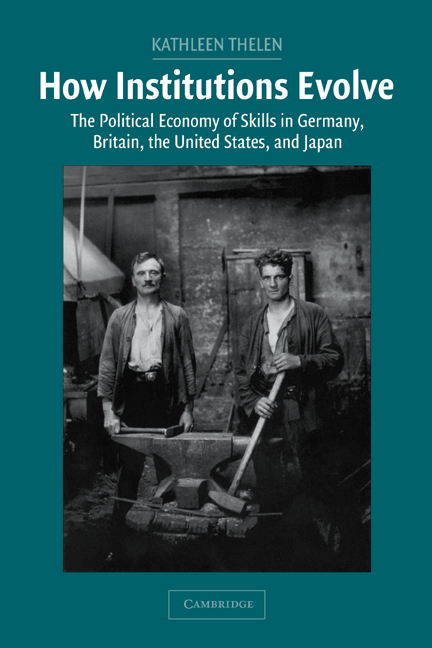
The institutional arrangements governing skill formation are widely seen as a key element in the institutional constellations defining 'varieties of capitalism' across the developed democracies. This book explores the origins and evolution of such institutions in four countries - Germany, Britain, the United States and Japan. It traces cross-national differences in contemporary training regimes back to the nineteenth century, and specifically to the character of the political settlement achieved among employers in skill-intensive industries, artisans, and early trade unions. The book also tracks evolution and change in training institutions over a century of development, uncovering important continuities through putative 'break points' in history. Crucially, it also provides insights into modes of institutional change that are incremental but cumulatively transformative. The study underscores the limits of the most prominent approaches to institutional change, and identifies the political processes through which the form and functions of institutions can be radically reconfigured over time.
Awards
Winner of the 2007 J. David Greenstone Award - Politics and History Section
Reviews
'This book should be required reading for every academic writing about, or conducting research into, skills. … I can thoroughly recommend this book.'
Source: Industrial Relations Journal
Contents
Contents
Metrics
Altmetric attention score
Full text views
Full text views helpTotal number of HTML views: 0
Total number of PDF views: 0 *
 Loading metrics...
* Views captured on Cambridge Core between #date#. This data will be updated every 24 hours.
Usage data cannot currently be displayed.
Accessibility standard: Unknown
Why this information is here
This section outlines the accessibility features of this content - including support for screen readers, full keyboard navigation and high-contrast display options. This may not be relevant for you.
Accessibility Information
Accessibility compliance for the PDF of this book is currently unknown and may be updated in the future.