How to Develop Productive Industry in India and the East

-
Select format
-
- Publisher:
- Cambridge University Press
- Publication date:
- 05 October 2013
- 26 April 2012
- ISBN:
- 9781139198264
- 9781108046237
- Dimensions:
- Weight & Pages:
- Dimensions:
- (216 x 140 mm)
- Weight & Pages:
- 0.54kg, 426 Pages
You may already have access via personal or institutional login
Show more authors 
You may already have access via personal or institutional login
Book description
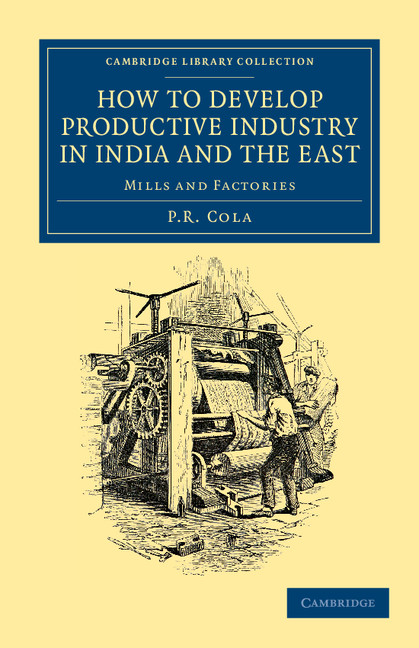
The craft of manufacturing cotton was learnt by the British in India, but the East India Company's drive for profits caused the development of a cotton-spinning industry in Britain, which grew enormously when mechanical processes were introduced during the industrial revolution. Subsequent protectionist legislation which forbade the export of anything except raw cotton meant that India's supremacy in the industry was lost to Britain in the nineteenth century. This 1867 work, edited by P. R. Cola, who owned the Arkwright Cotton Mills in Bombay (Mumbai), argues for investment in up-to-date machinery, and provides a blueprint for developing a host of industries such as cotton and other textiles, jute, sugar, oil and iron, which would bring prosperity to India. Containing illustrations and statistical data, the book gives useful insights into the early development of many industries in India and in some of the other economies of the East.
Contents
Contents
Metrics
Full text views
Full text views helpTotal number of HTML views: 0
Total number of PDF views: 0 *
 Loading metrics...
* Views captured on Cambridge Core between #date#. This data will be updated every 24 hours.
Usage data cannot currently be displayed.
Accessibility standard: Unknown
Why this information is here
This section outlines the accessibility features of this content - including support for screen readers, full keyboard navigation and high-contrast display options. This may not be relevant for you.
Accessibility Information
Accessibility compliance for the PDF of this book is currently unknown and may be updated in the future.