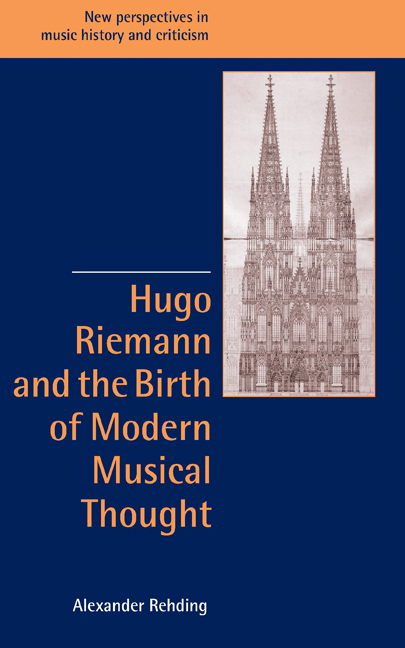
Hugo Riemann and the Birth of Modern Musical Thought

-
Select format
-
- Publisher:
- Cambridge University Press
- Publication date:
- 22 September 2009
- 01 May 2003
- ISBN:
- 9780511481369
- 9780521820738
- 9780521096362
- Dimensions:
- (228 x 152 mm)
- Weight & Pages:
- 0.507kg, 230 Pages
- Dimensions:
- (228 x 152 mm)
- Weight & Pages:
- 0.35kg, 232 Pages
- Subjects:
- Music, Music Criticism, Nineteenth-Century Music
- Series:
- New Perspectives in Music History and Criticism (11)
You may already have access via personal or institutional login- Subjects:
- Music, Music Criticism, Nineteenth-Century Music
- Series:
- New Perspectives in Music History and Criticism (11)
Show more authors 
You may already have access via personal or institutional login
Book description
Generally acknowledged as the most important German musicologist of his age, Hugo Riemann (1849–1919) shaped the ideas of generations of music scholars, not least because his work coincided with the institutionalisation of academic musicology around the turn of the last century. This influence, however, belies the contentious idea at the heart of his musical thought, an idea he defended for most of his career - harmonic dualism. By situating Riemann's musical thought within turn-of-the-century discourses about the natural sciences, German nationhood and modern technology, this book reconstructs the cultural context in which Riemann's ideas not only 'made sense' but advanced an understanding of the tonal tradition as both natural and German. Riemann's musical thought - from his considerations of acoustical properties to his aesthetic and music-historical views - thus regains the coherence and cultural urgency that it once possessed.
Reviews
Review of the hardback:'… this is a magnificent study. The writing throughout is sympathetic, witty, engaged, quietly ambitious; and Rehding is wonderfully sensitive to the poignancy of Riemann's tale.'
Source: Nineteenth-Century Music Review
Contents
Contents
Metrics
Altmetric attention score
Full text views
Full text views helpTotal number of HTML views: 0
Total number of PDF views: 0 *
 Loading metrics...
* Views captured on Cambridge Core between #date#. This data will be updated every 24 hours.
Usage data cannot currently be displayed.
Accessibility standard: Unknown
Why this information is here
This section outlines the accessibility features of this content - including support for screen readers, full keyboard navigation and high-contrast display options. This may not be relevant for you.
Accessibility Information
Accessibility compliance for the PDF of this book is currently unknown and may be updated in the future.