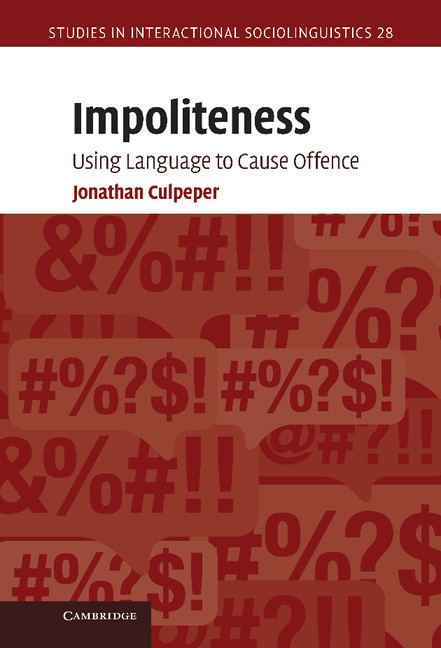
Impoliteness

-
Select format
-
- Publisher:
- Cambridge University Press
- Publication date:
- 16 May 2011
- 06 January 2011
- ISBN:
- 9780511975752
- 9780521869676
- 9780521689779
- Dimensions:
- (228 x 152 mm)
- Weight & Pages:
- 0.62kg, 308 Pages
- Dimensions:
- (228 x 152 mm)
- Weight & Pages:
- 0.49kg, 308 Pages
- Series:
- Studies in Interactional Sociolinguistics (28)
You may already have access via personal or institutional login- Series:
- Studies in Interactional Sociolinguistics (28)
Show more authors 
You may already have access via personal or institutional login
Book description
When is language considered 'impolite'? Is impolite language only used for anti-social purposes? Can impolite language be creative? What is the difference between 'impoliteness' and 'rudeness'? Grounded in naturally-occurring language data and drawing on findings from linguistic pragmatics and social psychology, Jonathan Culpeper provides a fascinating account of how impolite behaviour works. He examines not only its forms and functions but also people's understandings of it in both public and private contexts. He reveals, for example, the emotional consequences of impoliteness, how it shapes and is shaped by contexts, and how it is sometimes institutionalised. This book offers penetrating insights into a hitherto neglected and poorly understood phenomenon. It will be welcomed by students and researchers in linguistics and social psychology in particular.
Reviews
‘Stimulating and scholarly … a significant contribution to the growing research area of rudeness and impoliteness discourse.'
Janet Holmes - Victoria University of Wellington
‘Using diverse examples of rudeness, it will fascinate students of communication and linguistics as it addresses important controversies in the study of politeness.'
Karen Tracy - University of Colorado, Boulder
'Culpeper’s outstanding book documents that the time is ripe for us to address the urgent social problem of violence in language. In proposing an insightful theory of impoliteness, Culpeper accurately reads classic and contemporary linguistic theories and analyses a wide range of oral and written impoliteness events.'
Daniel Silva Source: Journal of Language Aggression and Conflict
Contents
Contents
Metrics
Altmetric attention score
Full text views
Full text views helpTotal number of HTML views: 0
Total number of PDF views: 0 *
 Loading metrics...
* Views captured on Cambridge Core between #date#. This data will be updated every 24 hours.
Usage data cannot currently be displayed.
Accessibility standard: Unknown
Why this information is here
This section outlines the accessibility features of this content - including support for screen readers, full keyboard navigation and high-contrast display options. This may not be relevant for you.
Accessibility Information
Accessibility compliance for the PDF of this book is currently unknown and may be updated in the future.