In Other Words

-
Select format
-
- Publisher:
- Cambridge University Press
- Publication date:
- 14 January 2010
- 09 February 2006
- ISBN:
- 9780511616273
- 9780521481595
- 9780521484749
- Dimensions:
- (216 x 138 mm)
- Weight & Pages:
- 0.75kg, 392 Pages
- Dimensions:
- (216 x 138 mm)
- Weight & Pages:
- 0.636kg, 390 Pages
- Series:
- Studies in Interactional Sociolinguistics (21)
- Subjects:
- Linguistic Anthropology, Sociology: General Interest, Sociolinguistics, Language and Linguistics, Sociology
You may already have access via personal or institutional login- Series:
- Studies in Interactional Sociolinguistics (21)
- Subjects:
- Linguistic Anthropology, Sociology: General Interest, Sociolinguistics, Language and Linguistics, Sociology
Show more authors 
You may already have access via personal or institutional login
Book description
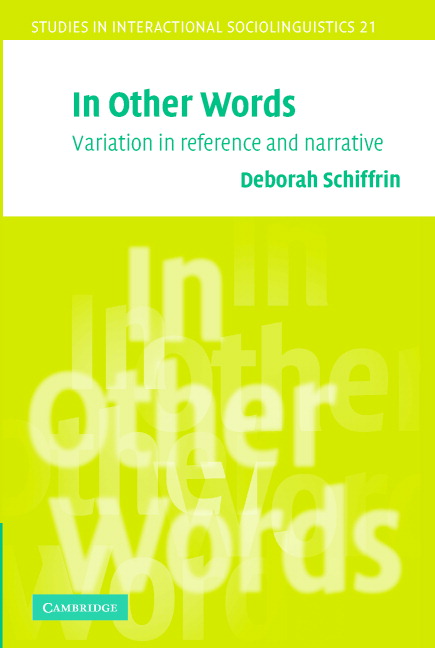
What we say always consists of prior words, structures and meanings that are combined in new ways and re-used in new contexts for new listeners. In this book, Deborah Schiffrin looks at two important tasks of language - presenting 'who' we are talking about (the referent) and 'what happened' to them (their actions and attributes) in a narrative - and explores how this presentation alters in relation to emergent forms and meanings. Drawing on examples from both face-to-face talk and public discourse, she analyses a variety of repairs, reformulations of referents, and retellings of narratives, ranging from word-level repairs within a single turn-at-talk, to life story narratives told years apart. Bringing together work from conversation analysis, interactional sociolinguistics, cognitive semantics, pragmatics, and variation analysis, In Other Words will be invaluable for scholars wishing to understand the many different factors that underlie the shaping and re-shaping of discourse over time, place and person.
Contents
Contents
Metrics
Altmetric attention score
Full text views
Full text views helpTotal number of HTML views: 0
Total number of PDF views: 0 *
 Loading metrics...
* Views captured on Cambridge Core between #date#. This data will be updated every 24 hours.
Usage data cannot currently be displayed.
Accessibility standard: Unknown
Why this information is here
This section outlines the accessibility features of this content - including support for screen readers, full keyboard navigation and high-contrast display options. This may not be relevant for you.
Accessibility Information
Accessibility compliance for the PDF of this book is currently unknown and may be updated in the future.