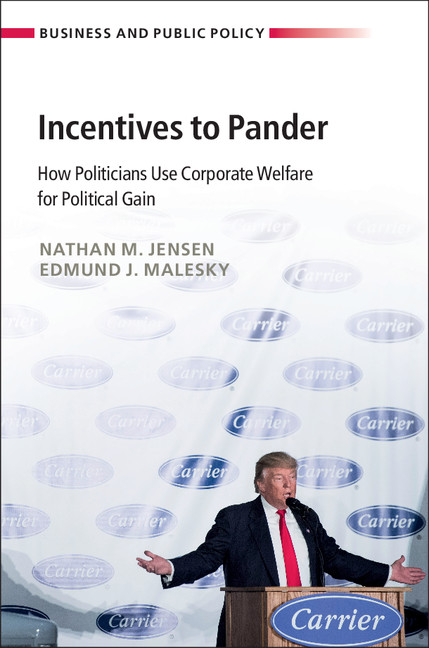
Incentives to Pander

-
Select format
-
- Publisher:
- Cambridge University Press
- Publication date:
- 23 February 2018
- 15 March 2018
- ISBN:
- 9781108292337
- 9781108418904
- 9781108408530
- Dimensions:
- (228 x 152 mm)
- Weight & Pages:
- 0.5kg, 268 Pages
- Dimensions:
- (229 x 152 mm)
- Weight & Pages:
- 0.5kg, 272 Pages
You may already have access via personal or institutional login
Show more authors 
You may already have access via personal or institutional login
Book description
Policies targeting individual companies for economic development incentives, such as tax holidays and abatements, are generally seen as inefficient, economically costly, and distortionary. Despite this evidence, politicians still choose to use these policies to claim credit for attracting investment. Thus, while fiscal incentives are economically inefficient, they pose an effective pandering strategy for politicians. Using original surveys of voters in the United States, Canada and the United Kingdom, as well as data on incentive use by politicians in the US, Vietnam and Russia, this book provides compelling evidence for the use of fiscal incentives for political gain and shows how such pandering appears to be associated with growing economic inequality. As national and subnational governments surrender valuable tax revenue to attract businesses in the vain hope of long-term economic growth, they are left with fiscal shortfalls that have been filled through regressive sales taxes, police fines and penalties, and cuts to public education.
Reviews
‘The puzzle of investment incentives like tax breaks and regulatory exemptions is that although they are generally inefficient, governments around the world - from Kansas to Vietnam - use them to attract investors. In this provocative and wide-ranging book, Jensen and Malesky show that politicians choose these policies because they reap political benefits from doing so. By identifying the political logic that drives inefficient policies, this book reveals how citizens may press for better policymaking.'
Thomas Pepinsky - Cornell University, New York
‘Is all politics local? In this intriguing study, Jensen and Malesky show that though separated by geography and political systems, politicians in the United States, Canada, Russia, and Vietnam all use fiscal policy to generate and sustain political support. The authors masterfully weave a variety of evidence - individual level surveys and original data on policymakers' incentives - to show how short term fiscal policies often have dramatically negative long term consequences.'
David Leblang - University of Virginia
Contents
Contents
Metrics
Altmetric attention score
Full text views
Full text views helpTotal number of HTML views: 0
Total number of PDF views: 0 *
 Loading metrics...
* Views captured on Cambridge Core between #date#. This data will be updated every 24 hours.
Usage data cannot currently be displayed.
Accessibility standard: Unknown
Why this information is here
This section outlines the accessibility features of this content - including support for screen readers, full keyboard navigation and high-contrast display options. This may not be relevant for you.
Accessibility Information
Accessibility compliance for the HTML of this book is currently unknown and may be updated in the future.