Indonesia in the New World

-
Select format
-
- Publisher:
- ISEAS–Yusof Ishak Institute
- Publication date:
- 08 June 2019
- 30 May 2018
- ISBN:
- 9789814818230
- 9789814818285
- 9789814818223
- Dimensions:
- Weight & Pages:
- Dimensions:
- Weight & Pages:
- Series:
- Books and Monographs
Show more authors 
You may already have access via personal or institutional login
Book description
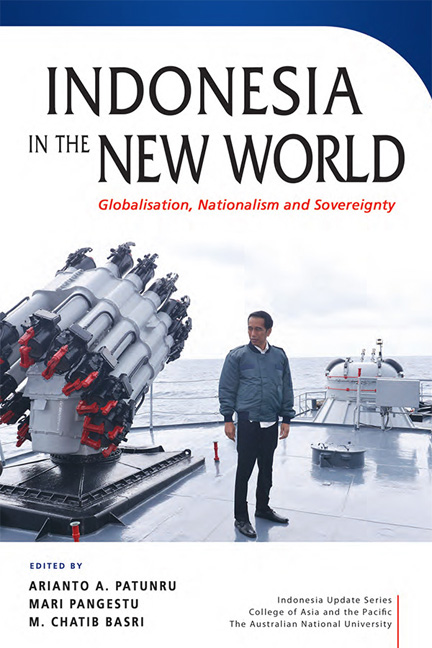
Globalisation is more complex than ever. The effects of the global financial crisis and increased inequality have spurred anti-globalisation sentiment in many countries and encouraged the adoption of populist and inward-looking policies. This has led to some surprising results: Duterte, Brexit and Trump, to name a few. In Indonesia, the disappointment with globalisation has led to rising protectionism, a rejection of foreign interference in the name of nationalism, and economic policies dominated by calls for self-sufficiency. Meanwhile, human trafficking and the abuse of migrant workers show the dark side of globalisation. In this volume, leading experts explore key issues around globalisation, nationalism and sovereignty in Indonesia. Topics include the history of Indonesia's engagement with the world, Indonesia's stance on the South China Sea and the re-emergence of nationalism. The book also examines the impact of globalisation on poverty and inequality, labour markets and people, especially women.
Contents
Contents
Metrics
Altmetric attention score
Full text views
Full text views helpTotal number of HTML views: 0
Total number of PDF views: 0 *
 Loading metrics...
* Views captured on Cambridge Core between #date#. This data will be updated every 24 hours.
Usage data cannot currently be displayed.
Accessibility standard: Unknown
Why this information is here
This section outlines the accessibility features of this content - including support for screen readers, full keyboard navigation and high-contrast display options. This may not be relevant for you.
Accessibility Information
Accessibility compliance for the PDF of this book is currently unknown and may be updated in the future.