
Skip to main content Accessibility help
×
  • Cited by 3
    • Show more authors
    • You may already have access via personal or institutional login
    • Select format
    • Publisher:
      Cambridge University Press
      Publication date:
      21 July 2022
      04 August 2022
      ISBN:
      9781108551878
      9781108427715
      9781108448024
      Dimensions:
      (229 x 152 mm)
      Weight & Pages:
      0.8kg, 448 Pages
      Dimensions:
      (229 x 152 mm)
      Weight & Pages:
      0.7kg, 448 Pages
    You may already have access via personal or institutional login
  • Selected: Digital
    Add to cart View cart Buy from Cambridge.org

    Book description

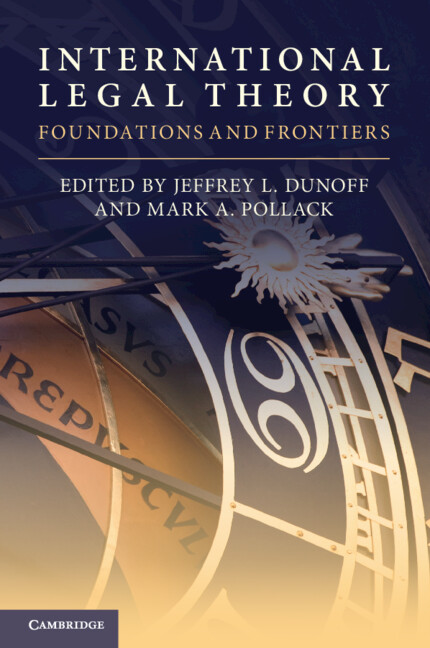
    Over the past decades international affairs have been increasingly legalized. International law has dramatically expanded into new fields and taken on new challenges. Despite this development, there has been little in-depth scholarship on what impact these changes have had on the field of international legal theory, how it is taught, and where it is going. This volume investigates the major developments in the field and explores the core assumptions and concepts, analytical tools, and key challenges associated with different approaches. An outstanding team of legal academics provides an accessible overview of competing theoretical movements, and a more in-depth understanding of the strengths, preoccupations, insights, and limits of those schools of thought. The contributions provide an authoritative account of current thinking about the theoretical foundations of contemporary international law and will serve as an indispensable resource for students, scholars, and practitioners.

    Reviews

    ‘Long ago, those of us teaching international legal theory looking for a single teaching text had to cobble together (and severely edit) a mountain of sometimes indigestible texts, perhaps supplemented by AJIL's 1999 symposium on ‘method.' Dunoff and Pollack have now gifted us with a cornucopia of riches. This is a highly readable collection of ‘traditional,' ‘critical,' ‘post-cold war,' and ‘interdisciplinary' frameworks for making sense of the field, capped by three ‘dialectic' perspectives by luminaries (Abi-Saab, de Chazournes, and Weiler). The sterling collection of well-crafted essays are written either by those who originated the theoretical approach (e.g., Koh on transnational legal process) or by contemporary adherents most associated with them (e.g., Gathii on TWAIL or the formidable trio of Engle, Nesiah, and Otto on feminist approaches). This is destined to be an indispensable text for those of us who think theory matters. And it may even convince those who think it doesn't. International law geeks (and their students) should give thanks for this most welcome contribution.'

    J. E. Alvarez - Herbert and Rose Rubin Professor of International Law, NYU School of Law

    ‘This is an inspired collection, both in terms of the scholars and the subjects that it brings together. It will be a gift to undergraduate and advanced students in international law, enabling them to go beyond the doctrinal to explore diverse approaches including critical and inter-disciplinary perspectives. The volume is destined to become a classic in its field.'

    Joanne Scott - Professor of Law and Head of Department, European University Institute

    ‘Once again, the scientific partnership of Jeff Dunoff and Mark Pollack works wonders. The charm of the book is that it shows how the representative collection of theories it proposes complement each other as much as they contradict each other. Their contradictions make sense of their plurality, but their complementarity makes sense of international law. The introduction and the (dialogical) conclusion, which show this so well, are real gems.'

    Hélène Ruiz Fabri - Director, Max Planck Institute Luxembourg for International, European and Regulatory Procedural Law

    ‘Nothing is more practical than a good theory! A wonderful choice of important approaches to international law, written by eminent scholars of our time. The chapters, each authoritative on its own account, are embedded in a highly informed and informing introduction by the editors and a dialogical epilogue by the authors with Joseph Weiler. The reflections on theory, method, and the ‘big picture' of international law are highly welcome in the current period of challenge and change.'

    Anne Peters - Director, Max Planck Institute for Comparative Public Law and International Law

    ‘International Legal Theory has much to offer practitioners and academics alike. … it succeeds admirably in giving readers a sense of the richness and diversity of contemporary international legal theory.’

    Daniel Bodansky Source: American Journal of International Law

    Refine List

    Actions for selected content:

    Select all | Deselect all
    • View selected items
    • Export citations
    • Download PDF (zip)
    • Save to Kindle
    • Save to Dropbox
    • Save to Google Drive

    Save Search

    You can save your searches here and later view and run them again in "My saved searches".

    Please provide a title, maximum of 40 characters.
    ×

    Contents


    Page 1 of 2


    Page 1 of 2


    Metrics

    Altmetric attention score

    Full text views

    Total number of HTML views: 0
    Total number of PDF views: 0 *
    Loading metrics...

    Book summary page views

    Total views: 0 *
    Loading metrics...

    * Views captured on Cambridge Core between #date#. This data will be updated every 24 hours.

    Usage data cannot currently be displayed.

    Accessibility standard: Unknown

    Why this information is here

    This section outlines the accessibility features of this content - including support for screen readers, full keyboard navigation and high-contrast display options. This may not be relevant for you.

    Accessibility Information

    Accessibility compliance for the HTML of this book is currently unknown and may be updated in the future.
