Skip to main content Accessibility help
×
    Show more authors
  • You may already have access via personal or institutional login
  • Select format
  • Publisher:
    Cambridge University Press
    Publication date:
    05 December 2011
    15 December 2011
    ISBN:
    9781139018753
    9780521509657
    9781107651753
    Dimensions:
    (228 x 152 mm)
    Weight & Pages:
    0.5kg, 228 Pages
    Dimensions:
    (229 x 152 mm)
    Weight & Pages:
    0.31kg, 230 Pages
You may already have access via personal or institutional login
  • Selected: Digital
    Add to cart View cart Buy from Cambridge.org

    Book description

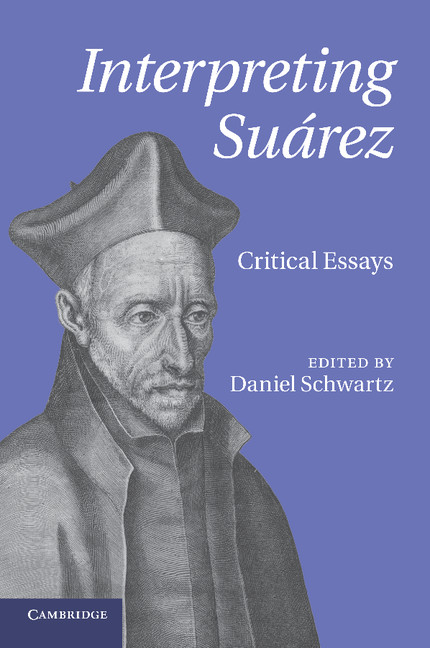
    Francisco Suárez is arguably the most important Neo-Scholastic philosopher and a vital link in the chain leading from medieval philosophy to that of the Renaissance and the Enlightenment. Long neglected by the Anglo-Saxon philosophical community, this sixteenth-century Jesuit theologian is now an object of intense scholarly attention. In this volume, Daniel Schwartz brings together essays by leading specialists which provide detailed treatment of some key themes of Francisco Suárez's philosophical work: God, metaphysics, meta-ethics, the human soul, action, ethics and law, justice and war. The authors assess the force of Suárez's arguments, set them within their wider argumentative context and single out influences and appraise competing interpretations. The book is a useful resource for scholars and students of philosophy, theology, philosophy of religion and history of political thought and provides a rich bibliography of secondary literature.

    Refine List

    Actions for selected content:

    Select all | Deselect all
    • View selected items
    • Export citations
    • Download PDF (zip)
    • Save to Kindle
    • Save to Dropbox
    • Save to Google Drive

    Save Search

    You can save your searches here and later view and run them again in "My saved searches".

    Please provide a title, maximum of 40 characters.
    ×

    Contents

    • Chapter 1 - Introduction
      pp 1-18
    • View abstract

      Summary

      Francisco Suárez covered a considerable number of canonical philosophical problems. His exposition is always thoughtful and compendious. Without claiming to be exhaustive, the author simply selects a number of central themes such as metaphysics, God, mind, ethics, law, political power and war, within Suárez's work, and relates them to the chapters that compose this book. Suárez's most notorious metaphysical innovations comprise the definition of the subject matter of metaphysics, as 'being insofar as it is real being', his revision of Thomas Aquinas's position on the difference between essence and existence, and his rejection of Aquinas's account of individuation. In the Disputationes Metaphysicae Suárez also discussed, in typically thorough manner, transcendentals, causation, finite and infinite being, substance and accident, categories, God's existence and his nature, modality, quantity, relations and beings of reason.
    • Chapter 2 - Fundamentals in Suárez's metaphysics: transcendentals and categories
      pp 19-38
    • View abstract

      Summary

      This chapter examines Francisco Suárez's view of transcendentals and categories as explored in his most significant work, Metaphysical Disputations. Even a glance into the contents of this work reveals that both transcendentals and categories lie at the center of Suárez's metaphysics. The chapter considers transcendentals, asking what they are and about their identity, number, and order. It then takes up categories, what they are and their identity, number, and relations. Like his scholastic predecessors, Suárez holds that categories are primarily diverse, which means that they share no property or genus. The aim of science from an Aristotelian-scholastic perspective is the possession of certain knowledge of truth, acquired by demonstration. For Suárez, metaphysics is the science of the transcendentals, which was a view first proposed by Scotus. In this Suárez's metaphysics manifests a fundamentally Scotistic character in spite of many real and apparent disagreements with Scotus on particular issues.
    • Chapter 3 - The reality of substantial form: Suárez, Metaphysical Disputations xv
      pp 39-61
    • View abstract

      Summary

      This chapter traces two sets of arguments given by Suárez in Metaphysical Disputations xv. In the first set he confronts arguments intended to show that substantial forms do not, or indeed cannot, exist. Several of these arguments foreshadow in fairly obvious ways the arguments later deployed by Boyle, Locke, and others writing under their influence. Suárez has a clear if somewhat idiosyncratic conception of substantial form, one articulated, understandably enough, within the framework of his general Aristotelian hylomorphism. Suárez begins his consideration of the anti-substantial form position directly, even rather bluntly. It is important to bear in mind that Suárez's arguments on behalf of substantial form may be judged from two radically different vantage points. There are those who simply deny the phenomena, who think, for example, that there simply are no data of co-incidence, property subordination, or systemic equilibrium to be explained.
    • Chapter 4 - Suárez on the ontology of relations
      pp 62-88
    • View abstract

      Summary

      Relations are a major topic in early modern philosophy, and not only on account of Leibniz. Following Aristotle, Suárez took some relations to be accidents constituting a category of their own. Like most scholastic philosophers and theologians, he considered such categorical relations to be ineliminable and real properties in their subjects, distinct from any other non-relational accidents. The term of a real categorical relation must be an actually existing entity, according to Suárez, and it must be really distinct from the foundation and the subject. Suárez argues against the view that there is a real distinction between foundation and relation on the grounds that it leads to unnecessary ontological profligacy. It could be argued further that if Suárez succeeds in avoiding the danger of undermining the reality of the relation, it is only at the cost of building an incoherent ineliminably relational reference to its term into the absolute foundation.
    • Chapter 5 - Suárez's cosmological argument for the existence of God
      pp 89-114
    • View abstract

      Summary

      This chapter examines Francisco Suárez's cosmological argument for the existence of God, and offers a critical evaluation of the argument. It examines in detail Suárez's argument and its logical structure, as well as proposed objections and rebuttals to the objections. Traditional arguments for the existence of God can be divided into three categories: (1) ontological arguments, (2) teleological arguments, and (3) cosmological arguments. These categories are based on the kind of evidence an argument uses as premises in support of its conclusion. Suárez's argument for the existence of God begins with a metaphysical cosmological argument for the existence of an uncreated being. He then defines God as an uncreated being and the creator of all things. He deliberately avoids the version of the cosmological argument based on physical principles taken from natural philosophy.
    • Chapter 6 - Action and freedom in Suárez's ethics
      pp 115-141
    • View abstract

      Summary

      Intentional action for Suárez occurs as the voluntarium, which consists in the occurrence of actions either of the will itself or of other capacities or faculties motivated by the will. Now Suárez's general conception of action is one he fully shares with such influential scholastic predecessors as Scotus and Aquinas. It is natural for many people nowadays to view freedom and law simply as phenomena that are opposed or that are at least in profound tension with each other. On this view, the function of law is to impose necessary constraints on freedom; and human freedom in turn imposes limits on the constraints that law can justifiably impose. For Suárez, the basic or foundational kind of freedom is freedom as a two-way metaphysical power. The distinctiveness of Suárez's view of freedom and the place he gives it in his moral theory can be appreciated by contrasting him with Hobbes.
    • Chapter 7 - Obligation, rightness, and natural law: Suárez and some critics
      pp 142-162
    • View abstract

      Summary

      Suárez holds a voluntarist conception of obligation, in so far as he takes obligation to depend essentially on the will of a superior, and, in the case of the natural law, on the will of God. Suárez accepts a voluntarist thesis about law. In his view, the character of a law consists partly in a command, and the natural law is a genuine law, measured by this criterion. According to Finnis, Suárez's voluntarist conception of obligation does not fit everything that Suárez wants to say about obligation. Suárez recognizes duties without obligations, because he sees that the expression of will introduces a distinct type of moral relation that is not reducible to a simple duty. He marks this distinct type of moral relation by speaking of 'obligation'. Finnis draws his evidence for Suárez's view of obligation from the treatment of obligation.
    • Chapter 8 - Suárez on distributive justice
      pp 163-184
    • View abstract

      Summary

      This chapter offers an exposition of Suárez's theory of distributive justice, which, until very recently, has not been the subject of scholarly attention. Suárez's immediate preoccupations were theological, there is a clear political dimension to his treatment. For Suárez politics provides the perfect platform for testing our intuitions about distributive justice. Suárez's discussion illuminates aspects of distributive justice too often overlooked by contemporary theorists. Suárez maintains that distributive justice is the sovereign's virtue, consisting in meeting and protecting the subjects' rights to acquire and remain in possession of portions of the common stock. These rights are created by a pact or conditional promise that specifies the personal qualities that ground the subject's rights to shares of the common stock. Distributive justice governs not only the fresh allocation of shares of the common stock, but also the conditions under which subjects can continue to own them.
    • Chapter 9 - Suárez on just war
      pp 185-204
    • View abstract

      Summary

      In the pantheon of scholastic just war theorists, a trio stands out: Aquinas, Vitoria, and Francisco Suárez. Of the three, Suárez was by far the most systematic in his treatment of issues relating to war. Suárez approached the question of legitimate authority in terms that had been broadly defined by Aquinas. Suárez did recognize one notable exception to his general rejection of what today is termed 'holy war'. This was a case in which people, subject to a non-Christian prince, wished to accept Christianity against his will. He promoted a moderate Christian exceptionalism on matters relating to just war. An overview of Suárez's teaching on bellum iustum has sought to clarify how he approached the core issue of just cause, and by extension legitimate authority, in relation to the positions staked out by his predecessors, most especially Aquinas, Cajetan, and Vitoria.

    Metrics

    Altmetric attention score

    Full text views

    Total number of HTML views: 0
    Total number of PDF views: 0 *

    Loading metrics...

    Book summary page views

    Total views: 0 *
    Loading metrics...

    * Views captured on Cambridge Core between #date#. This data will be updated every 24 hours.

    Usage data cannot currently be displayed.

    Accessibility standard: Unknown

    Why this information is here

    This section outlines the accessibility features of this content - including support for screen readers, full keyboard navigation and high-contrast display options. This may not be relevant for you.

    Accessibility Information

    Accessibility compliance for the PDF of this book is currently unknown and may be updated in the future.