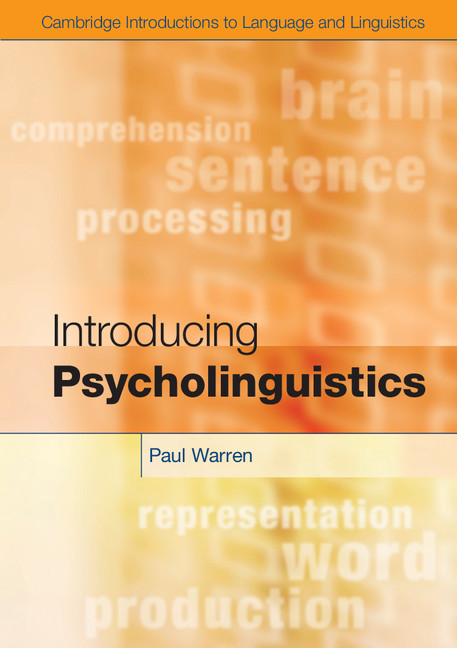
Introducing Psycholinguistics

-
Select format
-
- Publisher:
- Cambridge University Press
- Publication date:
- 05 November 2012
- 11 October 2012
- ISBN:
- 9780511978531
- 9780521113632
- 9780521130561
- Dimensions:
- (247 x 174 mm)
- Weight & Pages:
- 0.72kg, 286 Pages
- Dimensions:
- (247 x 174 mm)
- Weight & Pages:
- 0.55kg, 284 Pages
You may already have access via personal or institutional login
Show more authors 
You may already have access via personal or institutional login
Book description
How humans produce and understand language is clearly introduced in this textbook for students with only a basic knowledge of linguistics. With a logical, flexible structure Introducing Psycholinguistics steps through the central topics of production and comprehension of language and the interaction between them. Students will gain an understanding of the processes and representations involved in language use, aided by a comprehensive glossary, concepts defined in the margins and online flashcards that allow students to check their understanding of all the key terms and concepts of the subject. Examples and exercises throughout each topic reinforce understanding and encourage students to consider what language users might carry around in their heads as part of their linguistic knowledge, and how this stored knowledge relates to the structures and rules proposed by theoretical linguistics. Students will gain hands-on experience of experimental methods, with online demonstrations of techniques. This supports the theory within the book, reinforces a student's grasp of the concepts and allows the student to apply their understanding to the analysis of data.
Reviews
‘An engaging and impressively comprehensive view of psycholinguistics that will provide an excellent introduction for the novice reader, and inform the advanced reader as well. Lucid, balanced and thorough.’
Shari R. Speer - Ohio State University
‘A clear and digestible introduction to the field of psycholinguistics which illustrates the major research findings and carefully explains their relevance for theories of language processing. Starting from scratch, the book guides us through the psychology of language with engaging experimental demonstrations, web resources, and practical exercises.’
Nick Ellis - University of Michigan
‘An invaluable text for any student of psycholinguistics. Students will appreciate the concise chapter introductions and summaries, lists of key terms and online materials. Best of all, Introducing Psycholinguistics takes an interdisciplinary approach, drawing on evidence from classic and recent studies and placing it within current linguistic theory.’
Diane Nelson - University of Leeds
'I really enjoyed reading the book and I will definitely use it the next time I teach an introductory course in psycholinguistics.'
Åsa Abelin Source: Moderna språk
Contents
Contents
Metrics
Full text views
Full text views helpTotal number of HTML views: 0
Total number of PDF views: 0 *
 Loading metrics...
* Views captured on Cambridge Core between #date#. This data will be updated every 24 hours.
Usage data cannot currently be displayed.
Accessibility standard: Unknown
Why this information is here
This section outlines the accessibility features of this content - including support for screen readers, full keyboard navigation and high-contrast display options. This may not be relevant for you.
Accessibility Information
Accessibility compliance for the PDF of this book is currently unknown and may be updated in the future.