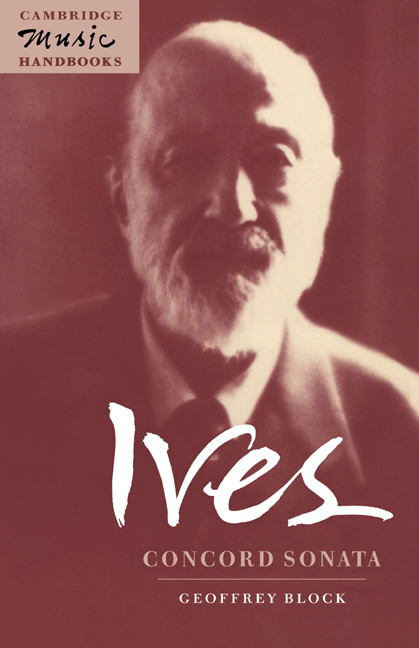

Charles Ives's massive Concord Sonata, his second sonata for piano, named after the town of Concord in Massachusetts, is central to his output and clearly reflects his aesthetic perspective. Geoffrey Block's wide-ranging 1996 account of the work thus provides an ideal introduction to this fascinating composer. As well as a discussion of the Sonata's reception history from 1920 to the time of publication, and a chapter on its compositional genesis, this handbook includes a detailed narrative of the motivic content as well as a historical and analytical survey of the work's borrowings, both certifiable and newly proposed. The programmatic element of the Sonata is explored in the context of Ives's personal vision of four literary subjects associated with the town of Concord between 1840 and 1860: Emerson, Thoreau, Hawthorne, and the Alcotts.
Loading metrics...
* Views captured on Cambridge Core between #date#. This data will be updated every 24 hours.
Usage data cannot currently be displayed.
This section outlines the accessibility features of this content - including support for screen readers, full keyboard navigation and high-contrast display options. This may not be relevant for you.
Accessibility compliance for the PDF of this book is currently unknown and may be updated in the future.
