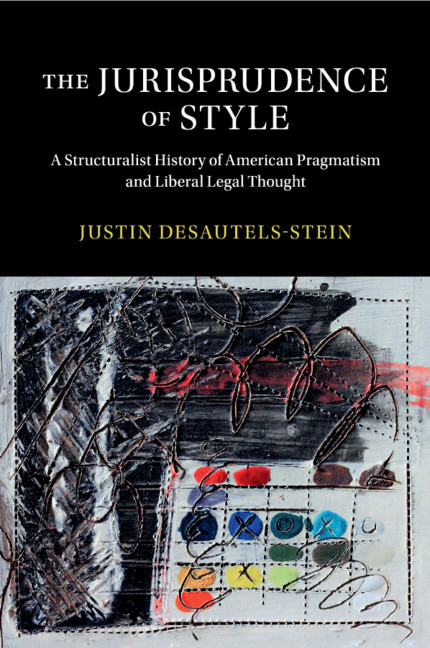

In the contemporary domain of American legal thought there is a dominant way in which lawyers and judges craft their argumentative practice. More colloquially, this is a dominant conception of what it means to 'think like a lawyer'. Despite the widespread popularity of this conception, it is rarely described in detail or given a name. Justin Desautels-Stein tells the story of how and why this happened, and why it matters. Drawing upon and updating the work of Harvard Law School's first generation of critical legal studies, Desautels-Stein develops what he calls a jurisprudence of style. In doing so, he uncovers the intellectual alliance, first emerging at the end of the nineteenth century and maturing in the last third of the twentieth century, between American pragmatism and liberal legal thought. Applying the tools of legal structuralism and phenomenology to real-world cases in areas of contemporary legal debate, this book develops a practice-oriented understanding of legal thought.
'In this wide-ranging and masterful work, Justin Desautels-Stein explores, dissects, and critiques what it means to think like a lawyer in today’s hegemonic context of liberal legal thought. Drawing on art history and musicology, ranging from the anthropologist Philippe Descola to the philosopher Hubert Dreyfus, from Roland Barthes to Michel Foucault, Desautels-Stein creatively reinvigorates the Harvard School of legal structuralism to expose the deep historical, structural, and conceptual illusions of contemporary pragmatic legal liberal thought.'
Bernard E. Harcourt - author of The Illusion of Free Markets: Punishment and the Myth of Natural Order
'An engrossing, at times deeply moving effort to recover the unity and purpose of critical legal studies.'
Charles Sabel - Columbia Law School, New York
'A fascinating contribution to critical legal thought in the United States. Desautels-Stein revisits and reinterprets American legal pragmatism alongside late twentieth century efforts to assess and critique its practice. His direct informal style brings complex theoretical debates to life.'
David Kennedy - Harvard Law School, Massachusetts
Loading metrics...
* Views captured on Cambridge Core between #date#. This data will be updated every 24 hours.
Usage data cannot currently be displayed.
This section outlines the accessibility features of this content - including support for screen readers, full keyboard navigation and high-contrast display options. This may not be relevant for you.
Accessibility compliance for the HTML of this book is currently unknown and may be updated in the future.
