Skip to main content Accessibility help
×
    • Edited by Lara Denis, Agnes Scott College, Decatur
    Show more authors
  • You may already have access via personal or institutional login
  • Select format
  • Publisher:
    Cambridge University Press
    Publication date:
    10 January 2011
    28 October 2010
    ISBN:
    9780511763250
    9780521513937
    9781107406995
    Dimensions:
    (228 x 152 mm)
    Weight & Pages:
    0.59kg, 284 Pages
    Dimensions:
    (229 x 152 mm)
    Weight & Pages:
    0.38kg, 286 Pages
You may already have access via personal or institutional login
  • Selected: Digital
    Add to cart View cart Buy from Cambridge.org

    Book description

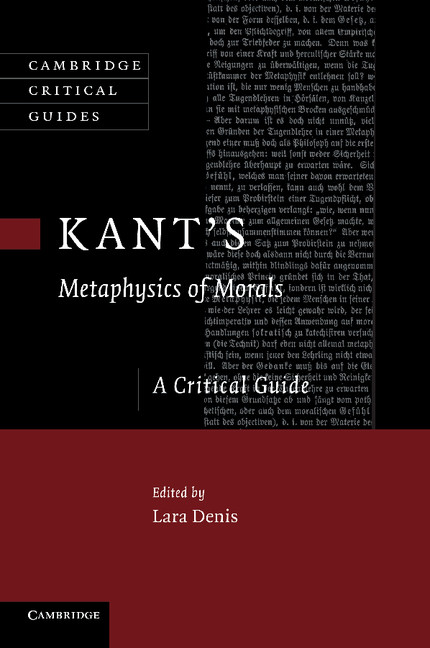
    Immanuel Kant's Metaphysics of Morals (1797), containing the Doctrine of Right and Doctrine of Virtue, is his final major work of practical philosophy. Its focus is not rational beings in general but human beings in particular, and it presupposes and deepens Kant's earlier accounts of morality, freedom and moral psychology. In this volume of newly-commissioned essays, a distinguished team of contributors explores the Metaphysics of Morals in relation to Kant's earlier works, as well as examining themes which emerge from the text itself. Topics include the relation between right and virtue, property, punishment, and moral feeling. Their diversity of questions, perspectives and approaches will provide new insights into the work for scholars in Kant's moral and political theory.
    Reviews

    'Denis has assembled an outstanding collection of essays that are dedicated to critically exploring Kant’s Metaphysics of Morals. This is an invaluable guide for reading a crucial text within the Kantian corpus.'

    Chris McTavish Source: Philosophy in Review

    'The book attempts to bridge the gap between German and English-language scholarship. Flikschuh, Wood, and Byrd in particular incorporate German secondary literature.'

    Georg Cavallar Source: The European Legacy

    Refine List

    Actions for selected content:

    Select all | Deselect all
    • View selected items
    • Export citations
    • Download PDF (zip)
    • Save to Kindle
    • Save to Dropbox
    • Save to Google Drive

    Save Search

    You can save your searches here and later view and run them again in "My saved searches".

    Please provide a title, maximum of 40 characters.
    ×

    Contents

    • 1 - Kant's Metaphysics of Morals: the history and significance of its deferral
      pp 9-27
    • View abstract

      Summary

      Immanuel Kant's Metaphysics of Morals appeared in 1797. The metaphysics of morals contains all the principles that "determine action and omission a priori and make them necessary". It will be "pure morality, which is not grounded on any anthropology. Kant's Groundwork clearly meant for an antecedent of the Metaphysics of Morals. Kant had to promise that he would not publish on religious topics, but any Metaphysics of Morals had to include a discussion of the relations between morality and religion. This chapter divides Kant's deferment of the proposed Metaphysics of Morals into three periods, with the first one dating from 1762 to about 1770, the second one from 1770 to 1785, and the third period from 1785 to 1797. The lectures that were most relevant for Metaphysics of Morals were those on natural law, on ethics, and on anthropology.
    • 2 - Reason, desire, and the will
      pp 28-50
    • View abstract

      Summary

      This chapter examines Kant's mature conception of the will, as presented in the Introduction to the Metaphysics of Morals. It also examines Kant's account of the faculty of desire, and then considers how the will is constituted through the relation reason bears to this faculty. Kant defines the faculty of desire, or the capacity to desire, as it might also be called as "the capacity to be, through one's representations, the cause of the objects of those representations". Having outlined separately Kant's conceptions of reason and desire as powers of cognition and causality, the chapter considers them together, in the idea of the will. It is noteworthy that the will is represented as having certain precedence over the power of choice, even in the latter's inner employment. Will and power of choice are distinguished through the difference between cognitive and causal self-consciousness.
    • 3 - Justice without virtue
      pp 51-70
    • View abstract

      Summary

      This chapter suggests two sorts of objections that mere outward conformity of a person's action with general principles of justice is all that can be required by justice even if not by ethics. It engages with both these objections, though pays more attention to the first and flags the second objection. The chapter sets out the systematic objection to the possible inclusion of Kant's philosophy of Right in his moral philosophy. It also argues that if one starts from central concerns of the Doctrine of Right, the text's distinctly public morality comes into focus. This chapter draws on Kant's late Wille/Willkr distinction in order to tease out the distinctive nature of public juridical willing: surprisingly, in the political context, autonomy as self-legislation is simply irrelevant. It explores how individual political judgment relates to public willing; and discovers crucial differences between Kant's political morality and Kant-inspired current liberalism.
    • 4 - Kant's innate right as a rational criterion for human rights
      pp 71-92
    • View abstract

      Summary

      The idea of a single innate right rests, as does the entire first part of the Metaphysics of Morals, upon a double distinction. Kant differentiates between two fundamentally distinct basic questions - what is "laid down as right" and "what is right" - and two fundamentally distinct doctrines of right, an empirical and a natural one. Thereupon follows reflections concerning the moral concept of right and the moral law of right, the authorization to employ force, and the turn of phrase "by virtue of his humanity". The chapter analyzes how Kant clarifies his thesis of an innate right in four statements, which only appear to refute his singular use of "human right". The conclusion further sharpens the focus already brought to Kant's thesis by mentioning two quasi-human rights. Even though Kant considers there to be only one innate human right, two further pronouncements are relevant to human rights.
    • 5 - Intelligible possession of objects of choice
      pp 93-110
    • View abstract

      Summary

      This chapter maps out Kant's arguments on how to have something as one's own. Kant has three concepts of possession: empirical physical possession, possession as a pure concept of the understanding, and intelligible possession. Notable about Kant's discourses on the permissive law in "Toward Perpetual Peace" is that they provide what might be called a justification for a temporary period of time to right a wrongful situation. Interpreting the permissive law as a power-conferring norm has the benefit of making the Kant text comprehensible. Kant's sole prerequisite for being permitted to take an external object into one's possession is that no one else's freedom of choice is violated through the taking. Kant's entire line of argumentation on original acquisition of external things can be applied by analogy to derived acquisition under contract or by virtue of a family relationship.
    • 6 - Punishment, retribution, and the coercive enforcement of right
      pp 111-129
    • View abstract

      Summary

      Most philosophers who have considered legal punishment suppose that penal institutions, either as they exist or at least as they would exist if they lived up to some normative concept of them, can be morally justified. Kant is best known as a subscriber to the first of the justifications of punishment. Kant's insistence on retributivism, that it is a fundamental moral principle or categorical imperative that moral evil deserves punishment is clear enough. Punishment is justified as a form of coercion used to protect right. Kant occasionally tries to present God's providential apportionment of happiness in accordance with worthiness as a case of doing retributive justice. Whatever opinions Kant himself may have held or expressed in favor of retributivism, Kantian ethics is seriously lacking as long as it cannot justify them or even consistently include them.
    • 7 - Moral feelings in the Metaphysics of Morals
      pp 130-151
    • View abstract

      Summary

      In his lectures on ethics prior to the Groundwork, Kant insisted upon an indispensable causal role for feeling in the production of moral action. Kant's discussion of the "Aesthetic Preconditions of the Mind's Receptivity to Concepts of Duty in General" in Section XII of the Introduction to the Doctrine of Virtue is brief but raises many questions. The chapter explores what causal roles do these distinct "aesthetic preconditions" play and how do they relate to the causal role or roles of the single feeling of respect Kant previously recognized. It discusses Kant's exposition and then Kant's four aesthetic preconditions. The empirical consciousness of the moral law produces a general feeling of respect that causes or at least strengthens our commitment to acting in accordance with it and that needs to be and can be cultivated.
    • 8 - What is the enemy of virtue?
      pp 152-169
    • View abstract

      Summary

      In the Doctrine of Virtue, the apparently unambiguous enemy of virtue is the inclinations, understood as a natural force. This chapter compares the two scenarios: inclinations, then a particular state of a free, rational being, as the enemy of virtue. It distinguishes Kantian and Aristotelian virtue more clearly. Inclinations are "impulses of nature", operating according to the laws of the natural world. The relationship of virtue to freedom can be best understood by exploring Kant's idea of "inner freedom". Kant suggests that vicious acts occur when the strength of one's natural inclinations overwhelms the strength of one's inner freedom. In the Groundwork, Kant describes a person tempted, through a process of rationalization, perversion, or corruption, to avert his eyes from the categorical demands of morality. Vicious acts are perverse realizations of freedom, a turning of the strength of freedom on its head as weakness.
    • 9 - Freedom, primacy, and perfect duties to oneself
      pp 170-191
    • View abstract

      Summary

      Kant attributes primacy to duties to oneself in general and perfect duties to oneself (PDS) in particular. Kant describes morality as "based on the conception of the human being as one who is free but who also, just because of that, binds himself through reason to unconditional laws". For the relationship between freedom and perfect duties to oneself to explain the primacy of PDS, especially tight, deep, or otherwise significant relations must hold between them. This chapter explicates three accounts of perfect duties to oneself. Within all three, Kant equates violating PDS with degrading oneself, subordinating one's rational freedom to other objects, impairing one's agency, and treating oneself as a thing or mere means. Kant's lectures on ethics and the Doctrine of Virtue provide distinct accounts of perfect duties to oneself.
    • 10 - Duties to and regarding others
      pp 192-209
    • View abstract

      Summary

      This chapter discusses Kant's views on the nature of the beings to whom we can owe duties. It also discusses views held by Andrews Reath and Allen Wood about what it means to have a duty to a person. The chapter discusses the relationship between duties to a person and the claims she may have on us as a result of such duties. In the Doctrine of Virtue, Kant offers a principle that he regards as the foundation of the division between obligations toward oneself and obligations toward others. Kant evidently thought that the necessity of willing our happiness together with our individual inability to achieve it implied the proposition that we cannot rationally will that everyone refuse to adopt anyone else's happiness as his end. The latter is the proposition he would need in order to gain the conclusion that the happiness of others is an obligatory end.
    • 11 - Duties regarding animals
      pp 210-233
    • View abstract

      Summary

      A better appreciation of Kant's commitments in a variety of disciplines reveals that Kant had a deeper understanding of human and non-human animals than is generally recognized and will help address, at least from Kant's perspective, many of the familiar objections to his account of our "duties regarding animals". It reviews some of Kant's core principles about the nature of moral obligation, which structure his thoughts about the moral status of human beings and non-human animals. Then, it considers Kant's account of the nature of and distinction between humans and non-human animals. With this account in hand, the chapter turns to Kant's case for claiming that we have duties to every human being and significant duties regarding non-human animals that are grounded in their nature. Finally, in "Two Kantian alternatives", this chapter considers Kant's account in relation to some recently proposed Kantian alternatives.
    • 12 - Kant's Tugendlehre as normative ethics
      pp 234-255
    • View abstract

      Summary

      In The Metaphysics of Morals, especially the Tugendlehre or Doctrine of Virtue, Kant clarifies, develops, and extends ideas that he presented in the Groundwork for the Metaphysics of Morals and the Critique of Practical Reason. This chapter reviews some features of normative ethics that distinguish Tugendlehre from science, metaphysics, metaethics, and theories of law. It discusses the role of the basic moral principles in Kant's theory and how they relate to more specific principles. The chapter considers Kant's idea of duties to oneself and their relevance to certain contemporary discussions. Then, it discusses second-order duties to oneself that anticipate our liability to errors in moral judgment, ulterior motives, and weakness of will. Finally, the chapter notes some ways in which the Tugendlehre is incomplete. It is incomplete partly because Kant's aim was only to present the first principles of "the doctrine of virtue".

    Metrics

    Full text views

    Total number of HTML views: 0
    Total number of PDF views: 0 *

    Loading metrics...

    Book summary page views

    Total views: 0 *
    Loading metrics...

    * Views captured on Cambridge Core between #date#. This data will be updated every 24 hours.

    Usage data cannot currently be displayed.

    Accessibility standard: Unknown

    Why this information is here

    This section outlines the accessibility features of this content - including support for screen readers, full keyboard navigation and high-contrast display options. This may not be relevant for you.

    Accessibility Information

    Accessibility compliance for the PDF of this book is currently unknown and may be updated in the future.