Skip to main content Accessibility help
×
    Show more authors
  • You may already have access via personal or institutional login
  • Select format
  • Publisher:
    Cambridge University Press
    Publication date:
    04 August 2010
    29 July 2010
    ISBN:
    9780511782008
    9780521897983
    9781107411401
    Dimensions:
    (228 x 152 mm)
    Weight & Pages:
    0.56kg, 272 Pages
    Dimensions:
    (229 x 152 mm)
    Weight & Pages:
    0.37kg, 274 Pages
You may already have access via personal or institutional login
  • Selected: Digital
    Add to cart View cart Buy from Cambridge.org

    Book description

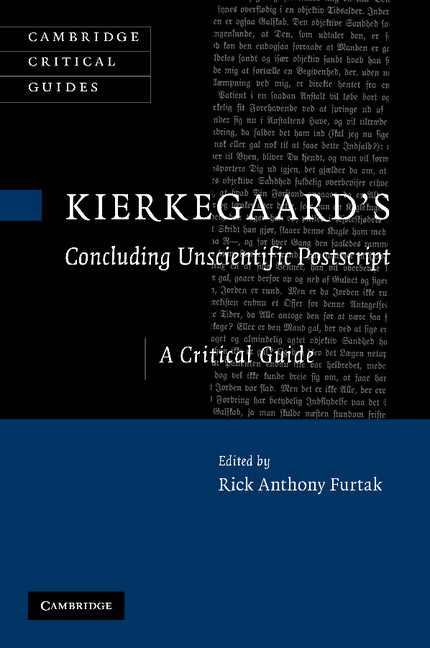
    Søren Kierkegaard's Concluding Unscientific Postscript has provoked a lively variety of divergent interpretations for a century and a half. It has been both celebrated and condemned as the chief inspiration for twentieth-century existential thought, as a subversive parody of philosophical argument, as a critique of mass society, as a forerunner of phenomenology and of postmodern relativism, and as an appeal for a renewal of religious commitment. These 2010 essays written by international Kierkegaard scholars offer a plurality of critical approaches to this fundamental text of existential philosophy. They cover hotly debated topics such as the tension between the Socratic-philosophical and the Christian-religious; the identity and personality of Kierkegaard's pseudonym 'Johannes Climacus'; his conceptions of paradoxical faith and of passionate understanding; his relation to his contemporaries and to some of his more distant predecessors; and, last but not least, his pertinence to our present-day concerns.

    Reviews

    'One of the most noteworthy features of Kierkegaard’s 'Concluding Unscientific Postscript': A Critical Guide is that it lives up to its subtitle. This collection truly is a guide to the work as a whole … [It] contains significant steps forward in our understanding of this complex text, the difficulty of which continues to reward the sharpest critical study.'

    Jeffrey Hanson - Australian Catholic University

    Refine List

    Actions for selected content:

    Select all | Deselect all
    • View selected items
    • Export citations
    • Download PDF (zip)
    • Save to Kindle
    • Save to Dropbox
    • Save to Google Drive

    Save Search

    You can save your searches here and later view and run them again in "My saved searches".

    Please provide a title, maximum of 40 characters.
    ×

    Contents

    • 1 - The “Socratic secret”: the postscript to the Philosophical Crumbs
      pp 6-24
    • View abstract

      Summary

      This chapter suggests that the book, Concluding Unscientific Postscript, contains both a quasi-sequel to Philosophical Crumbs and a postscript to Crumbs that provided a new and crucial supplement to Crumbs. Although some aspects of Crumbs become more finely grained in the part of the Postscript that is a "sequel", the point of the "postscript" part of the Postscript was to provide something new. The chapter also suggests that whereas in Crumbs Socratic subjectivity was presented as an alternative to the non-Socratic (Christian) position, the Concluding Unscientific Postscript reveals them in a positive relation. The "postscript" raises the question of how to think of a "deepening" of human subjectivity that is not an "evolution". The difficulty is to think such a sharpening (intensification, deepening) of pathos, one in which pathos is preserved and transfigured, without eliminating the qualitativeness of the transition.
    • 2 - Kierkegaard's Socratic pseudonym: A profile of Johannes Climacus
      pp 25-44
    • View abstract

      Summary

      This chapter presents an overview of Johannes Climacus' two works and the two therapeutic, experimental stances he adopts in relation to his readers. Climacus' first book, Philosophical Crumbs, is a rather slender volume that hypothetically investigates the difference between a Socratic conception of the individual's relation to the truth and a Christian conception. His second book, Concluding Unscientific Postscript, is a kind of sequel to Philosophical Crumbs in the form of a postscript. The chapter also presents a brief examination of Søren Kierkegaard's unfinished manuscript Johannes Climacus, or De Omnibus Dubitandum Est; and a more detailed account of Climacus' diagnosis of what he thinks has gone wrong in Christendom and how this relates to his decision to become an author. So while Kierkegaard's use of pseudonyms may be one means of engaging in indirect communication, there are presumably other means of indirection that are available to the pseudonymous authors themselves.
    • 3 - Johannes Climacus' revocation
      pp 45-63
    • View abstract

      Summary

      The revocation can easily be confused with a phenomenon that Johannes Climacus and Søren Kierkegaard both share with many another writer with something to impart. Several commentators have, quite to the contrary, understood humor to be the key to the revocation. An alternative explanation of the revocation is that what Climacus says about absurdity and the paradox is itself absurd, that is to say nonsensical. If that were literally the case, there would be no need to appeal to some later disregard on Kierkegaard's part of Climacus' "exaggerated" claims; Postscript could be considered nonsensical on the basis of its own notions of what makes sense. This brings Climacus within analogical range of Ludwig Wittgenstein's ladder metaphor. Wittgenstein's Tractatus famously describes its own core sentences as "nonsensical". Climacus calls humor a confinium and he portrays it as a special kind of vantage-point.
    • 4 - From the garden of the dead: Climacus on interpersonal inwardness
      pp 64-86
    • View abstract

      Summary

      Johannes Climacus lingers in "the garden of the dead", a cemetery, for the dead to speak, awaiting whatever death speaks to him. He overhears a graveside address on how death disrupts the living, puts the dead under judgment, and warns the living to heed their lives. Stepping beyond the garden of death and a grief-filled outpouring, one might consider what is meant by the expression "truth is subjectivity", or by "indirect communication". Concluding Unscientific Postscript can depict faith or "subjective truth" abstractly as "the objective uncertainty" held in "the most passionate inwardness. The graveyard intimates this restless inwardness. Climacus notes that inwardness is both a self's relation to itself and also its outward relation to others. To lose inwardness is to exemplify "an unnatural form of interpersonal association". The teacher's inwardness, Climacus reports, "is a respect for the learner precisely as one having inwardness in himself".
    • 5 - The Kierkegaardian ideal of “essential knowing” and the scandal of modern philosophy
      pp 87-110
    • View abstract

      Summary

      According to the Concluding Unscientific Postscript, the scandal of modern philosophy is not that it has attempted unsuccessfully to prove the reality of the objective world, but that it has failed to offer the kind of knowledge that "essentially relates to existence". Søren Kierkegaard's affinity for ancient philosophy is widely recognized. Among Kierkegaard's pseudonymous authors, "Johannes Climacus" is one who seems to be especially preoccupied with this contrast between ancient Greek and modern European philosophy. For instance, Climacus alludes to the Greeks as proof that "inwardness" and "subjectivity" can exist outside of Christianity. He is not trying to change the subject, but he is trying to change the nature of the conversation. The plea for "essential knowing" is nothing other than an attempt to return philosophy, the love of wisdom, to a focus on wisdom as a "form of understanding that unites a reflective attitude and a practical concern".
    • 6 - Lessing and Socrates in Kierkegaard's Postscript
      pp 111-131
    • View abstract

      Summary

      This chapter talks about important roles of two historical figures, Socrates and Gotthold Ephraim Lessing, in Johannes Climacus' Concluding Unscientific Postscript to the Philosophical Crumbs. The clues about the roles of Lessing and Socrates in Postscript are furnished by the nature and structure of the book as a whole. Climacus' discussion of Lessing helps one to see that it is neither possible nor desirable for another to know the religious life of a subjective existing thinker. Climacus' characterization of Socrates' passionate faithfulness in existence that sets the stage for his transition to what it means to exist in Christian faith. Climacus arguably evinces the full extent of his kinship with Lessing and Socrates in employing a mode of communication that arouses and intensifies the passion of thought. The great question with which Postscript leaves us is whether this intellectual passion is transferable to the tasks of existence.
    • 7 - Climacus on subjectivity and the system
      pp 132-148
    • View abstract

      Summary

      Johannes Climacus, the pseudonymous author of Søren Kierkegaard's Concluding Unscientific Postscript, is concerned about subjectivity, and it comes as no surprise that his critique of Hegel is primarily in that domain. He makes about the idea that Hegelian philosophy is the system that satisfies its own holistic requirements. Much of what Climacus has to say about subjectivity comes to its culmination in the (in) famous claim that "truth is subjectivity". Two central claims of the Hegelian system are that it succeeds in grasping God objectively, and that in so doing it gives us an improved, superior version of Christianity. Climacus argues that, as the disinterested spectator of being and world history, the Hegelian is not even within the horizon within which Christianity can happen. Existential pathos, insofar as it appears at all in Hegelian thought, is what is to be overcome or surpassed.
    • 8 - Humor and irony in the Postscript
      pp 149-169
    • View abstract

      Summary

      The pseudonymous author of the Philosophical Crumbs and its Concluding Unscientific Postscript, Johannes Climacus, describes himself as a "humorist". This chapter discusses his account of the roles for irony and humor as confinia, or boundaries, between the aesthetic, ethical, and religious existence-spheres. Irony and humor serve as "incognitos" for ethical and religious existence and play significant roles in ethical and religious development. The Postscript contains the most famous Søren Kierkegaardian satire, ostensibly at the expense of Hegelianism. The chapter considers how Climacus' ostensibly anti-Hegelian satire might rebound on his readers, and aspects of the "way out" central to the "legitimacy" of the comic. For Christianity, the "way out" would ultimately have to be eschatological. That belief, for the Christian, is indeed eschatological: faith in a God who "will prevail in the end", such that the essential suffering of life need not be experienced as utterly overwhelming.
    • 9 - Climacus on the task of becoming a Christian
      pp 170-189
    • View abstract

      Summary

      Johannes Climacus' discussion of the task of becoming a Christian focuses on "how" rather than "what": on the existential form rather than the intellectual content of Christian belief. He touches hardly at all on the doctrine of the incarnation, and even less on the existence and nature of God. In the Concluding Unscientific Postscript, the meaning of "Christianity" is inseparable from the meaning of "task" and "becoming", and indeed these latter terms receive more attention than the former. If the task of becoming a Christian involves decision, then the nature of this decision needs to be clarified philosophically. In several of the pseudonymous texts, Søren Kierkegaard more or less explicitly takes up Aristotle's conceptualization of kinêsis in terms of the transition from possibility to actuality, and relocates it in the spiritual, existential sphere, where he opposes it to Hegel's principle of mediation.
    • 10 - The epistemology of the Postscript
      pp 190-203
    • View abstract

      Summary

      The chapter provides a great deal of insight into Søren Kierkegaard's epistemology of the Concluding Unscientific Postscript. It focuses on the concept of truth in the Postscript. The chapter shows that one of the most important distinctions Kierkegaard makes between subjective and objective truth is obscured in English translations, which use the single word "approximation" to render two very different Danish terms: Approximation and Tilnærmelse. Truth, according to Kierkegaard, is an agreement between thought and being. Such agreement can be established in two ways: by making thought conform to being and by making being conform to thought. The truth is a property of actuality rather than of mental representations which is argued with ethics and religion by Kierkegaard. Thus, ethical and religious truth is an agreement between the ideality of ethical and religious prescriptions and the actuality of the individual's existence.
    • 11 - Faith and reason in Kierkegaard's Concluding Unscientific Postscript
      pp 204-218
    • View abstract

      Summary

      This chapter addresses issues concerning the stance of faith toward reason in Søren Kierkegaard's philosophical work Concluding Unscientific Postscript. It discusses that these common textbook characterizations of Kierkegaard are misleading. Although Kierkegaard holds that the relationship between faith and reason is often one of tension, the conflict is not a necessary or essential conflict. The chapter deals with two preliminary questions: first concerns the pseudonymity of Postscript and the second is whether "reason" must be distinguished from "the understanding" in Kierkegaard's thought. The major interpretive problem that faces the reader of the relevant section of Postscript is that Johannes Climacus, author of Postscript, appears to waffle on the question as to whether faith and reason are essentially opposed. For Climacus the relationship between human reason and Christian faith centers on the incarnation, which lies at the heart of Christianity and which Climacus consistently describes as "the absolute paradox".
    • 12 - Making Christianity difficult: The “existentialist theology” of Kierkegaard's Postscript
      pp 219-246
    • View abstract

      Summary

      Any attempt to identify the "theology" of Concluding Unscientific Postscript is confronted from the outset by several difficulties. The notion of Christianity as an existence-task leads Johannes Climacus to state that Christianity is not a doctrine, but an existence-communication. This notion of Christianity as an existence-communication forms the basis of Climacus' critique of contemporary theology. In order to assist the subjective thinker in thinking about his existence and existing in his thinking, a new type of dialectic is needed, namely what Climacus calls "the Greek or the existence-dialectic", "concrete dialectics", or, more frequently, "qualitative dialectics". Qualitative dialectics is concerned with the problem of identifying the absolute telos and ensures that the human being sustains a relationship to the absolute telos in existence. Climacus describes the absolute orientation of the individual to the absolute telos by renunciation, suffering, and guilt-consciousness as "the religion of immediacy" or "religiousness A".

    Metrics

    Full text views

    Total number of HTML views: 0
    Total number of PDF views: 0 *

    Loading metrics...

    Book summary page views

    Total views: 0 *
    Loading metrics...

    * Views captured on Cambridge Core between #date#. This data will be updated every 24 hours.

    Usage data cannot currently be displayed.

    Accessibility standard: Unknown

    Why this information is here

    This section outlines the accessibility features of this content - including support for screen readers, full keyboard navigation and high-contrast display options. This may not be relevant for you.

    Accessibility Information

    Accessibility compliance for the PDF of this book is currently unknown and may be updated in the future.