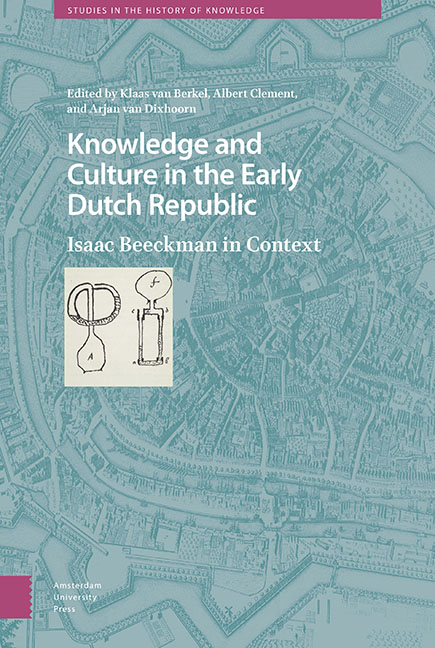
Knowledge and Culture in the Early Dutch Republic

-
The digital format of this book is no longer available to purchase from Cambridge Core. Other formats may be available.
-
Select format
-
- Publisher:
- Amsterdam University Press
- Publication date:
- 07 October 2022
- 24 June 2022
- ISBN:
- 9789048551477
- 9789463722537
- Dimensions:
- Weight & Pages:
- Dimensions:
- Weight & Pages:
- Subjects:
- Popular Science, General Science
You may already have access via personal or institutional login- Subjects:
- Popular Science, General Science
Show more authors 
You may already have access via personal or institutional login
Book description
The Dutch Republic around 1600 was a laboratory of the Scientific Revolution of the seventeenth century. Here conditions were favourable for the development of new ways of knowing nature and the natural philosopher Isaac Beeckman, who was born in Middelburg in 1588, was a seminal figure in this context. He laid the groundwork for the strictly mechanical philosophy that is at the heart of the new science. Descartes and others could build on what they learned, directly or indirectly, from Beeckman. As previous studies have mainly dealt with the scientific content of Beeckman's thinking, this volume also explores the wider social, scientific and cultural context of his work. Beeckman was both a craftsman and a scholar and fruitfully combined artisanal ways of knowing with international scholarly traditions. Beeckman's extensive private notebook offers a unique perspective on the cultures of knowledge that emerged in this crucial period in intellectual history.
Contents
Contents
Metrics
Full text views
Full text views helpTotal number of HTML views: 0
Total number of PDF views: 0 *
 Loading metrics...
* Views captured on Cambridge Core between #date#. This data will be updated every 24 hours.
Usage data cannot currently be displayed.
Accessibility standard: Unknown
Why this information is here
This section outlines the accessibility features of this content - including support for screen readers, full keyboard navigation and high-contrast display options. This may not be relevant for you.
Accessibility Information
Accessibility compliance for the PDF of this book is currently unknown and may be updated in the future.