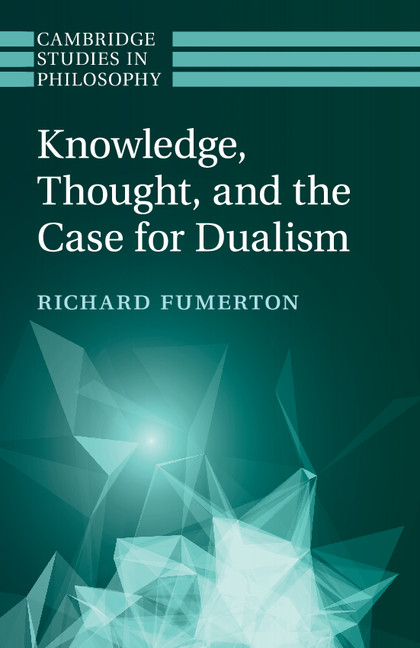
Knowledge, Thought, and the Case for Dualism

-
Select format
-
- Publisher:
- Cambridge University Press
- Publication date:
- 05 October 2013
- 17 October 2013
- ISBN:
- 9781139795401
- 9781107037878
- 9781107559257
- Dimensions:
- (216 x 138 mm)
- Weight & Pages:
- 0.51kg, 295 Pages
- Dimensions:
- (216 x 140 mm)
- Weight & Pages:
- 0.38kg, 300 Pages
You may already have access via personal or institutional login- Series:
- Cambridge Studies in Philosophy
Show more authors 
You may already have access via personal or institutional login
Book description
The relationship between mind and matter, mental states and physical states, has occupied the attention of philosophers for thousands of years. Richard Fumerton's primary concern is the knowledge argument for dualism - an argument that proceeds from the idea that we can know truths about our existence and our mental states without knowing any truths about the physical world. This view has come under relentless criticism, but here Fumerton makes a powerful case for its rehabilitation, demonstrating clearly the importance of its interconnections with a wide range of other controversies within philosophy. Fumerton analyzes philosophical views about the nature of thought and the relation of those views to arguments for dualism, and investigates the connection between a traditional form of foundationalism about knowledge, and a foundationalist view about thought that underlies traditional arguments for dualism. His book will be of great interest to those studying epistemology and the philosophy of mind.
Contents
Contents
Metrics
Altmetric attention score
Full text views
Full text views helpTotal number of HTML views: 0
Total number of PDF views: 0 *
 Loading metrics...
* Views captured on Cambridge Core between #date#. This data will be updated every 24 hours.
Usage data cannot currently be displayed.
Accessibility standard: Unknown
Why this information is here
This section outlines the accessibility features of this content - including support for screen readers, full keyboard navigation and high-contrast display options. This may not be relevant for you.
Accessibility Information
Accessibility compliance for the HTML of this book is currently unknown and may be updated in the future.