
Skip to main content Accessibility help
×
  • Cited by 5
    • Show more authors
    • You may already have access via personal or institutional login
    • Select format
    • Publisher:
      Cambridge University Press
      Publication date:
      24 March 2022
      31 March 2022
      ISBN:
      9781009106672
      9781009098960
      9781009102032
      Dimensions:
      (229 x 152 mm)
      Weight & Pages:
      0.604kg, 318 Pages
      Dimensions:
      (229 x 152 mm)
      Weight & Pages:
      0.47kg, 318 Pages
    You may already have access via personal or institutional login
  • Selected: Digital
    Add to cart View cart Buy from Cambridge.org

    Book description

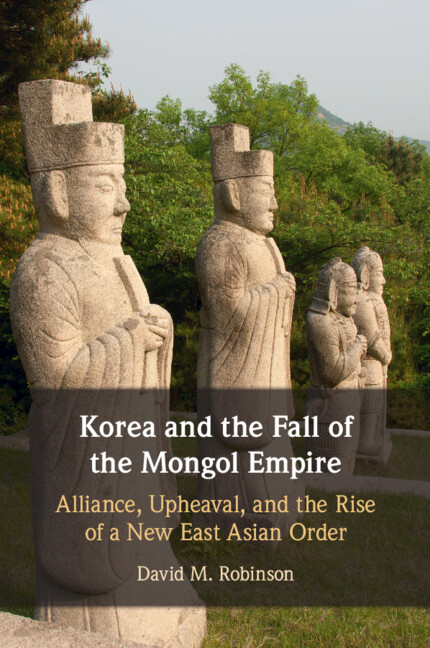
    Korea and the Fall of the Mongol Empire explores the experiences of the enigmatic and controversial King Gongmin of Goryeo, Wang Gi, as he navigated the upheavals of the mid-fourteenth century, including the collapse of the Mongol Empire and the rise of its successors in West, Central, and East Asia. Drawing on a wealth of Korean and Chinese sources and integrating East Asian and Western scholarship on the topic, David Robinson considers the single greatest geopolitical transformation of the fourteenth century through the experiences of this one East Asian ruler. He focuses on the motives of Wang Gi, rather than the major contemporary powers, to understand the rise and fall of empire, offering a fresh perspective on this period of history. The result is a more nuanced and accessible appreciation of Korean, Mongolian, and Chinese history, which sharpens our understanding of alliances across Eurasia.

    Reviews

    'With Korea and the Fall of the Mongol Empire, Robinson achieves something few can do—write an interesting, engaging, and illuminating study of the Koryŏ-Mongol relationship. The writer is one of a few scholars in any language working on broader issues of empire in premodern Northeast Asia through a transnational lens. His work is a major scholarly achievement.'

    George Kallander - Syracuse University

    'The late 14th century in East Asia was a chaotic time. Korea and the Fall of the Mongol Empire brings this period into sharp focus better than any other work in English. By focusing on Korea’s King Kongmin, Robinson adroitly weaves the upheavals of the age that witnessed the rise of the Ming, the collapse of the Yuan, and the changes in Korea. King Kongmin is controversial but through Robinson’s skillful use of Chinese, Yuan, and Korean sources, both primary and secondary, this work emerges foundational in exploring this age.'

    Edward Shultz - University of Hawaii

    Refine List

    Actions for selected content:

    Select all | Deselect all
    • View selected items
    • Export citations
    • Download PDF (zip)
    • Save to Kindle
    • Save to Dropbox
    • Save to Google Drive

    Save Search

    You can save your searches here and later view and run them again in "My saved searches".

    Please provide a title, maximum of 40 characters.
    ×

    Contents

    Metrics

    Altmetric attention score

    Full text views

    Total number of HTML views: 0
    Total number of PDF views: 0 *
    Loading metrics...

    Book summary page views

    Total views: 0 *
    Loading metrics...

    * Views captured on Cambridge Core between #date#. This data will be updated every 24 hours.

    Usage data cannot currently be displayed.

    Accessibility standard: Unknown

    Why this information is here

    This section outlines the accessibility features of this content - including support for screen readers, full keyboard navigation and high-contrast display options. This may not be relevant for you.

    Accessibility Information

    Accessibility compliance for the HTML of this book is currently unknown and may be updated in the future.
