Ladies-in-Waiting in Medieval England

-
Select format
-
- Publisher:
- Cambridge University Press
- Publication date:
- 02 January 2025
- 09 January 2025
- ISBN:
- 9781009456975
- 9781009457019
- 9781009456999
- Dimensions:
- (229 x 152 mm)
- Weight & Pages:
- 0.664kg, 362 Pages
- Dimensions:
- (229 x 152 mm)
- Weight & Pages:
- 0.524kg, 362 Pages
- Subjects:
- British History 1066-1450, History
You may already have access via personal or institutional login- Subjects:
- British History 1066-1450, History
Show more authors 
You may already have access via personal or institutional login
Book description
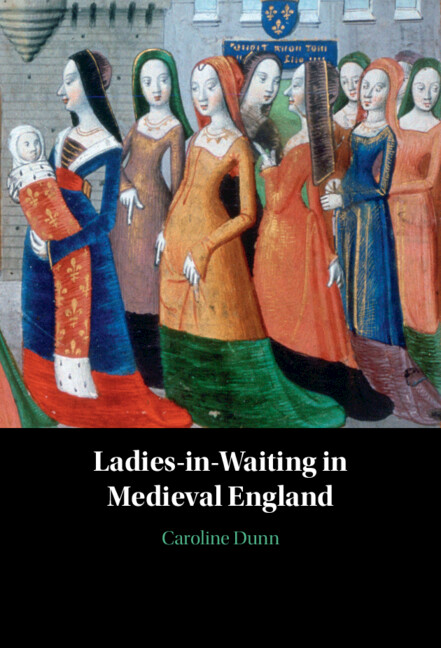
Ladies-in-Waiting in Medieval England examines female attendants who served queens and aristocratic women during the late medieval period. Using a unique set of primary source based statistics, Caroline Dunn reveals that the lady-in-waiting was far more than a pretty girl sewing in the queen's chamber while seeking to catch the eye of an eligible bachelor. Ladies-in-waiting witnessed major historical events of the era and were sophisticated players who earned significant rewards. They had both family and personal interests to advance – through employment they linked kin and court, and through marriage they built bridges between families. Whether royal or aristocratic, ladies-in-waiting worked within gendered spaces, building female-dominated social networks, while also operating within a masculine milieu that offered courtiers of both sexes access to power. Working from a range of sources wider than the subjective anecdote, Dunn presents the first scholarly treatment of medieval English ladies-in-waiting.
Reviews
‘Caroline Dunn’s richly fascinating book documents the careers of nearly 1200 elite female servants in royal and aristocratic households in England between 1236 and 1536. She devised a sophisticated methodology to convincingly argue that ladies-in-waiting were liminal but essential, vital to creating and maintaining networks of family alliances that comprise monarchy.’
Theresa Earenfight - editor of Elite and Royal Households in Medieval and early Modern Europe
‘This landmark work offers a rich perspective on ladies-in-waiting in the late medieval English court. A real strength of this book is the focus on the women themselves including their experience of life at court, their role in ritual and ceremonial and the rewards they gained from service to the queen.’
Ellie Woodacre - author of Queens and Queenship
‘Caroline Dunn takes us as never before into the world of honourable service of ladies-in-waiting. We see the inner workings of these establishments through the lives of some 1200 ladies, the links between families, kin, service, and their daily routine. This is a major contribution to our understanding of the significance of the domestic and access to power in the great household.’
Chris Woolgar - author of The Great Household in Late Medieval England
‘… set to become the standard reference work on this topic for both scholars and students. Documenting the careers of nearly twelve hundred women from 1236 to 1536, this thoroughly researched and concisely expressed book synthesizes a vast amount of information from a difficult, patchy archive … Having the integral roles, power and contribution of ladies-in-waiting laid out in print with the statistics and analysis to support them is an invaluable contribution to the existing literature and will remain the 'go-to' text on this topic for a long time to come.’
Nicola Clark Source: The American Historical Review
‘[T]his is a rich study of the women behind the scenes of power, through which Dunn greatly enhances our understanding of the closely intertwined world of politics and domestics in medieval rulership and of the important role of the women who supported queens and noblewomen.’
Abigail S. Armstrong Source: Royal Studies Journal
Contents
Contents
References
Metrics
Full text views
Full text views helpTotal number of HTML views: 0
Total number of PDF views: 0 *
 Loading metrics...
* Views captured on Cambridge Core between #date#. This data will be updated every 24 hours.
Usage data cannot currently be displayed.
Accessibility standard: Unknown
Why this information is here
This section outlines the accessibility features of this content - including support for screen readers, full keyboard navigation and high-contrast display options. This may not be relevant for you.
Accessibility Information
Accessibility compliance for the HTML of this book is currently unknown and may be updated in the future.