Lambda Calculus with Types
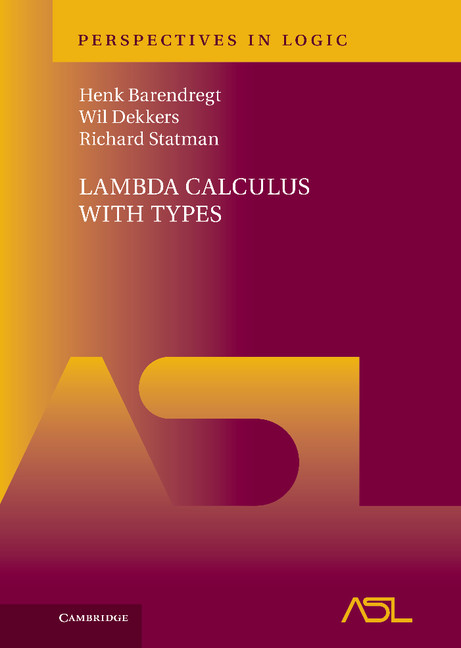

-
Select format
-
- Publisher:
- Cambridge University Press
- Publication date:
- 05 August 2013
- 20 June 2013
- ISBN:
- 9781139032636
- 9780521766142
- Dimensions:
- (228 x 152 mm)
- Weight & Pages:
- 1.55kg, 856 Pages
- Dimensions:
- Weight & Pages:
Show more authors 
You may already have access via personal or institutional login
Book description
This handbook with exercises reveals in formalisms, hitherto mainly used for hardware and software design and verification, unexpected mathematical beauty. The lambda calculus forms a prototype universal programming language, which in its untyped version is related to Lisp, and was treated in the first author's classic The Lambda Calculus (1984). The formalism has since been extended with types and used in functional programming (Haskell, Clean) and proof assistants (Coq, Isabelle, HOL), used in designing and verifying IT products and mathematical proofs. In this book, the authors focus on three classes of typing for lambda terms: simple types, recursive types and intersection types. It is in these three formalisms of terms and types that the unexpected mathematical beauty is revealed. The treatment is authoritative and comprehensive, complemented by an exhaustive bibliography, and numerous exercises are provided to deepen the readers' understanding and increase their confidence using types.
Reviews
'The book has a place in undergraduate libraries because of its uniquely comprehensive, if theoretical, treatment of a timely, widely important subject. Recommended.'
D. V. Feldman Source: Choice
'The authors have produced a well-written, organised and comprehensive account of three important type systems. These systems’ properties have been rich sources of interest to logicians for many years; their problems are not all solved, and in future work this book will almost certainly become a standard reference about them. It will also allow the more mathematically inclined computer scientist to obtain a deeper understanding of the principles behind some of the higher order languages in current use.'
Source: Bulletin of the London Mathematical Society
Contents
Contents
Metrics
Altmetric attention score
Full text views
Full text views helpTotal number of HTML views: 0
Total number of PDF views: 0 *
 Loading metrics...
* Views captured on Cambridge Core between #date#. This data will be updated every 24 hours.
Usage data cannot currently be displayed.
Accessibility standard: Unknown
Why this information is here
This section outlines the accessibility features of this content - including support for screen readers, full keyboard navigation and high-contrast display options. This may not be relevant for you.
Accessibility Information
Accessibility compliance for the PDF of this book is currently unknown and may be updated in the future.