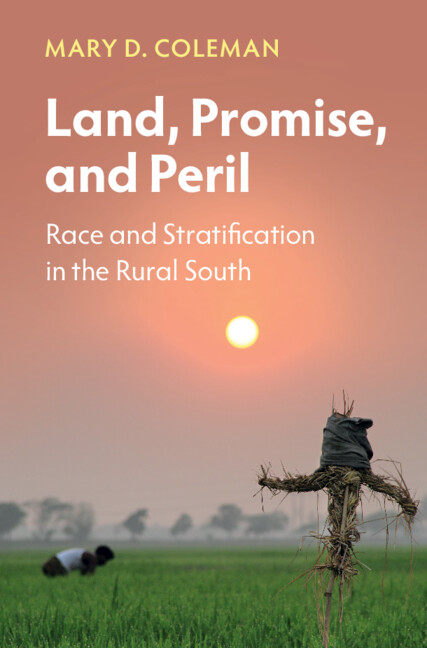
Land, Promise, and Peril

-
Select format
-
- Publisher:
- Cambridge University Press
- Publication date:
- 15 April 2023
- 20 April 2023
- ISBN:
- 9781009182546
- 9781009182560
- 9781009182553
- Dimensions:
- (229 x 152 mm)
- Weight & Pages:
- 0.751kg, 418 Pages
- Dimensions:
- (229 x 152 mm)
- Weight & Pages:
- 0.6kg, 418 Pages
- Subjects:
- Microeconomics, Sociology of Race and Ethnicity, Macroeconomics, Sociology
You may already have access via personal or institutional login- Subjects:
- Microeconomics, Sociology of Race and Ethnicity, Macroeconomics, Sociology
Show more authors 
You may already have access via personal or institutional login
Book description
In Langston Hughes' 'Mother to Son,' (1922), written at a time of dramatic disruption in the American economy and continued tyranny in the lives of Black people, urban and rural, the Mother pleads with the child not to give up. She tells the child that she has been 'a climbing on, reaching landings and turning corners.' Not only did the seven families chronicled in this unique study not give up, while both losing and gaining ground, they managed to sponsor a generation of children, several of whom reached the middle and upper-middle classes. Land, Promise, and Peril chronicles the actions, actors, and events that propelled legal racism and quelled it, showing how leadership and political institutions play a crucial role in shaping the pace and quality of exits from poverty. Despite great odds, some domestics, sharecroppers, tenants, and farmers and their children navigated pathways toward the middle class and beyond.
Contents
Contents
Metrics
Altmetric attention score
Full text views
Full text views helpTotal number of HTML views: 0
Total number of PDF views: 0 *
 Loading metrics...
* Views captured on Cambridge Core between #date#. This data will be updated every 24 hours.
Usage data cannot currently be displayed.
Accessibility standard: Unknown
Why this information is here
This section outlines the accessibility features of this content - including support for screen readers, full keyboard navigation and high-contrast display options. This may not be relevant for you.
Accessibility Information
Accessibility compliance for the HTML of this book is currently unknown and may be updated in the future.