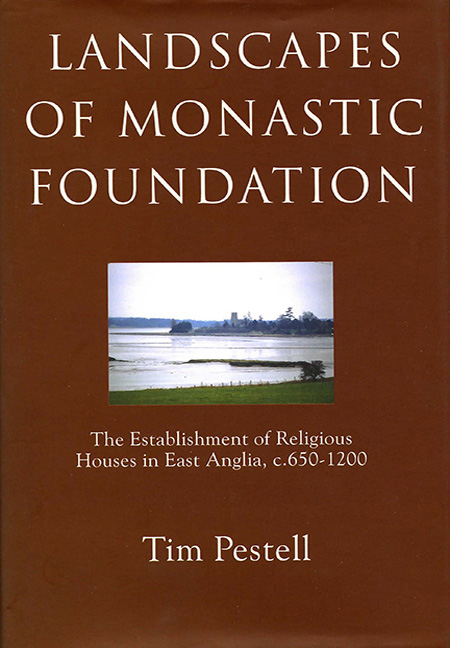
Landscapes of Monastic Foundation

-
Select format
-
- Publisher:
- Boydell & Brewer
- Publication date:
- 11 May 2017
- 01 November 2004
- ISBN:
- 9781846152368
- 9781843830627
- Dimensions:
- Weight & Pages:
- Dimensions:
- Weight & Pages:
- Series:
- Anglo-Saxon Studies
- Subjects:
- History, British History Before 1066
You may already have access via personal or institutional login- Series:
- Anglo-Saxon Studies
- Subjects:
- History, British History Before 1066
Show more authors 
You may already have access via personal or institutional login
Book description
Monastic studies usually focus upon the post-Conquest period; here, in valuable contrast, the focus is on pre-Conquest monastic foundations, in the present-day counties of Norfolk and Suffolk. Tim Pestell considers the place of the monastery in wider landscapes - topographical, social, economic and political. He observes that by 1215 the Diocese of Norwich contained about a tenth of all English monasteries, a remarkable richness of patronage was no sudden flush of enthusiasm, but a manifestation of religious devotion that had been evolving in East Anglia since the seventh-century Conversion. By integrating archaeological and historical sources, Dr Pestell presents an in-depth examination of where and how communal religious life developed in the region over half a millennium. In so doing, he demonstrates how the more visible and better-evidenced post-Conquest monastic landscape was typically structured by its Anglo-Saxon past.
Dr TIM PESTELL is Curator of Archaeology at Norwich Castle Museum.
Contents
Contents
Metrics
Altmetric attention score
Full text views
Full text views helpTotal number of HTML views: 0
Total number of PDF views: 0 *
 Loading metrics...
* Views captured on Cambridge Core between #date#. This data will be updated every 24 hours.
Usage data cannot currently be displayed.
Accessibility standard: Unknown
Why this information is here
This section outlines the accessibility features of this content - including support for screen readers, full keyboard navigation and high-contrast display options. This may not be relevant for you.
Accessibility Information
Accessibility compliance for the PDF of this book is currently unknown and may be updated in the future.