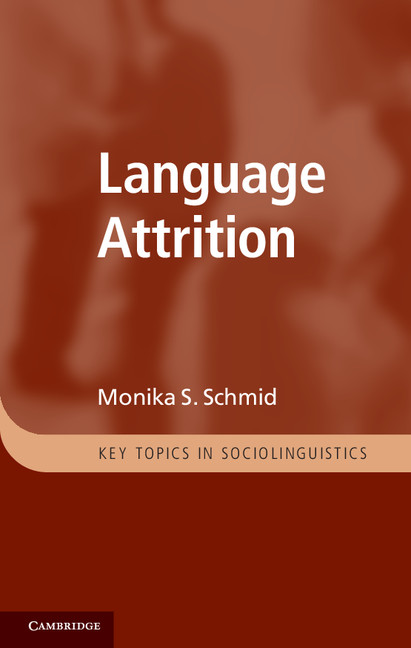
Language Attrition

-
Select format
-
- Publisher:
- Cambridge University Press
- Publication date:
- 05 June 2012
- 07 July 2011
- ISBN:
- 9780511852046
- 9780521760409
- 9780521759939
- Dimensions:
- (216 x 138 mm)
- Weight & Pages:
- 0.5kg, 296 Pages
- Dimensions:
- (216 x 138 mm)
- Weight & Pages:
- 0.4kg, 306 Pages
- Series:
- Key Topics in Sociolinguistics
- Subjects:
- Sociology: General Interest, Sociolinguistics, Psycholinguistics and Neurolinguistics, Language and Linguistics
You may already have access via personal or institutional login- Series:
- Key Topics in Sociolinguistics
- Subjects:
- Sociology: General Interest, Sociolinguistics, Psycholinguistics and Neurolinguistics, Language and Linguistics
Show more authors 
You may already have access via personal or institutional login
Book description
'Language attrition' describes the loss of, or changes to, grammatical and other features of a language as a result of declining use by speakers who have changed their linguistic environment and language habits. In such a situation there may, for example, be simplification in the tense system or in certain properties of subordinate clauses; some vocabulary items might fall into disuse and phonetic features may be restructured. These changes can be affected by features of the speaker's environment, but also by his or her attitudes and processes of identification. This book provides a detailed and up-to-date introduction to the way in which language attrition can affect language, as well as to the extra- and sociolinguistic features involved. It also familiarizes the reader with experimental approaches to attrition and data analysis techniques and provides hands-on guidelines on how to apply them.
Reviews
‘An outstanding how-to research manual … a superb introduction to the fast-growing field of first language attrition.'
Aneta Pavlenko - Temple University
'A masterful introduction to the theoretical key concepts and methodological issues in first language attrition research. Surely a landmark book!'
Barbara Köpke - Octogone-Lordat, University of Toulouse
'In this book, every crucial aspect of language attrition research is highlighted and clearly explained. Each chapter starts with essential questions that describe its focus and main ideas. In doing so, each chapter acts as a scaffold for the following one, and the reader is well-prepared and trained for what is next.'
Bahar Otcu-Grillman Source: The Linguist List (linguistlist.org)
Contents
Contents
Metrics
Altmetric attention score
Full text views
Full text views helpTotal number of HTML views: 0
Total number of PDF views: 0 *
 Loading metrics...
* Views captured on Cambridge Core between #date#. This data will be updated every 24 hours.
Usage data cannot currently be displayed.
Accessibility standard: Unknown
Why this information is here
This section outlines the accessibility features of this content - including support for screen readers, full keyboard navigation and high-contrast display options. This may not be relevant for you.
Accessibility Information
Accessibility compliance for the PDF of this book is currently unknown and may be updated in the future.