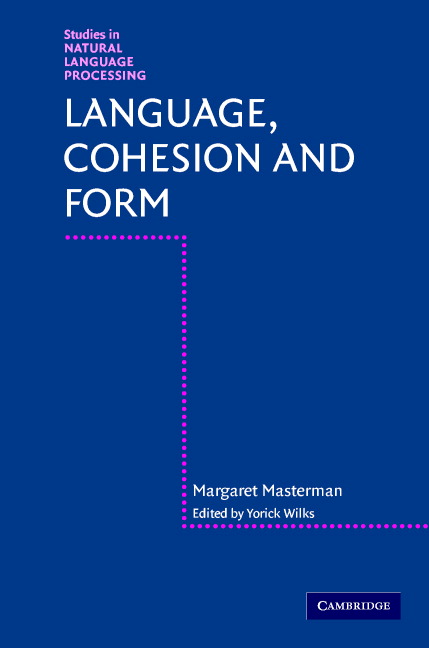
Language, Cohesion and Form

-
Select format
-
- Publisher:
- Cambridge University Press
- Publication date:
- 22 September 2009
- 16 January 2005
- ISBN:
- 9780511486609
- 9780521454896
- 9780521129633
- Dimensions:
- (228 x 152 mm)
- Weight & Pages:
- 0.65kg, 324 Pages
- Dimensions:
- (229 x 152 mm)
- Weight & Pages:
- 0.48kg, 324 Pages
You may already have access via personal or institutional login
Show more authors 
You may already have access via personal or institutional login
Book description
Margaret Masterman was a pioneer in the field of computational linguistics. Working in the earliest days of language processing by computer, she believed that meaning, not grammar, was the key to understanding languages, and that machines could determine the meaning of sentences. She was able, even on simple machines, to undertake sophisticated experiments in machine translation, and carried out important work on the use of semantic codings and thesauri to determine the meaning structure of texts. This volume brings together Masterman's groundbreaking papers for the first time. Through his insightful commentaries, Yorick Wilks argues that Masterman came close to developing a computational theory of language meaning based on the ideas of Wittgenstein, and shows the importance of her work in the philosophy of science and the nature of iconic languages. Of key interest in computational linguistics and artificial intelligence, it will remind scholars of Masterman's significant contribution to the field.
Reviews
Review of the hardback:'we should be grateful to Wilks and the publisher for making these papers available.'
Source: Computational Linguistics
Contents
Contents
Metrics
Altmetric attention score
Full text views
Full text views helpTotal number of HTML views: 0
Total number of PDF views: 0 *
 Loading metrics...
* Views captured on Cambridge Core between #date#. This data will be updated every 24 hours.
Usage data cannot currently be displayed.
Accessibility standard: Unknown
Why this information is here
This section outlines the accessibility features of this content - including support for screen readers, full keyboard navigation and high-contrast display options. This may not be relevant for you.
Accessibility Information
Accessibility compliance for the PDF of this book is currently unknown and may be updated in the future.