Latin America's Radical Left

-
Select format
-
- Publisher:
- Cambridge University Press
- Publication date:
- 13 October 2017
- 26 October 2017
- ISBN:
- 9781316822968
- 9781107177710
- 9781316630716
- Dimensions:
- (228 x 152 mm)
- Weight & Pages:
- 0.52kg, 272 Pages
- Dimensions:
- (229 x 152 mm)
- Weight & Pages:
- 0.39kg, 278 Pages
You may already have access via personal or institutional login
Show more authors 
You may already have access via personal or institutional login
Book description
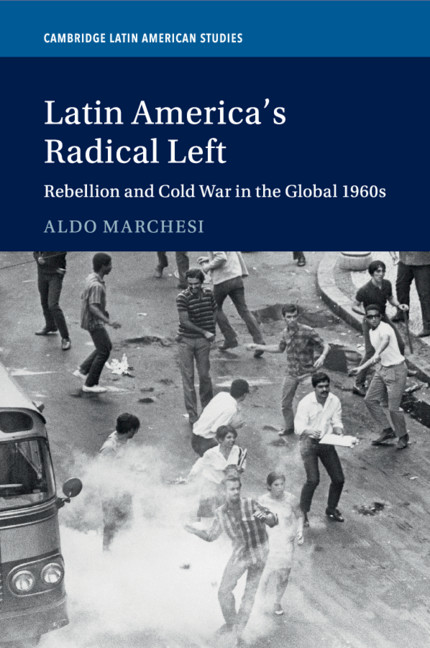
This book examines the emergence, development, and demise of a network of organizations of young leftist militants and intellectuals in South America. This new generation, formed primarily by people who in the late 1960s were still under the age of thirty, challenged traditional politics and embraced organized violence and transnational strategies as the only ways of achieving social change in their countries during the Cold War. This lasted for more than a decade, beginning in Uruguay as a result of the rise of authoritarianism in Brazil and Argentina, and expanding with Che Guevara's Bolivia campaign in 1966. These coordination efforts reached their highest point in Buenos Aires from 1973 to 1976, until the military coup d'état in Argentina eliminated the last refuge for these groups. Aldo Marchesi offers the first in-depth, regional and transnational study of the militant left in Latin America during the turbulent 1960s and 1970s.
Reviews
'Marchesi's ambitious transnational history of radical politics in the Southern Cone blazes exciting paths for understanding Latin America's distinctive variants of the Cold War and the New Left. Based on new written and oral sources, it also fleshes out new dimensions of the Global Sixties and the consolidation of authoritarian regimes, while provoking us to reconsider the legacies of radical leftist politics. A surpassing achievement.'
Gil Joseph - Yale University, Connecticut
'This is an important book on an important subject that has been little studied and less well understood. This is required reading for scholars and students of the Cold War in Latin America and the contest between revolution and counter-revolution in the Southern Cone.'
Peter Winn - Tufts University, Massachusetts, and author of Weavers of Revolution
'Marchesi does a superb job of tracing the development of strategic thinking about armed revolution and social change as it responded to shifting international conditions. … this is an informative and well-researched book, making effective contributions to the history of the Left during Latin America’s Cold War, and the political, intellectual, and cultural history of militant groups.'
Patrick Iber Source: H-LatAm
Contents
Contents
Metrics
Altmetric attention score
Full text views
Full text views helpTotal number of HTML views: 0
Total number of PDF views: 0 *
 Loading metrics...
* Views captured on Cambridge Core between #date#. This data will be updated every 24 hours.
Usage data cannot currently be displayed.
Accessibility standard: Unknown
Why this information is here
This section outlines the accessibility features of this content - including support for screen readers, full keyboard navigation and high-contrast display options. This may not be relevant for you.
Accessibility Information
Accessibility compliance for the HTML of this book is currently unknown and may be updated in the future.