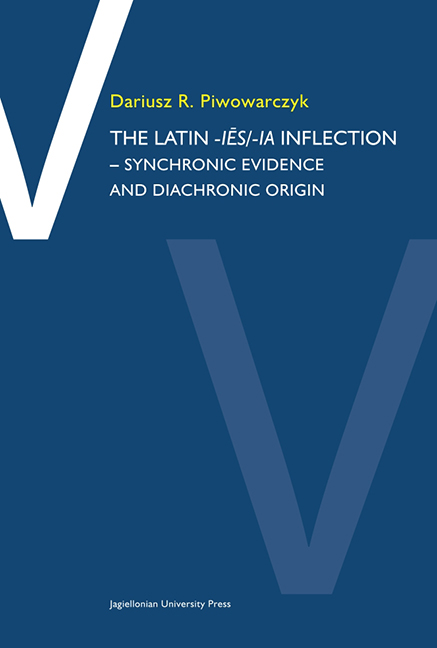
The Latin -iés/ia Inflection

-
Select format
-
- Publisher:
- Jagiellonian University Press
- Publication date:
- 16 July 2022
- 21 August 2022
- ISBN:
- 9788323370697
- 9788323347804
- Dimensions:
- Weight & Pages:
- Dimensions:
- Weight & Pages:
You may already have access via personal or institutional login
Show more authors 
You may already have access via personal or institutional login
Book description
The monograph concerns the origin of the Latin -iés/-ia inflection, the topic which to this day has not been explained satisfactorily. The proposal presented in the book allows for the most economic solution to the problem without difficult assumptions which were present in the previous hypotheses. The author explains the origin of the formation as the result of the identification and mutual influence of three former paradigms reconstructed for Proto-Indo-European and subsequent analogical influence of the commonly used Latin noun diés ‘day’ from the fifth declension.
Apart from the hypothesis itself, the analysis of all the forms of the Latin -iés/-ia inflection is presented with an etymological commentary and illustrative examples from the original ancient texts. The question on the origin of the Latin fifth declension is also mentioned alongside the modern description of the Proto-Indo-European derivational morphology.
Contents
Contents
Metrics
Full text views
Full text views helpTotal number of HTML views: 0
Total number of PDF views: 0 *
 Loading metrics...
* Views captured on Cambridge Core between #date#. This data will be updated every 24 hours.
Usage data cannot currently be displayed.
Accessibility standard: Unknown
Why this information is here
This section outlines the accessibility features of this content - including support for screen readers, full keyboard navigation and high-contrast display options. This may not be relevant for you.
Accessibility Information
Accessibility compliance for the PDF of this book is currently unknown and may be updated in the future.