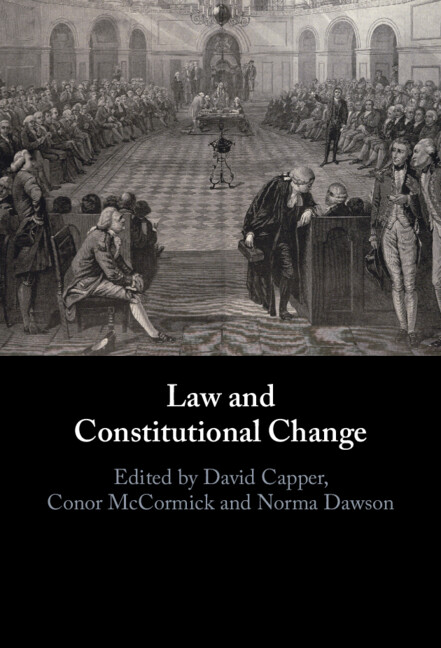
Law and Constitutional Change

-
Select format
-
- Publisher:
- Cambridge University Press
- Publication date:
- 26 September 2025
- 16 October 2025
- ISBN:
- 9781009797733
- 9781009797740
- Creative Commons:
-
This content is Open Access and distributed under the terms of the Creative Commons Attribution licence CC-BY-NC 4.0.


https://creativecommons.org/creativelicenses - Dimensions:
- (229 x 152 mm)
- Weight & Pages:
- 0.708kg, 370 Pages
- Dimensions:
- Weight & Pages:
- Subjects:
- Constitutional and Administrative Law, Legal History, Law
Open AccessYou have digital access to this book- Subjects:
- Constitutional and Administrative Law, Legal History, Law
Show more authors 
You have digital access to this book
Book description
A collection of some of the best papers presented at the 25th British Legal History Conference at Queen's University Belfast in July 2022, Law and Constitutional Change examines the role that law plays when countries experience a major constitutional upheaval. It examines the interaction of law and politics in history across different legal jurisdictions with different legal traditions. The theme of the conference was 'Law and Constitutional Change' and was inspired by the decade of anniversaries in Ireland (2012–2023) commemorating events from a century ago that began with the Home Rule Crisis and ended with the partition of the country. It studies the changes that occurred at that time in a wider British and Irish as well as international context, with a view to deepening understanding of contemporary debates such as those surrounding Brexit and its longer-term implications. This title is also available as open access on Cambridge Core.
Reviews
‘This is an excellent collection. The chapters are more than the sum of their (already very impressive) parts. Collectively, they show the renaissance of interest in constitutional history; they highlight its scope, ambition and relevance. Law and Constitutional Change shows that constitutional history no longer resembles what it looked like and what functions it provided in its 19th century heyday. It is no longer one ‘top-down’ story of progress designed to stabilise and romanticise the status quo. In the hands of the authors of the chapters published here, constitutional history is a number of stories, a plethora of perspectives, that helps shed a light on issues of power, questioning what we know about our constitutional past and by implication our constitutional present. This is a must-read collection whose open access status means that its chapters should find their way to many a reading list, hopefully to inspire the constitutional historians of the future.’
Russell Sandberg Source: Public Law
Contents
Contents
-
Law and Constitutional Change
pp i-ii -
-
- You have access
- Open access
- HTML
- Export citation
-
-
Law and Constitutional Change - Title page
pp iii-iii -
-
- You have access
- Open access
- HTML
- Export citation
-
-
Copyright page
pp iv-iv -
-
- You have access
- Open access
- HTML
- Export citation
-
-
Dedication
pp v-vi -
-
- You have access
- Open access
- HTML
- Export citation
-
-
Contents
pp vii-viii -
-
- You have access
- Open access
- HTML
- Export citation
-
-
Contributors
pp ix-x -
-
- You have access
- Open access
- HTML
- Export citation
-
-
Foreword
pp xi-xii -
-
- You have access
- Open access
- HTML
- Export citation
-
-
Acknowledgements
pp xiii-xiv -
-
- You have access
- Open access
- HTML
- Export citation
-
-
Editors’ Introduction
pp 1-10 -
-
-
- You have access
- Open access
- HTML
- Export citation
-
-
1 - ‘Another Sort of Treason’
pp 11-26 - The Troubled Home of Husband-Killing in Late Medieval Common Law
-
-
-
- You have access
- Open access
- HTML
- Export citation
-
-
2 - The Origins of the Statute of Uses
pp 27-43 -
-
-
- You have access
- Open access
- HTML
- Export citation
-
-
3 - Examining the Doctrine of Art and Part in Early Modern Scotland
pp 44-62 -
-
-
- You have access
- Open access
- HTML
- Export citation
-
-
4 - The Beginnings of Judicial Review
pp 63-79 -
-
-
- You have access
- Open access
- HTML
- Export citation
-
-
5 - The Aspirations of James Stuart
pp 80-97 -
-
-
- You have access
- Open access
- HTML
- Export citation
-
-
6 - A British Common Law?
pp 98-121 - Public Law after the 1707 Union between England and Scotland
-
-
-
- You have access
- Open access
- HTML
- Export citation
-
-
7 - Quo Warranto and the Borough Office Holder, 1700–1792
pp 122-146 -
-
-
- You have access
- Open access
- HTML
- Export citation
-
-
9 - Constitutional Change, Law and Grattan’s Parliament
pp 163-180 -
-
-
- You have access
- Open access
- HTML
- Export citation
-
-
10 - Sir John Ross Bt
pp 181-197 - The Last Lord Chancellor of Ireland, 1921–1922
-
-
-
- You have access
- Open access
- HTML
- Export citation
-
-
11 - Lord Birkenhead, Ambiguity and the Irish Border
pp 198-215 - Lawyers and the Anglo-Irish Treaty
-
-
-
- You have access
- Open access
- HTML
- Export citation
-
-
14 - Fortuna Fortes Adiuvat
pp 256-274 - The Importance of Individuals in Estonian Constitutional Change
-
-
-
- You have access
- Open access
- HTML
- Export citation
-
-
16 - The Rise and Fall of the UK Human Rights Act
pp 294-306 -
-
-
- You have access
- Open access
- HTML
- Export citation
-
-
17 - Courting the Past
pp 307-340 - Reconstructing Ireland’s Lost Legal Records, circa 1300–1922
-
-
-
- You have access
- Open access
- HTML
- Export citation
-
-
Index
pp 341-354 -
-
- You have access
- Open access
- HTML
- Export citation
-
References
Metrics
Altmetric attention score
Full text views
Full text views helpTotal number of HTML views: 0
Total number of PDF views: 0 *
 Loading metrics...
* Views captured on Cambridge Core between #date#. This data will be updated every 24 hours.
Usage data cannot currently be displayed.
Accessibility standard: WCAG 2.2 AAA
Why this information is here
This section outlines the accessibility features of this content - including support for screen readers, full keyboard navigation and high-contrast display options. This may not be relevant for you.
Accessibility Information
The HTML of this book complies with version 2.2 of the Web Content Accessibility Guidelines (WCAG), offering more comprehensive accessibility measures for a broad range of users and attains the highest (AAA) level of WCAG compliance, optimising the user experience by meeting the most extensive accessibility guidelines.
Content Navigation
Table of contents navigation
Allows you to navigate directly to chapters, sections, or non‐text items through a linked table of contents, reducing the need for extensive scrolling.
Index navigation
Provides an interactive index, letting you go straight to where a term or subject appears in the text without manual searching.
Reading Order and Textual Equivalents
Single logical reading order
You will encounter all content (including footnotes, captions, etc.) in a clear, sequential flow, making it easier to follow with assistive tools like screen readers.
Short alternative textual descriptions
You get concise descriptions (for images, charts, or media clips), ensuring you do not miss crucial information when visual or audio elements are not accessible.
Visual Accessibility
Use of colour is not sole means of conveying information
You will still understand key ideas or prompts without relying solely on colour, which is especially helpful if you have colour vision deficiencies.
Use of high contrast between text and background colour
You benefit from high‐contrast text, which improves legibility if you have low vision or if you are reading in less‐than‐ideal lighting conditions.