
Skip to main content Accessibility help
×
  • Cited by 10
    • Show more authors
    • You may already have access via personal or institutional login
    • Select format
    • Publisher:
      Cambridge University Press
      Publication date:
      08 April 2019
      18 April 2019
      ISBN:
      9781108654784
      9781108496780
      9781108721950
      Dimensions:
      (228 x 152 mm)
      Weight & Pages:
      0.59kg, 326 Pages
      Dimensions:
      (229 x 152 mm)
      Weight & Pages:
      0.5kg, 330 Pages
    You may already have access via personal or institutional login
  • Selected: Digital
    Add to cart View cart Buy from Cambridge.org

    Book description

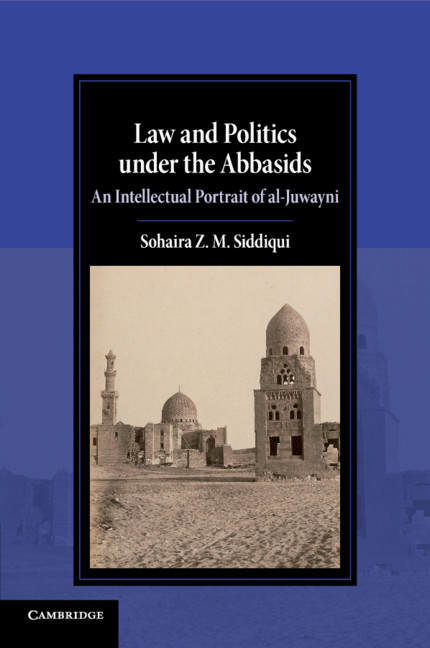
    Abu Ma'ali al-Juwayni (d.478/1085) lived in a politically tumultuous period. The rise of powerful dynastic families forced the Abbasid Caliph into a position of titular power, and created instability. He also witnessed intellectual upheavals living amidst great theological and legal diversity. Collectively, these experiences led him to consider questions of religious certainty and social and political continuity. He noted that if political elites are constantly changing, paralleled with shifting intellectual allegiances, what ensures the continuity of religion? He concluded that continuity of society is contingent upon knowledge and practice of the Shari'a. Here, Sohaira Siddiqui explores how scholars grappled with questions of human reason and knowledge, and how their answers to these questions often led them to challenge dominant ideas of what the Shari'a is. By doing this, she highlights the interconnections between al-Juwayni's discussions on theology, law and politics, and the socio-political intellectual landscapes that forged them.

    Reviews

    'Sohaira Siddiqui has written a cogent and important study of the towering figure of Imam al-Haramayn al-Juwayni, one of the most significant scholars of the 5th/11th century. Siddiqui insightfully explores al-Juwayni’s intellectual legacy placing him within his proper historical milieu and in doing so, she has produced a study that is required reading for all students of Islamic theology and law. Notably, Siddiqui’s measured argument that al-Juwayni conceived of Shari‘ah as a dialectical nomos warrants careful consideration. Ultimately, one cannot but feel grateful for this refreshingly rich contribution to Islamic studies.'

    Khaled Abou El Fadl - UCLA School of Law

    'In this book, Sohaira Siddiqui provides us with an insightful, meticulously-researched, and comprehensive account of the life and thought of al-Juwayni, one of the most influential Muslim thinkers of the pre-modern period. Her sophisticated analysis and careful contextualization of al-Juwayni’s oeuvre will be greatly appreciated by all those who deal with Islamic intellectual history and juridical thought. This book is guaranteed to remain the definitive work on the subject for a long time to come.'

    Asma Afsaruddin - Indiana University, Bloomington

    ‘Siddiqui’s first monograph is a seminal contribution and a tremendous achievement that serves as an exemplary intellectual biography and sets the standard for interdisciplinary analysis, meticulous research, intellectual coherence, and engaging prose.’

    Mariam Sheibani Source: Journal of Near Eastern Studies

    Refine List

    Actions for selected content:

    Select all | Deselect all
    • View selected items
    • Export citations
    • Download PDF (zip)
    • Save to Kindle
    • Save to Dropbox
    • Save to Google Drive

    Save Search

    You can save your searches here and later view and run them again in "My saved searches".

    Please provide a title, maximum of 40 characters.
    ×

    Contents

    Metrics

    Altmetric attention score

    Full text views

    Total number of HTML views: 0
    Total number of PDF views: 0 *
    Loading metrics...

    Book summary page views

    Total views: 0 *
    Loading metrics...

    * Views captured on Cambridge Core between #date#. This data will be updated every 24 hours.

    Usage data cannot currently be displayed.

    Accessibility standard: Unknown

    Why this information is here

    This section outlines the accessibility features of this content - including support for screen readers, full keyboard navigation and high-contrast display options. This may not be relevant for you.

    Accessibility Information

    Accessibility compliance for the HTML of this book is currently unknown and may be updated in the future.
