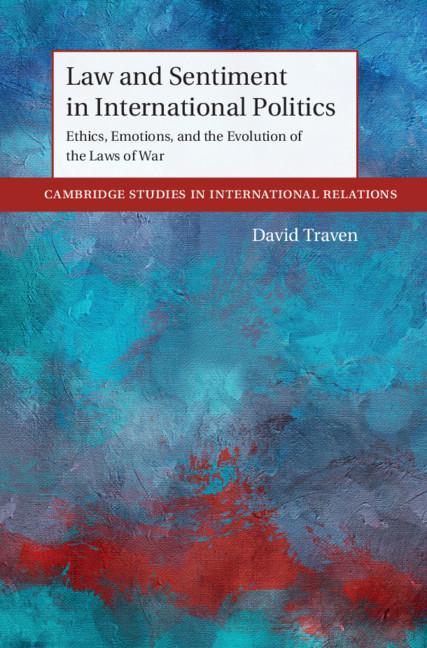
Law and Sentiment in International Politics

-
Select format
-
- Publisher:
- Cambridge University Press
- Publication date:
- 11 June 2021
- 01 July 2021
- ISBN:
- 9781108954280
- 9781108845007
- 9781108949392
- Dimensions:
- (229 x 152 mm)
- Weight & Pages:
- 0.62kg, 328 Pages
- Dimensions:
- (229 x 152 mm)
- Weight & Pages:
- 0.48kg, 328 Pages
You may already have access via personal or institutional login
Show more authors 
You may already have access via personal or institutional login
Book description
Drawing on recent research in moral psychology and neuroscience, this book argues that universal moral beliefs and emotions shaped the evolution of the laws of war, and in particular laws that protect civilians. It argues that civilian protection norms are not just a figment of the modern West, but that these norms were embryonic in earlier societies and civilizations, including Ancient China, early Islam, and medieval Europe. However, despite their ubiquity, this book argues that civilian protection rules are inherently fragile, and that their fragility lies not just in failures of compliance, but also in how moral emotions shaped the design of the law. The same beliefs and emotions that lead people to judge that it is wrong to intentionally target civilians can paradoxically constitute the basis for excusing states for incidental civilian casualties, or collateral damage. To make the laws of war work better for civilians, this book argues that we need to change how we think about the ethics of killing in war.
Reviews
'This book is extraordinarily rich in contributions. Drawing on recent advances in moral psychology, Traven proposes a fresh theory of international norm development. The theoretical analysis and historical case studies are as thorough as they are creative. The book is highly instructive for anyone grappling with the problem of how to constrain warfare!'
Janina Dill - John G. Winant Associate Professor of US Foreign Policy, University of Oxford
'The field of international norms and ethics has been waiting for a book like this, one that expands our historical view of the evolution of morality beyond the West and takes seriously the question of where our moral instincts come from. By showing that human beings do not create notions of right and wrong out of whole cloth and that the West has no monopoly on ideas about ethical conduct in war, Law and Sentiment in International Politics is an important corrective to longstanding but mistaken conventional wisdoms in the field.'
Brian C. Rathbun - Professor of International Relations, University of Southern California, Dornsife
'Why do the laws of armed conflict in ancient China, medieval Islamic states, and modern Western society contain similar prohibitions against the deliberate killing of civilians? In this profound and provocative book, David Traven traces these similarities to a common moral psychology existing in human beings across space and time. Unfortunately, these moral sentiments create inherently fragile rules, often permitting ‘unintentional’ killing, even on a massive scale.'
Scott D. Sagan - Caroline S.G. Munro Professor of Political Science, Stanford University
'The book offers a forensic account of what international law has to say about war, drawing on a detailed reading of national and international legal instruments and dozens of legal cases.'
Alex J. Bellamy Source: International Affairs
Contents
Contents
Metrics
Altmetric attention score
Full text views
Full text views helpTotal number of HTML views: 0
Total number of PDF views: 0 *
 Loading metrics...
* Views captured on Cambridge Core between #date#. This data will be updated every 24 hours.
Usage data cannot currently be displayed.
Accessibility standard: Unknown
Why this information is here
This section outlines the accessibility features of this content - including support for screen readers, full keyboard navigation and high-contrast display options. This may not be relevant for you.
Accessibility Information
Accessibility compliance for the HTML of this book is currently unknown and may be updated in the future.