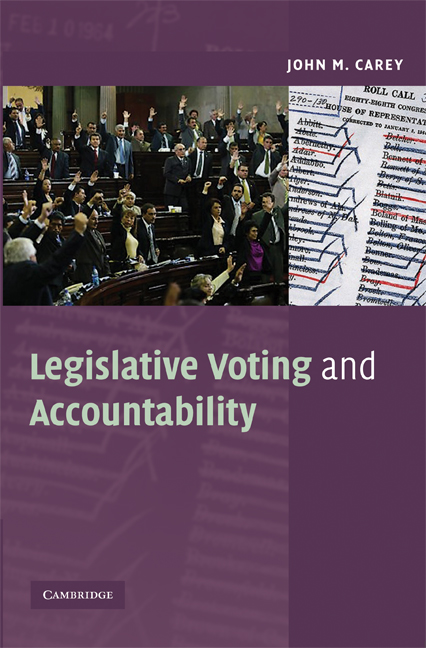
Legislative Voting and Accountability

-
Select format
-
- Publisher:
- Cambridge University Press
- Publication date:
- 05 June 2012
- 15 December 2008
- ISBN:
- 9780511810077
- 9780521884938
- 9780521711913
- Dimensions:
- (228 x 152 mm)
- Weight & Pages:
- 0.42kg, 216 Pages
- Dimensions:
- (228 x 152 mm)
- Weight & Pages:
- 0.3kg, 216 Pages
You may already have access via personal or institutional login
Show more authors 
You may already have access via personal or institutional login
Book description
Legislatures are the core representative institutions in modern democracies. Citizens want legislatures to be decisive, and they want accountability, but they are frequently disillusioned with the representation legislators deliver. Political parties can provide decisiveness in legislatures, and they may provide collective accountability, but citizens and political reformers frequently demand another type of accountability from legislators – at the individual level. Can legislatures provide both kinds of accountability? This book considers what collective and individual accountability require and provides the most extensive cross-national analysis of legislative voting undertaken to date. It illustrates the balance between individualistic and collective representation in democracies, and how party unity in legislative voting shapes that balance. In addition to quantitative analysis of voting patterns, the book draws on extensive field and archival research to provide an extensive assessment of legislative transparency throughout the Americas.
Reviews
'Legislative accountability is a core question in any democratic polity. Carey writes insightfully, analytically, and with technical virtuosity and pertinent evidence, about presidents, parliaments, parties, and politicians, and their complex relationships with voters. He illuminates topics of broad comparative concern and sets a new standard of excellence for the study of legislatures and legislators in Latin American countries.'
Jorge I. Domínguez - Harvard University
'Until now, our understanding of how different democracies work has been based mainly on the analysis of aggregate phenomena, such as how proportional different parliaments are, how many parties different parliaments have, and so on. By analysing individual roll-call votes in 19 countries, this book has changed that. As a result of Carey's analysis, a new research agenda has been launched in comparative political science: on how representative democracy works at a micro-level, inside political parties, inside legislatures, and between voters and their elected representatives.'
Simon Hix - London School of Economics
'Political representation can occur through the actions of individualistic legislators who care little about the desires of party leaders, or it can occur through the actions of cohesive political parties, where individual legislators toe the party line. Legislative voting and accountability is the first study to demonstrate empirically the circumstances under which these two forms of representation occur. It is a path breaking book, one with a compelling story about institutional design that should be read by anyone interested in the comparative study of democracy.'
John Huber - Columbia University
'With his new book, John Carey renews his claim as one of the world's leading authorities in comparative legislative studies. Legislative Voting and Accountability makes a theoretical contribution by carefully examining the tradeoff between collective and individual accountability of legislator to principals. Empirically, Carey presents a wealth of new data about unity in legislative voting in Latin America, and he provides a cogent explanation of cross-national and cross-party differences in unity.'
Scott Mainwaring - Notre Dame University
'This is a wonderful work of great intelligence and originality. Carey investigates public voting or ‘transparency’ in legislative bodies and relates it to political accountability. An obvious contribution to comparative politics, the book is must reading for students of American politics also since it frames U.S. politics in a novel and creative way.'
David Mayhew - Yale University
'Carey's book expands our understanding of democratic representation by probing, both theoretically and empirically, citizens' ability to use legislatures as instruments of accountability. His approach is distinctive in its focus on the actions and votes of individual legislators. Most of his rich evidence comes from Latin American democracies, but anyone interested in representation and accountability will want to read and reflect on this seminalstudy.'
Susan Stokes - Yale University
Contents
Contents
Metrics
Altmetric attention score
Full text views
Full text views helpTotal number of HTML views: 0
Total number of PDF views: 0 *
 Loading metrics...
* Views captured on Cambridge Core between #date#. This data will be updated every 24 hours.
Usage data cannot currently be displayed.
Accessibility standard: Unknown
Why this information is here
This section outlines the accessibility features of this content - including support for screen readers, full keyboard navigation and high-contrast display options. This may not be relevant for you.
Accessibility Information
Accessibility compliance for the PDF of this book is currently unknown and may be updated in the future.