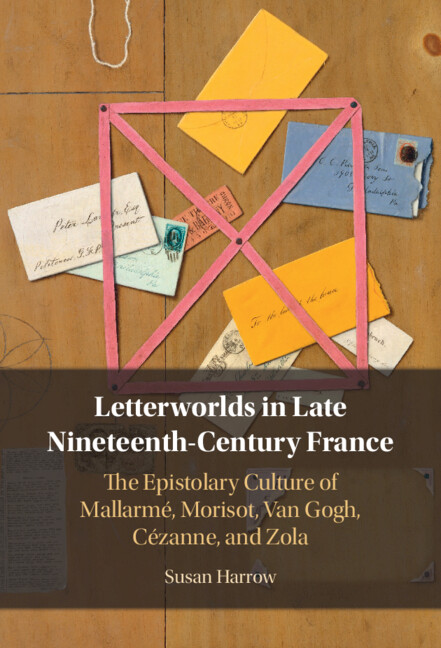
Letterworlds in Late Nineteenth-Century France

-
Select format
-
- Publisher:
- Cambridge University Press
- Publication date:
- 16 October 2025
- 30 October 2025
- ISBN:
- 9781009619028
- 9781009619004
- Dimensions:
- (228 x 152 mm)
- Weight & Pages:
- 0.57kg, 290 Pages
- Dimensions:
- Weight & Pages:
- Subjects:
- Literature, Area Studies, Art, European Literature, European Studies, Western Art
You may already have access via personal or institutional login- Subjects:
- Literature, Area Studies, Art, European Literature, European Studies, Western Art
Show more authors 
You may already have access via personal or institutional login
Book description
Today's world of e-mails, text messages, and social media posts reminds us that letter-writing is an age-old practice that has continually re-invented itself culturally and contextually, connecting individuals and creating communities that may be local or global, personal or public, purposeful or playful, actual or virtual. Yet we have barely begun to explore why letter-writing matters: how it teaches us important lessons, across historical, cultural, and geographical boundaries, about being human. Letterworlds turns to the past – to the late nineteenth century – in order to explore questions of crucial relevance to our present: questions of subjectivity, solitude, and community, physical and mental wellbeing, ethics, and the everyday. Using a fresh holistic and thematic methodology, Susan Harrow examines how such issues suffuse and animate the letter-writing of a group of writers and artists whose contributions are seminal in the development of Western aesthetic modernity: Mallarmé, Morisot, Van Gogh, Cézanne, and Zola.
Reviews
‘Providing a fresh and original discussion of letters by luminaries in late 19th century France, Susan Harrow's Letterworlds is a very good read indeed. Its focus on the mundane as well as the extraordinary, offers fresh insights and contributes in a major way to epistolary theory. A must read for anybody interested in the history and art of letter writing.'
Liz Stanley - Professor Emerita of Sociology, University of Edinburgh
‘This brilliant book on letters of nineteenth century artists and writers reminds us that reading letters provides not only a marvelous glimpse into the intimacy of artists, but has to be seen as a cultural production reflecting on the values, ideas and debates of their time. A wonderful reminder of the importance of correspondence in every sense of the word.'
Florence Fix - Professor of Comparative Literature, Normandie University
Contents
Contents
References
Metrics
Altmetric attention score
Full text views
Full text views helpTotal number of HTML views: 0
Total number of PDF views: 0 *
 Loading metrics...
* Views captured on Cambridge Core between #date#. This data will be updated every 24 hours.
Usage data cannot currently be displayed.
Accessibility standard: WCAG 2.2 AAA
Why this information is here
This section outlines the accessibility features of this content - including support for screen readers, full keyboard navigation and high-contrast display options. This may not be relevant for you.
Accessibility Information
The HTML of this book complies with version 2.2 of the Web Content Accessibility Guidelines (WCAG), offering more comprehensive accessibility measures for a broad range of users and attains the highest (AAA) level of WCAG compliance, optimising the user experience by meeting the most extensive accessibility guidelines.
Content Navigation
Table of contents navigation
Allows you to navigate directly to chapters, sections, or non‐text items through a linked table of contents, reducing the need for extensive scrolling.
Index navigation
Provides an interactive index, letting you go straight to where a term or subject appears in the text without manual searching.
Reading Order and Textual Equivalents
Single logical reading order
You will encounter all content (including footnotes, captions, etc.) in a clear, sequential flow, making it easier to follow with assistive tools like screen readers.
Short alternative textual descriptions
You get concise descriptions (for images, charts, or media clips), ensuring you do not miss crucial information when visual or audio elements are not accessible.
Full alternative textual descriptions
You get more than just short alt text: you have comprehensive text equivalents, transcripts, captions, or audio descriptions for substantial non‐text content, which is especially helpful for complex visuals or multimedia.
Visual Accessibility
Use of colour is not sole means of conveying information
You will still understand key ideas or prompts without relying solely on colour, which is especially helpful if you have colour vision deficiencies.
Use of high contrast between text and background colour
You benefit from high‐contrast text, which improves legibility if you have low vision or if you are reading in less‐than‐ideal lighting conditions.