Skip to main content Accessibility help
×
  • Cited by 1
    • Show more authors
    • Open Access
      You have digital access to this book
    • Select format
    • Publisher:
      Cambridge University Press
      Publication date:
      07 September 2023
      21 September 2023
      ISBN:
      9781009369992
      9781009369985
      Creative Commons:
      Creative Common License - CC Creative Common License - BY Creative Common License - NC
      This content is Open Access and distributed under the terms of the Creative Commons Attribution licence CC-BY-NC 4.0.
      https://creativecommons.org/creativelicenses
      Dimensions:
      (229 x 152 mm)
      Weight & Pages:
      0.47kg, 234 Pages
      Dimensions:
      Weight & Pages:
    Open Access
    You have digital access to this book
    Selected: Digital
    View content
    Add to cart View cart Buy from Cambridge.org

    Book description

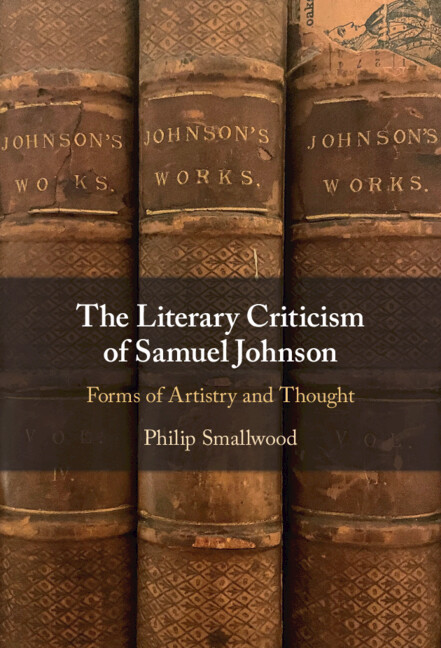
    For Samuel Johnson, poetical judgments were no mere exercise in dry evaluation; rather, they reflected deep emotional responsiveness. In this provocative study, Philip Smallwood argues for experiencing Johnson's critical texts as artworks in their own right. The criticism, he suggests, often springs from emotional sources of great personal intensity and depth, inspiring translation of criticism into poetry and channelling prose's poetic potential. Through consideration of other critics, Smallwood highlights singularities in Johnson's judgments and approach, showing how such judgments are irreducible to philosophical doctrines. 'Ideas', otherwise the material of criticism's propensity to systems and theories, exist for Johnson as feelings that 'slumber in the heart.' Revealing Johnson's humour and intellectual reach, Smallwood frames his criticism in unresolved ironies of time and forms of historical change. This title is part of the Flip it Open Programme and may also be available Open Access. Check our website Cambridge Core for details.

    Awards

    Winner, 2024 Choice Awards

    Reviews

    ‘Philip Smallwood has been writing insightfully and eloquently about Samuel Johnson for thirty years. The Literary Criticism of Samuel Johnson confirms his standing as one of our most authoritative, appealing scholars of Johnson and literature. Drawing on a lifetime of reading and thinking Smallwood sensitively explores the artistic implications and human depths of Johnson's engagement with literature and experience – not only within the parameters of Johnson's critical traditions, both European and Classical, but particularly in his enduring concern with action, love, loss, time, death, compassion, happiness, and beginnings and endings, in which his criticism is rooted. Written with an elegance and honesty commensurate with their subject, these essays cohere to disclose a Johnson whose heart and mind inform a literary personality that continues to challenge us intellectually and to resonate with our emotional needs.'

    Greg Clingham - Professor of English Literature, Bucknell University

    ‘An enquiring defence of Johnson as critic, and of literary criticism as a creative living medium, Philip Smallwood's new book is absorbing, richly informed and beautifully exemplified.'

    Freya Johnston - Professor of English Literature, University of Oxford

    ‘An incisive book about the motives and operations of Samuel Johnson’s literary criticism …’

    Michael Adams Source: Modern Philology

    ‘In a brilliant reconsideration of The literary criticism of Samuel Johnson, Smallwood (Birmingham City Univ., UK) argues that affective response, not rational analysis, drove Johnson’s literary pronouncements. As Smallwood thoroughly demonstrates, lived experience-emotional, relational, philosophical, temporal, editorial-is at the heart of Johnson’s critical enterprise. Johnson’s work on Shakespeare and his Lives of the Poets are particularly important texts in Smallwood’s account, but one of the most interesting aspects of the study is Smallwood’s exploration of conversations (some real, some imagined) between Johnson and a host of other writers, from poet David Ferry to Thomas Warton to Montaigne to F. R. Leavis. Johnson’s literary criticism, Smallwood demonstrates, everywhere evidences his experience of compassion and emotion, time and duration, immersion in the vicissitudes of life and awareness of the inevitability of death. Smallwood’s book does full justice to Johnson’s critical acumen; it (perhaps more importantly) exemplifies literary criticism as a creative, deeply human enterprise.’

    Elizabeth Kraft Source: Choice

    ‘The book makes a compelling argument for the ongoing value of Johnson’s criticism. Although Smallwood’s insistence on the links between the text and the sensibility that informs its creation runs counter to much recent critical theory, nonetheless he illustrates his argument persuasively by judicious use of supporting evidence and the pertinent enlistment of writers not often associated with Johnson, from Montaigne to Bergson and Wittgenstein, to elicit underlying continuities. By so doing, Smallwood shows that the ideas that obsessed Johnson were also important to other writers and thinkers throughout history. He was, accordingly, a very different writer from the one that he has been traditionally taken to be. Johnson challenges us because of this difference, and Smallwood’s book is to be praised for demonstrating it.’

    Phil Jones Source: The Scriblerian and the Kit-Cats

    ‘A sympathetic and illuminating critical appreciation that situates Johnson the man and the writer at the intersection of autobiography, biography, and criticism. As Smallwood shows, Johnson’s lived experience, his emotional experience in particular, gives shape to his biographical insights and exerts a powerful formative influence on the critical precepts by which he judged and evaluated the literary work of his fellow writers. Smallwood’s key recognition, that ‘the heart’s role as a principle of judgment is primary’ for Johnson, has resulted in a book that enables us to value anew the deep humanity of Johnson’s critical and moral judgments.’

    Frans De Bruyn Source: Johnsonian News Letter
    Refine List

    Actions for selected content:

    Select all | Deselect all
    • View selected items
    • Export citations
    • Download PDF (zip)
    • Save to Kindle
    • Save to Dropbox
    • Save to Google Drive

    Save Search

    You can save your searches here and later view and run them again in "My saved searches".

    Please provide a title, maximum of 40 characters.
    ×

    Contents

    Full book PDF
    • The Literary Criticism of Samuel Johnson
      pp i-ii
    • The Literary Criticism of Samuel Johnson - Title page
      pp iii-iii
    • Forms of Artistry and Thought
    • Copyright page
      pp iv-iv
    • Dedication
      pp v-v
    • Epigraph
      pp vi-vi
    • Contents
      pp vii-viii
    • Preface
      pp ix-x
    • Acknowledgments
      pp xi-xii
    • Abbreviations
      pp xiii-xiv
    • Introduction
      pp 1-14
    • The Criteria of the Heart
    • Part I - Johnson’s Criticism and the Forms of Feeling
      pp 15-52
    • Chapter 1 - Johnson’s Compassion
      pp 17-33
    • Chapter 2 - “The tears stand in my eyes”
      pp 34-52
    • Johnson and Emotion
    • Part II - Critical Relations and the Art of Literary History
      pp 53-90
    • Chapter 3 - Petty Caviller or “Formidable Assailant”
      pp 55-74
    • Johnson Reads Dennis
    • Chapter 4 - Readers Curious and Common
      pp 75-90
    • Johnson, Thomas Warton and Historical Form
    • Part III - Johnson, Dramatic Poetry and Thinking
      pp 91-126
    • Chapter 5 - Shakespeare, Johnson and Philosophy
      pp 93-110
    • Chapter 6 - Two Ways of Being Wise
      pp 111-126
    • Johnson, Philosophy and Montaigne
    • Part IV - Time, Truth and History
      pp 127-156
    • Chapter 7 - Johnson and Time
      pp 129-142
    • Chapter 8 - Truth, Fiction and “Undisputed History”
      pp 143-156
    • Part V - Editing Lives, and Life
      pp 157-188
    • Chapter 9 - Annotated Immortality
      pp 159-173
    • Chapter 10 - Arts of Structure and the Rhythm of the Lives
      pp 174-188
    • Appendix - Irony in Revolt: F. R. Leavis Reads Johnson
      pp 189-198
    • Bibliography
      pp 199-212
    • Index
      pp 213-220

    Metrics

    Altmetric attention score

    Full text views

    Total number of HTML views: 0
    Total number of PDF views: 0 *
    Loading metrics...

    Book summary page views

    Total views: 0 *
    Loading metrics...

    * Views captured on Cambridge Core between #date#. This data will be updated every 24 hours.

    Usage data cannot currently be displayed.

    Accessibility standard: Unknown

    Why this information is here

    This section outlines the accessibility features of this content - including support for screen readers, full keyboard navigation and high-contrast display options. This may not be relevant for you.

    Accessibility Information

    Accessibility compliance for the HTML of this book is currently unknown and may be updated in the future.

