The Logic of Precedent
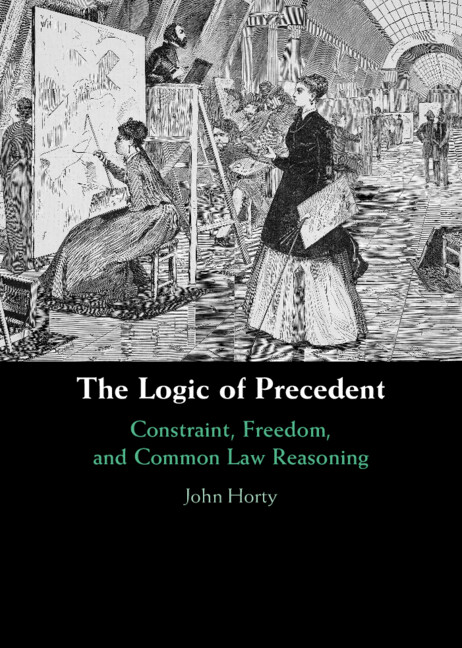

-
Select format
-
- Publisher:
- Cambridge University Press
- Publication date:
- 16 January 2025
- 27 February 2025
- ISBN:
- 9781009356480
- 9781009356503
- Dimensions:
- (228 x 152 mm)
- Weight & Pages:
- 0.64kg, 276 Pages
- Dimensions:
- Weight & Pages:
- Subjects:
- Logic, Legal Philosophy, Philosophy
You may already have access via personal or institutional login- Subjects:
- Logic, Legal Philosophy, Philosophy
Show more authors 
You may already have access via personal or institutional login
Book description
Unlike statutory law, which relies on the explicit formulation of rules, common law is thought to emerge from a complex doctrine of precedential constraint, according to which decisions in earlier cases constrain later courts while still allowing these courts the freedom to address new situations in creative ways. Although this doctrine is applied by legal practitioners on a daily basis, it has proved to be considerably more difficult to develop an adequate theoretical account of the doctrine itself. Drawing on recent work in legal theory, as well as AI and law, this book develops a new account of precedential constraint and the balance achieved in the common law between constraint and freedom. This account, which involves construction of a group priority ordering among reasons, is then applied to other topics including the semantics of open-textured predicates and the practice of making exceptions to general rules.
Reviews
‘Just as it is obvious that rule-based reasoning can be formalized, so it seemed obvious that common law, or case-based, reasoning, would resist rigorous formalization. Yet this extraordinary book, which builds on Horty's previous work, provides a precise formal treatment of case-based reasoning in terms of relations among reasons, with rich conceptual payoffs.’
Sarah Lawsky - Northwestern University
‘Deeply informed by a leading understanding of existing work in legal theory as well as in logic and artificial intelligence - a really impressive intellectual and scholarly accomplishment as well as an achievement in logic and philosophy.’
Mark Schroeder - University of Southern California
Contents
Contents
Metrics
Altmetric attention score
Full text views
Full text views helpTotal number of HTML views: 0
Total number of PDF views: 0 *
 Loading metrics...
* Views captured on Cambridge Core between #date#. This data will be updated every 24 hours.
Usage data cannot currently be displayed.
Accessibility standard: Unknown
Why this information is here
This section outlines the accessibility features of this content - including support for screen readers, full keyboard navigation and high-contrast display options. This may not be relevant for you.
Accessibility Information
Accessibility compliance for the PDF of this book is currently unknown and may be updated in the future.