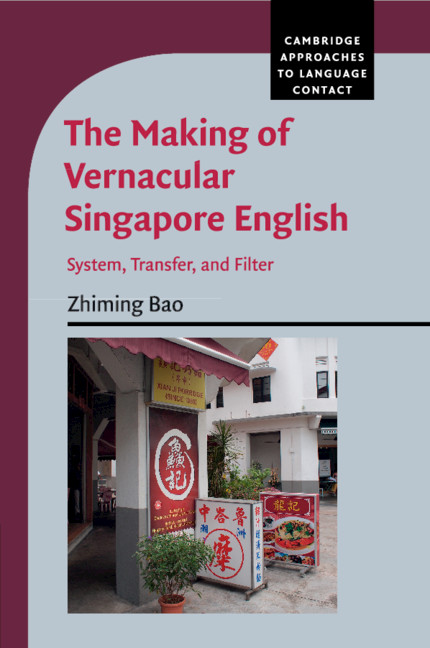
The Making of Vernacular Singapore English

-
Select format
-
- Publisher:
- Cambridge University Press
- Publication date:
- 05 November 2015
- 14 August 2015
- ISBN:
- 9781139135375
- 9781107022089
- 9781108731669
- Dimensions:
- (228 x 152 mm)
- Weight & Pages:
- 0.5kg, 232 Pages
- Dimensions:
- (229 x 152 mm)
- Weight & Pages:
- 0.25kg, 232 Pages
You may already have access via personal or institutional login
Show more authors 
You may already have access via personal or institutional login
Book description
Singapore English is a focal point across the many subfields of linguistics, as its semantic, syntactic and phonetic/phonological qualities tell us a great deal about what happens when very different types of language come together. Sociolinguists are also interested in the relative status of Singapore English compared to other languages in the country. This book charts the history of Singapore English and explores the linguistic, historical and social factors that have influenced the variety as it is spoken today. It identifies novel grammatical features of the language, discusses their structure and function, and traces their origins to the local languages of Singapore. It places grammatical system and usage at the core of the analysis, and shows that introspective and corpus data are complementary. This study will be of interest to scholars and advanced students working on language contact, world varieties of English, historical linguistics and sociolinguistics.
Reviews
‘Bao offers a nuanced and novel take on the role of Chinese grammar in the formation of Singapore English. He clearly shows that this continuously evolving language holds important lessons for our understanding of language creation and New English varieties.'
Umberto Ansaldo - University of Hong Kong
‘Superstrate filter guides selection from systemic substrate transfer in emergent ‘Singlish': Bao's brilliant, theoretically ambitious analysis represents cutting-edge thinking uniting contact theory, usage-based linguistics, exemplar theory, typology, and construction grammar.'
Edgar W. Schneider - Universität Regensburg, Germany
Contents
Contents
Metrics
Altmetric attention score
Full text views
Full text views helpTotal number of HTML views: 0
Total number of PDF views: 0 *
 Loading metrics...
* Views captured on Cambridge Core between #date#. This data will be updated every 24 hours.
Usage data cannot currently be displayed.
Accessibility standard: Unknown
Why this information is here
This section outlines the accessibility features of this content - including support for screen readers, full keyboard navigation and high-contrast display options. This may not be relevant for you.
Accessibility Information
Accessibility compliance for the HTML of this book is currently unknown and may be updated in the future.