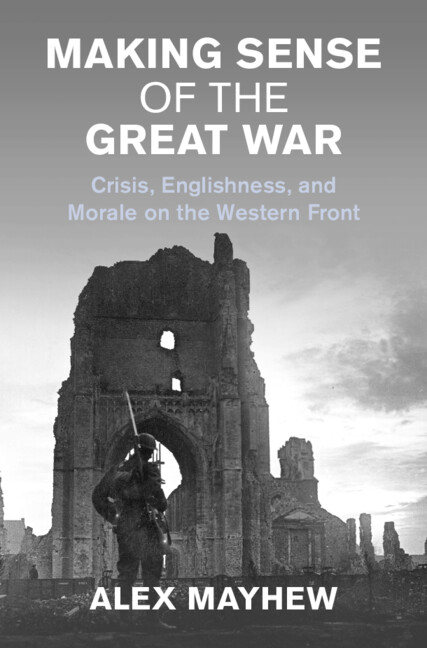

The First World War was an unprecedented crisis, with communities and societies enduring the unimaginable hardships of a prolonged conflict on an industrial scale. In Belgium and France, the terrible capacity of modern weaponry destroyed the natural world and exposed previously held truths about military morale and tactics as falsehoods. Hundreds of thousands of soldiers suffered some of the worst conditions that combatants have ever faced. How did they survive? What did it mean to them? How did they perceive these events? Whilst the trenches of the Western Front have come to symbolise the futility and hopelessness of the Great War, Alex Mayhew shows that English infantrymen rarely interpreted their experiences in this way. They sought to survive, navigated the crises that confronted them, and crafted meaningful narratives about their service. Making Sense of the Great War reveals the mechanisms that allowed them to do so.
Honourable Mention, 2025 Tomlinson Prize, Western Front Association
‘An outstanding book from one of the best of a new generation of First World War historians which sheds fresh light on how men survived and endured the horrors of modern war on the Western Front.’
Jonathan Boff - Professor of Military History, University of Birmingham
‘Within the undeniable horrors of life on the Western Front in the First World War lies a crucial question: how did men endure? Alex Mayhew offers a thoroughly researched and compelling insight into the world of combatant sense-making and survival. An impressive interdisciplinary history, it is essential reading for anyone wanting to understand what enabled men to keep going.’
Catriona Pennell - Professor of Modern History and Memory Studies, University of Exeter
‘Alex Mayhew meticulously reconstructs the distinctively English experience of the western front, comparing it with other armies and showing its deep foundations. A brilliant contribution to the cultural history of the Great War, his book also casts light on human endurance in general.’
John Horne - Fellow Emeritus, Trinity College Dublin
‘Well-researched and ably written, this book represents a useful contribution to the literature of World War I. It underscores for readers and historians the relationships between crisis and morale - and the complex ways in which perception and perspective help shape events.’
Nicholas Sambaluk Source: Journal of Military History
‘Making Sense of the Great War offers insights to scholars and could also be used well in the classroom. It is highly readable … this book is a fresh look at … familiar ground and a welcome addition to the conversation surrounding morale.’
Elizabeth Stice Source: First World War Studies
‘The book is well researched, accessible and scholarly. Its conclusions are provocative … it is a major contribution and deserves to stand in the canon … as a ‘standard work’ on the morale of the British soldier in the Great War.’
Tom Thorpe Source: Stand To! – the journal of the Western Front Association
‘Mayhew’s analysis paints a rich picture of the various ways in which men made sense of the war … Making Sense of the Great War offers points of reflections not just for the historian, but also for scholars of psychology, sociology, and military processes.’
James Sewry Source: LSE Review of Books
‘This is a sophisticated and elaborate study of mental survival and fortitude among a discrete group of men in an immeasurably challenging time and place. As such, it adds greatly to the military history of morale during the First World War, offering new insights into Englishness, subjecthood and the belief systems men were fighting for during this fraught and terrifying time.’
Nicoletta Gullace Source: The English Historical Review
’This fine monograph … both advances our understanding of morale and highlights the fundamental difficulties which remain at the heart of this endeavour.’
Vanda Wilcox Source: War in History
Loading metrics...
* Views captured on Cambridge Core between #date#. This data will be updated every 24 hours.
Usage data cannot currently be displayed.
This section outlines the accessibility features of this content - including support for screen readers, full keyboard navigation and high-contrast display options. This may not be relevant for you.
Accessibility compliance for the HTML of this book is currently unknown and may be updated in the future.
