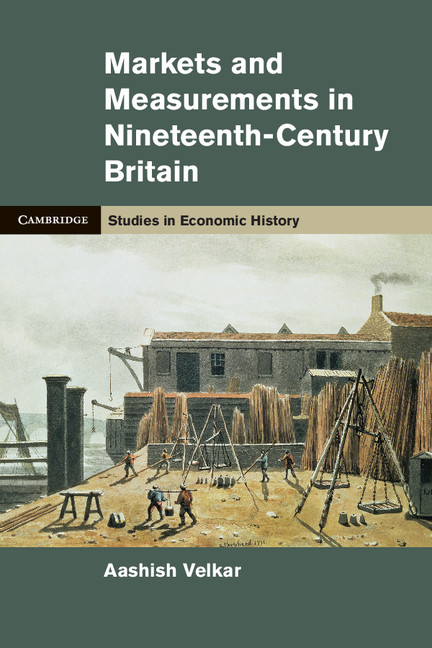
Markets and Measurements in Nineteenth-Century Britain

-
Select format
-
- Publisher:
- Cambridge University Press
- Publication date:
- 05 July 2012
- 25 June 2012
- ISBN:
- 9781139151030
- 9781107023338
- Dimensions:
- (228 x 152 mm)
- Weight & Pages:
- 0.52kg, 274 Pages
- Dimensions:
- Weight & Pages:
You may already have access via personal or institutional login- Subjects:
- History, Regional History after 1500, Economic History
Show more authors 
You may already have access via personal or institutional login
Book description
Measurements are a central institutional component of markets and economic exchange. By the nineteenth century, the measurement system in Britain was desperately in need of revision: a multiplicity of measurement standards, proliferation of local or regional weights and measures, and a confusing array of measurement practices made everyday measurements unreliable. Aashish Velkar uncovers how metrology and economic logic alone failed to make 'measurements' reliable, and discusses the importance of localised practices in shaping trust in them. Markets and Measurements in Nineteenth-Century Britain steers away from the traditional explanations of measurement reliability based on the standardisation and centralisation of metrology; the focus is on changing measurement practices in local economic contexts. Detailed case studies from the industrial revolution suggest that such practices were path-dependent and 'anthropocentric'. Therefore, whilst standardised metrology may have improved precision, it was localised practices that determined the reliability and trustworthiness of measurements in economic contexts.
Contents
Contents
References
Bibliography
., ‘Industrial standardization’, Annals of the American Academy of Political and Social Science 82 No 1 (1919): 289–99.
., ‘The British metrological standardization debate, 1756–1824: The importance of parliamentary sources in its reassessment’, Parliamentary History 22 No 2 (2003): 165–82.
., ‘Brass and brass manufactures’, in (ed.), The resources, products and industrial history of Birmingham and the Midland hardware district (London, Robert Hardwicke, 1866).
, Conceiving companies: joint-stock politics in Victorian England (London, Routledge, 1998).
., ‘A revolution to measure: the political economy of the metric system in the ancien régime’, in (ed.), The values of precision (Princeton, Princeton University Press, 1995).
., ‘Innovation and amnesia: engineering rationality and the fate of interchangeable parts manufacturing in France’, Technology and Culture 38 No 2 (1997): 273–311.
., ‘Making things the same: representation, tolerance and the end of the ancien régime in France’, Social Studies of Science 28 No 4 (1998): 499–545.
, The measure of all things: the seven-year odyssey and hidden error that transformed the world (New York, Free Press, 2003).
., ‘International competition in iron and steel, 1850–1913’, Journal of Economic History 39 No 4 (1979): 911–37.
. ‘An account of a comparison lately made by some gentlemen of the Royal Society, of the standard of a yard, and the several weights lately made for their use; with the original standards of measures and weights in The Exchequer, and some others kept for public use, at Guild-Hall, Founders-Hall, The Tower, &c’, Philosophical Transactions 42 (1742): 541–56.
., ‘Localized technological change and the evolution of standards as economic institutions’, Information Economics and Policy 6 Nos 3–4 (1994): 195–216.
., ‘Competing technologies, increasing returns, and lock-in by historical events’, Economic Journal 99 No 394 (1989): 116–31.
., and ., ‘Distributed cognition in an emergency co-ordination centre’, Cognition, Technology and Work 1 (1999): 237–46.
, and , The coal industry of the eighteenth century (Manchester, Manchester University Press, 1929).
., ‘The calculating eye: Baily, Herschel, Babbage and the business of astronomy’, British Journal for the History of Science 27 No 4 (1994): 409–41.
, Customs and excise: trade, production, and consumption in England, 1640–1845 (Oxford, Oxford University Press, 2003).
, The rise and fall of freedom of contract (Oxford, Clarendon Press, 1979).
, Sir Joseph Whitworth: ‘the world's best mechanician’ (Gloucestershire, Sutton, 1996).
., and ., ‘Strategies of European standardization’, Journal of European Public Policy 8 No 3 (2001): 411–31.
., ., ., ., and ., ‘Coalition formation in standard-setting alliances’, Management Science 41 No 9 (1995): 1493–1508.
, The Railway Clearing House in the British economy 1842–1922 (London, Allen and Unwin, 1968).
., ‘The marketing of corn in the first half of the eighteenth century: north-east Kent’, Agricultural History Review 18 No 2 (1970): 126–50.
, The farmer and corn-dealer's assistant; or, the knowledge of weights and measures made easy, by a variety of tables, etc. (Stirling, 1780).
., ‘The operation of sand clocks and their medieval development’, Technology and Culture 19 No 4 (1978): 615–32.
, and , Weights and measures standards of the United States: a brief history (Washington, DC, US Department of Commerce, National Bureau of Standards, 1976).
., ‘The history of measurement and the engineers of space’, British Journal for the History of Science 26 No 4 (1993): 459–68.
, The Baltic story: Baltic coffee house to Baltic Exchange, 1744–1994 (London, Quiller Press, 1994).
., ‘Measurement cost and the organization of markets’, Journal of Law and Economics 25 No 1 (1982): 27–48.
, The iron trade of United Kingdom (London, British Iron Trade Association, 1886).
, , and , A fighting trade: rail transport in Tyne coal, 1600–1800 (Gateshead, County Durham, Portcullis, 1990).
., ‘From imitation to invention: creating commodities in eighteenth-century Britain’, Economic History Review 55 No 1 (2002): 1–30.
., ‘The production of compatibility: technical standards as collective goods’, Kyklos 42 No 3 (1989): 361–83.
., and ., ‘Choosing how to compete: strategies and tactics in standardization’, Journal of Economic Perspectives 8 No 2 (1994): 117–31.
., ‘A statistical crime of the seventeenth century’, Journal of Economic and Business History 1 No 4 (1929): 503–33.
, Prices and wages in England: from the twelfth to the nineteenth century, Vol. 1 (London, Longmans, Green, 1939).
., ‘A tale untangled: measuring the fineness of yarn’, Textile History 35 No 1 (2004): 120–29.
, Copper wire and electrical conductors – the shaping of a technology (Reading, Harwood Academic, 1992).
(ed.), Measurement in economics: a handbook (London, Elsevier, 2007).
, The economics of quality, grades and brands (London, Routledge, 1992).
., ., and ., ‘The emergence of discounted cash flow analysis in the Tyneside coal industry c1700–1820’, British Accounting Review 33 No 2 (2001): 137–55.
, and , Corn trade memories: recent and remote (Liverpool, Northern, 1930).
., and ., ‘The contemporary expansion of standardisation’, in and (eds), A world of standards (Oxford, Oxford University Press, 2000).
, Drawn together: one hundred and fifty years of wire workers’ trade unionism (Wigan, Wire Workers Section of the Iron and Steel Trades Confederation, 1992).
., ‘“Crooks, thieves and receivers”: transaction costs in nineteenth-century industrial Birmingham’, Economic History Review 57 No 3 (2004): 533–50.
, Inventing temperature: measurement and scientific progress (New York, Oxford University Press, 2004).
, ‘Arbitration in the foreign corn trade in London’, Economic Journal 17 No 67 (1907): 428–31.
, A new discourse on trade (Glasgow, 1751).
., ‘On the Birmingham wire gauge (paper presented to the British Association in 1867)’, Journal of the Society of Telegraph Engineers 7 (1878): 332–35.
., ‘On the Birmingham wire gauge (paper presented to the British Association in 1869)’, Journal of the Society of Telegraph Engineers 7 (1878): 336–44.
, The weights and measures of England (London, HMSO, 1987).
., ‘Nuclear power reactors: a study in technological lock-in’, Journal of Economic History 50 No 3 (1990): 541–67.
., ‘Relation of the price and quality of cotton’, Journal of Farm Economics 11 No 4 (1929): 542–49.
., ‘The metric system: a quarter-century of acceptance (1851–1876)’, Osiris 13 (1958).
, ‘The coal industry on Tyneside 1771–1800: oligopoly and spatial change’, Economic Geography 53 No 1 (1977): 79–94.
, Cargo handling at ports: a survey of the various systems in vogue, with a consideration of their respective merits (London, Chapman and Hall, 1923).
., ‘From the moral thermometer to money: metrological reform in pre-confederation Canada’, Social Studies of Science 28 No 4 (1998): 547–70.
., ., and ., ‘Strategic maneuvering and mass-market dynamics: the triumph of VHS over beta’, Business History Review 66 No 1 (1992): 51–94.
, The fellowship of woodmongers: six centuries of the London coal trade (London, repr. from the Coal Merchant and Shipper, 1923).
, Peter Stubs and the Lancashire hand tool industry (Altrincham, John Sherratt, 1973).
, On coal – with reference to its screening, transport, etc. (London, W. H. Allen, 1872).
., ‘The material politics of natural monopoly: consuming gas in Victorian Britain’, in and (eds), The politics of consumption: material culture and citizenship in Europe and America (Oxford, Berg, 2001).
, Progress and poverty: an economic and social history of Britain 1700–1850 (Oxford, Oxford University Press, 1995).
, and (eds), The politics of consumption: material culture and citizenship in Europe and America (Oxford, Berg, 2001).
, ‘Clio and the economics of QWERTY’, American Economic Review 75 No 2 (1985): 332–37.
., and , ‘The economics of compatibility standards: an introduction to recent research’, Economics of Innovation and New Technology 1 Nos 1 and 2 (1990): 3–41.
, ‘Small farm production and the standardization of tropical products’, Journal of Agrarian Change 2 No 2 (2002): 162–84.
, ‘Baking for the common good: a reassessment of the assize of bread in medieval England’, Economic History Review 57 No 3 (2004): 465–502.
, and , British economic growth: 1688–1959 – trends and structures (Cambridge, Cambridge University Press, 1962).
. (ed.), Records of the company of hostmen of Newcastle-upon-Tyne (Durham, Surtees Society, 1901).
., and ., ‘Shared mental models: ideologies and institutions’, Kyklos 47 No 1 (1994): 3–31.
., ‘How real are statistics? Four possible attitudes’, Social Research 68 No 2 (2001): 339–55.
., and ., ‘Origin of gauges for wire, sheets and strip’, Transactions of the Newcomen Society 21 (1943): 87–98.
., ‘The north-east coal trade, 1550–1750: measures, markets and the metropolis’, Northern History 22 (1986): 280–94.
., and ., ‘Radical innovation as a multilevel process: introducing floating grain elevators in the Port of Rotterdam’, Technology and Culture 46 No 1 (2005): 51–76.
., ‘Early Liverpool cotton imports and the organization of the cotton market in the eighteenth century’, Economic Journal 33 No 131 (1923): 362–73.
., ‘The sale of corn in the nineteenth century’, Economic Journal 35 No 137 (1925): 141–45.
., and ., ‘Invention and innovation in the British pin industry, 1790–1850’, Business History Review 57 No 2 (1983): 175–93.
, Essay on the coal trade (London, 1803).
, Basic concepts of measurements (Cambridge, Cambridge University Press, 1966).
, The cotton trade of Great Britain: including a history of the Liverpool cotton market and of the Liverpool cotton brokers’ association (London, E. Wilson, 1886).
., ‘Should competition policy favour compatibility?’, in and (eds), Standards and public policy (Cambridge, Cambridge University Press, 2007).
, and , ‘Coordination through committees and markets’, RAND Journal of Economics 19 No 2 (1988): 235–52.
., and ., ‘Installed base and compatibility: innovation, product preannouncements, and predation’, American Economic Review 76 No 5 (1986): 940–55.
, and , ‘Standard setting in high-definition television’, Brookings Papers on Economic Activity. Microeconomics 1992 (1992): 1–93.
, ., and ., ‘Where do markets come from? From (quality) conventions!’ in and (eds), Conventions and structures in economic organization (Cheltenham, Edward Elgar, 2002).
., ‘The London corn market at the beginning of the nineteenth century’, American Economic Review 15 No 1 (1925): 70–76.
., ‘The sale of corn in the nineteenth century’, Economic Journal 34 No 134 (1924): 211–18.
., ‘Integration of trade and disintegration of production in the global economy’, Journal of Economic Perspectives 12 No 4 (1998): 31–50.
., ‘Pessimism perpetuated: real wages and the standard of living in Britain during and after the Industrial Revolution’, Journal of Economic History 58 No 3 (1998): 625–58.
, ‘The adjudication of commercial disputes and the legal system in modern England’, British Journal of Law and Society 7 No 2 (1980): 141–57.
., ‘The development of the London food market, 1540–1640’, Economic History Review 5 No 2 (1935): 46–64.
, and ., ‘Coals from Newcastle: an evaluation of alternative frameworks for interpreting the development of cost and management accounting in Northeast coal mining during the British Industrial Revolution’, Accounting and Business Research 32 No 3 (2002): 133–52.
, The history of the British coal industry, Vol. 2, 1700–1830 (Oxford, Clarendon Press, 1984).
., ‘The adolescence of American engineering competition, 1860–1900’, Economic History Review 27 No 1 (1974): 57–71.
., ‘Users, standards and the economics of coalitions and committees’, Information Economics and Policy 6 Nos 3–4 (1994): 269–93.
, A hundred years of Ceylon tea: 1867–1967 (London, Chatto and Windus, 1967).
, ‘Commodity exchanges in England’, Annals of the American Academy of Political and Social Science 155 No 1 (1931): 196–207.
, , and (eds), The quantifying spirit in the 18th century (Berkeley, University of California Press, 1990).
, Protection and politics: conservative economic discourse 1815–1852 (London, Royal Historical Society, 1999).
, Cotton goes to market: a graphic description of a great industry (New York, Frederick A. Stokes, 1935).
., ‘The organization of buyer-driven global commodity chains: how US retailers shape overseas production networks’, in and (eds), Commodity chains and global capitalism (Westport, Praeger, 1994).
., ., and ., ‘The governance of global value chains’, Review of International Political Economy 12 No 1 (2005): 78–104.
, The morals of measurement: accuracy, irony and trust in late Victorian electrical practice (Cambridge, Cambridge University Press, 2004).
., ‘Who turned the mechanical ideal into mechanical reality?’, Technology and Culture 29 No 4 (1988): 744–78.
, and (eds), Standards and public policy (Cambridge, Cambridge University Press, 2007).
., ‘The fundamental problem of exchange: a research agenda in historical institutional analysis’, European Review of Economic History 4 No 3 (2000): 251–84.
., ., and ., ‘Coordination, commitment, and enforcement: the case of the merchant guild’, Journal of Political Economy 102 No 4 (1994): 745–76.
., ‘The emergence of the Liverpool raw cotton market, 1800–1850’, Northern History 38 No 1 (2001): 65–81.
., ‘Remarks on the coal trade’, Transactions of the North of England Institute of Mining and Mechanical Engineers II (1853–1854): 104–236.
, Organizing international standardization: ISO and the IASC in quest in authority (Cheltenham,Edward Elgar, 2004).
., ‘Coal exports and British shipping, 1850–1913’, Explorations in Economic History 26 No 3 (1989): 311–38.
., ‘Ocean freight rates and productivity, 1740–1913: the primacy of mechanical invention reaffirmed’, Journal of Economic History 48 No 4 (1988): 851–76.
., ‘Agricultural weights and measures’, in (ed.), The agrarian history of England and Wales, Vol. VII, 1640–1750 (agrarian change) (Cambridge, Cambridge University Press, 1985).
, The history of the British coal industry, Vol. 1, Before 1700 (Oxford, Clarendon Press, 1993).
., ‘Cheap coals or limitation of the vend? London coal trade, 1770–1845’, Journal of Economic History 44 No 2 (1984): 321–28.
., ‘The English coastal coal trade, 1691–1910: how rapid was productivity growth?’, Economic History Review 40 No 4 (1987): 588–96.
., ‘Market power in London coal trade: the limitation of the vend, 1770–1845’, Explorations in Economic History 21 No 4 (1984): 383–405.
., ‘Private regulation of food safety by supermarkets’, Law and Policy 28 No 4 (2006): 515–33.
., ‘Introductory essay’, in , and (eds), The quantifying spirit in the 18th century (Berkeley, University of California Press, 1990).
., ‘The measure of enlightenment’, in , and (eds), The quantifying spirit in the 18th century (Berkeley, University of California Press, 1990).
., ., and ., ‘Standards as institutions: problems with creating all-European standards for terminal equipment’, in , and (eds), On economic institutions: Theory and applications (Cheltenham, Edward Elgar, 1995).
., and ., ‘Understanding the complexities of private standards in global agri-food chains’, paper presented at International Workshop on Globalization, Global Governance and Private Standards, Leuven (2008).
., and ., ‘Private agri-food standards: implications for food policy and the agri-food system’, Food Policy 30 No 3 (2005): 241–53.
, The corn dealer's assistant (London, 1736).
., and ., ‘Standardization, globalization and rationalities of government’, Organization 14 No 5 (2007): 685–704.
, Grain, grades and standards: historical issues shaping the future (Urbana, University of Illinois Press, 1990).
, A series of mercantile letters, with the weights, measures and monies reduced into the English Standard, etc. (London, 1815).
, Turning and mechanical manipulation, Vol. 2 (London, Holtzapffel, 1847).
, ‘Income, welfare and the Industrial Revolution in Britain’, Historical Journal 31 No 3 (1988): 721–31.
., ‘Reforming Britain's weights and measures, 1660–1824’, English Historical Review 108 No 426 (1993): 82–104.
., ‘The rise of legal formalism’, American Journal of Legal History 19 No 4 (1975): 251–64.
, From the American system to mass production 1800–1932: the development of manufacturing technology in the United States (Baltimore, Johns Hopkins University Press, 1984).
, The English wire gauge (London, E. and F. N. Spon, 1879).
., ‘Doing science in a global empire: cable telegraphy and electrical physics in Victorian Britain’, in (ed.), Victorian science in context (Chicago, University of Chicago Press, 1997).
., ‘The ohm is where the art is: British telegraph engineers and development of electrical standards’, Osiris 9 (1994): 48–63.
., ‘Concept of a national measurement system’, Science 158 No 3797 (1967): 67–71.
, Cognition in the wild (Cambridge, MA, MIT Press, 1996).
., ., and ., ‘Benefitting from innovation: value creation, value appropriation and the role of industry architectures’, Research Policy 35 (2006): 1200–1221.
., ‘Competition and the size of firms in the north-east coal trade, 1800–1850’, Northern History 25 (1989): 235–55.
, and , The technology of bread-making (London, Kent, 1911).
, Rylands of Warrington: 1805–1955 (London, Harley, 1956).
, General view of the agriculture of the county of Lancaster…(David and Charles, 1795; repr. Newton Abbot Devon, 1969).
., ‘Market disciplines’, in (ed.), Liberty and authority in Victorian Britain (Oxford, Oxford University Press, 2006).
., ‘From eye to machine: shifting authority in colour measurement’, in and (eds), Theories, technologies and instrumentalities of colour (Lanham, Maryland,University Press of America, 2002).
., ‘The role of information in US grain and oilseed markets’, Review of Agricultural Economics 21 No 1 (1999): 237–55.
, The millers: a story of technological endeavour and industrial success, 1870–2001 (Lancaster, Carnegie, 2001).
., ‘Price associations and competition in the British pin industry, 1814–40’, Economic History Review 26 No 2 (1973): 236–53.
, Provisioning Paris: merchants and millers in the grain and flour trade during the eighteenth century (Ithaca, Cornell University Press, 1984).
., and ., ‘Network externalities, competition and compatibility’, American Economic Review 75 No 3 (1985): 424–40.
, Metrology; or an exposition of weights and measures chiefly those of Great Britain and France…(London, 1816).
, Vestiges of pre-metric weights and measures persisting in metric-system Europe 1926–1927 (New York, Macmillan, 1928).
, ‘Capital investment in docks, harbours, and river improvements in north-eastern England 1825–1850’, Journal of Transport History 1 No 2 (1971): 69–84.
, Joseph Whitworth: toolmaker (Cromford, Derbyshire, Scarthin Books, 1987).
., ‘Standards as public, collective and private goods’, Kyklos 36 No 3 (1983): 377–96.
., ‘Measurements and managerial decisions’, in and (eds), Measurement: definition and theories (New York, John Wiley, 1959).
., ‘The relative prices of wheat and bread’, Economic Journal 6 No 23 (1896): 475–84.
., and ., ‘Fundamental standards and time consistency’, Kyklos 46 No 4 (1993): 545–68.
., and ., ‘Entry, standards and competition: firm strategies and the diffusion of mobile telephony’, Review of Industrial Organization 26 (2005): 89–113.
, Measures and men, R. Szreter (trans.) (Princeton, Princeton University Press, 1986).
., ‘The development of the wire-drawing industry’, Metallurgist 3 No 6 (1959): 267–70.
, ‘Watchmaking: a case study in enterprise and change’, Business History Review 53 No 1 (1979): 1–39.
., ‘Competition through institutional form: the case of cluster tools standards’, in and (eds), Standards and public policy (Cambridge, Cambridge University Press, 2007).
, ‘The Industrial Revolution and the regional geography of England’, Transactions of the Institute of British Geographers 9 No 2 (1984): 145–67.
, Science in action: how to follow scientists and engineers through society (Cambridge, MA, Harvard University Press, 1987).
., ‘The free trade epidemic of the 1860s and other outbreaks of economic discrimination’, World Politics 51 No 4 (1999): 447–83.
., ‘Wire drawing and steel wire, and its uses’, in (ed.), The resources, products and industrial history of Birmingham and the Midland hardware district (London, Robert Hardwicke, 1866).
., ‘Packaging small facts for re-use: databases in model organism biology’, in and (eds), How well do facts travel? The dissemination of reliable knowledge (New York, Cambridge University Press, 2010).
, The theory and practice of the metric system of weights and measures (London, Griffith and Farran, 1871).
., and ., ‘The fable of the keys’, Journal of Law and Economics 33 No 1 (1990): 1–25.
, The London hanged: crime and civil society in the eighteenth century (London, Allen Lane, 1991).
., ‘The grainmilling industry: a study in organization’, Economic Journal 13 No 51 (1903): 324–34.
., and ., ‘On a new telegraph wire gauge’, Journal of the Society of Telegraph Engineers 1 (1872): 79–83.
, Principles of economics (London, Macmillan, 1891).
., ‘The politics and economics of international institutional standards’, Journal of European Public Policy 8 No 3 (2001): 328–44.
., ‘The English railway rate question’, Quarterly Journal of Economics 8 No 3 (1894): 280–318.
, and , ‘Screw threads on the SS Xantho Engine: a case of standardization in the 19th century Britain’, International Journal of Nautical Archaeology 33 No 2 (2004): 330–37.
., ‘Classification of grain into grades’, Annals of the American Academy of Political and Social Science 38 No 2 (1911): 58–77.
., ‘Contextuality’, in and (eds), Mental models in cognitive science: essays in honour of Phil Johnson-Laird (Hove, Psychology Press, 1996).
., ‘On knowing a word’, Annual Review of Psychology 50 (1999): 1–19.
, The gifts of Athena (Princeton, Princeton University Press, 2002).
., ‘Technological inertia in economic history’, Journal of Economic History 52 No 2 (1992): 325–38.
, Merchants of grain (New York, Viking Press, 1979).
., ‘Making measuring instruments’, History of Political Economy 33 Suppl. (2001): 235–51.
, and (eds), How well do facts travel? The dissemination of reliable knowledge (New York, Cambridge University Press, 2010).
., ‘The London and Newcastle chaldrons for measuring coal’, Archaeologia Aeliana 40 4th Ser. (1962): 227–39.
, and , The International Organization for Standardization (ISO): global governance through voluntary consensus (New York, Routledge, 2009).
., ‘Comprehending complex concepts’, Cognitive Science 12 (1988): 529–62.
., ‘Joseph Whitworth and the growth of mass-production engineering’, in (ed.), Capital, entrepreneurs and profits (London, Frank Cass, 1990).
, and ., ‘The origins of engineering in Lancashire’, Journal of Economic History 20 No 2 (1960): 209–33.
., ‘Remarks on the introduction of the slide principle’, in (ed.), Practical essays on mill work and other machinery (London, John Weale, 1841).
, The rise of the British coal industry, Vol. 2 (London, George Routledge, 1932).
., ‘Co-evolution of industry structure, technology and supporting institutions, and the making of comparative advantage’, International Journal of the Economics of Business 2 No 2 (1995): 171–84.
, Institutions, institutional change and economic performance (Cambridge, Cambridge University Press, 1990).
., ‘The political economy of British taxation, 1660–1815’, Economic History Review 41 No 1 (1988): 1–32.
, ‘“Whatever is, is right”? Economic institutions in pre-industrial Europe’, Economic History Review 60 No 4 (2007): 649–84.
., and ., ‘Hog-round marketing, seed quality, and government policy: institutional change in US cotton production, 1920–1960’, Journal of Economic History 63 No 2 (2003): 447–88.
., and ., ‘When did globalisation begin?’, European Review of Economic History 6 No 1 (2002): 23–50.
., and ., ‘Science and imperialism’, Isis 84 No 1 (1993): 91–102.
, Observations on the expediency and practicability of simplifying and improving the measures, weights and money (London, Egerton's Military Library, 1834).
, ‘Moral hazard and the assessment of insurance risk in eighteenth- and early-nineteenth-century Britain’, Business History Review 76 No 1 (2002): 1–35.
, Wheat in Great Britain (Reading, 1934).
., ‘Structural change and market growth in the food industry: flour milling in Britain, Europe and America, 1850–1914’, Economic History Review 43 No 3 (1990): 420–37.
, Bread and the British economy, c1770–1870 (Aldershot, Solar Press, 1995).
., ‘The efficient scope of private transactions-cost-reducing institutions: the successes and failures of commodity exchanges’, Journal of Legal studies 24 No 1 (1995): 229–55.
., ‘The story of the gauge’, Anaesthesia 54 No 6 (1999): 575–81.
., ‘Capitalism and rationality: a study of measurements in British coal mining, ca. 1750–1850’, Explorations in Economic History 20 No 1 (1983): 110–29.
., ‘Standards, trust and civil discourse: measuring the thickness and quality of silk thread’, History of Technology 23 (2001): 1–16.
., and ., ‘Quality standards, conventions and the governance of global value chains’, Economy and Society 34 No 1 (2005): 1–31.
., and ., ‘Testing alternative theories of the firm: transaction cost, knowledge-based, and measurement explanations for make-or-buy decisions in information services’, Strategic Management Journal 19 No 9 (1998): 853–77.
., ‘Technology and competitive advantage’, Journal of Business Strategy 5 No 3 (1985): 60–78.
, ‘Objectivity as standardization: the rhetoric of impersonality in measurement, statistics, and cost-benefit analysis’, in (ed.), Rethinking objectivity (London, Duke University Press, 1994).
., ‘Precision’, in (ed.), Measurement in economics: a handbook (London, Elsevier, 2007).
, Trust in numbers: the pursuit of objectivity in science and public life (Princeton, Princeton University Press, 1995).
., ‘Counting, control and calculation: reflections on measuring and management’, Human Relations 57 No 6 (2004): 765–83.
, Tracks across continents, paths through history: the economic dynamics of standardization in railway gauge (Chicago, University of Chicago Press, 2009).
., and ., ‘The development of modern metrology and its role today’, Philosophical Transactions of the Royal Society of London, Series A 363 No 1834 (2005): 2307–27.
., ‘Strategies and boundaries: subcontracting and the London trades in the long eighteenth century’, Enterprise and Society 9 No 2 (2008): 243–80.
., ‘Endogenous technological change’, Journal of Political Economy 98 No 5, Part 2 (1990): S71–S102.
, Perspectives on technology (Cambridge, Cambridge University Press, 1976).
., ‘Technological change in the machine tool industry, 1840–1910’, Journal of Economic History 23 No 4 (1963): 414–43.
., ‘Centralizing firms and spreading markets: the world of international grain traders, 1846–1914’, Business and Economic History 17 (1988): 103–13.
., ‘Multinationals in the grain trade, 1850–1914’, Business and Economic History 12 2nd Ser. (1983): 85–93.
., ‘The pure theory of public expenditure’, Review of Economics and Statistics 36 No 3 (1954): 387–89.
., and ., ‘Organizational boundaries and theories of organization’, Organization Science 16 No 5 (2005): 491–508.
, ‘The market and the development of the mechanical engineering industries in Britain, 1860–1914’, Economic History Review 20 No 1 (1967): 111–30.
., ‘Metrology, metrication and Victorian values’, in (ed.), Victorian science in context (Chicago, University of Chicago Press, 1997).
, Wings of wood, wings of metal: culture and technical choice in American airplane materials, 1914–1945 (Princeton, Princeton University Press, 1999).
, The theory of economic development, R. Opie (trans.) (Cambridge, MA, Harvard University Press, 1912).
, Seeing like a state: how certain schemes to improve the human condition have failed (New Haven, Yale University Press, 1998).
, Morality and the market in Victorian Britain (Oxford, Clarendon Press, 1998).
, The construction of social reality (London, Allen Lane, 1995).
, Two hundred years of Richard Johnson and Nephew (Manchester, Richard Johnson and Nephew, 1973).
., and ., ‘The art of standards wars’, California Management Review 41 No 2 (1999): 8–32.
, and , Information rules: a strategic guide to the network economy (Cambridge, MA, Harvard Business School Press, 1998).
., ., ., and ., ‘Popular protest and the persistence of customary corn measures: resistance to the Winchester bushel in the English west’, in and (eds), Markets, market culture and popular protest in eighteenth-century Britain and Ireland (Liverpool, Liverpool University Press, 1996).
., ‘Standardizing production – what has been done and what can be done’, Annals of the American Academy of Political and Social Science 142 (1929): 419–24.
., ‘Grain packing in early standard capacity measures: evidence from the Scottish dry capacity standards’, Annals of Science 49 No 4 (1992): 337–50.
., ‘The pendulum as the British length standard: a nineteenth-century legal aberration’, in , and (eds), Making instruments count: essays on historical scientific instruments presented to Gerard L’Estrange Turner (Aldershot, Ashgate, 1993).
., ‘At the turn of the screw: William Sellers, the Franklin Institute, and a standard American thread’, Technology and Culture 10 No 1 (1969): 20–34.
, Wire, its manufacture and uses (London, John Wiley, 1891).
, Organised produce markets (New York, Longmans, Green, 1922).
, Sea-coal for London: history of the coal factors in the London market (London, Longhams, 1961).
., ‘The imperial system of weights and measures: traditional, superior and banned by Europe?’ Contemporary British History 15 No 4 (2001): 111--28.
., ‘The Earls of Durham and the great northern coal field, 1830–1880’, Canadian Historical Review 33 No 3 (1952): 237–53.
., ‘The supply and demand of governance in standard-setting: insights from the past’, Journal of European Public Policy 8 No 3 (2001): 371–91.
., ‘Problematic stimulation: historians and sociologists constructing technology studies’, in (ed.), Social and philosophical constructions of technology (London, Jai Press, 1995).
., ‘The first London dock boom and the growth of the West India docks’, Economica 19 No 73 (1952): 59–77.
., ‘On the theory of scales of measurement’, Science 103 No 2684 (1946): 677–80.
., ‘Marketing wheat’, Annals of the American Academy of Political and Social Science 107 (1923): 187–92.
, The British ferrous wire industry (Sheffield, J. W. Northend, 1977).
., ., and ., ‘Standards and trade performance: the UK experience’, Economic Journal 106 No 438 (1996): 1297–1313.
, Monopoly and competition in the English coal trade: 1550–1850 (Cambridge, MA, Harvard University Press, 1938).
., and ., ‘Technology and transformation: the diffusion of the roller mill in the British flour milling industry, 1870–1907’, Technology and Culture 37 No 1 (1996): 36–69.
., ‘The role of government in supporting measurement standards for high-technology industries’, Research Policy 11 No 5 (1982): 311–20.
, Smoot's ear: the measure of humanity (New Haven, Yale University Press, 2007).
, The archaeology of the coal trade (Newcastle, Frank Graham, 1858).
., ‘Profiting from technological innovation: implications for integration, collaboration, licensing and public policy’, Research Policy 15 No 6 (1986): 285–305.
., and ., ‘Standards setting and antitrust’, Minnesota Law Review 87 No 6 (2003): 1913–94.
., and ., ‘Infra-technology and economic performance: evidence from the United Kingdom measurement infrastructure’, Information Economics and Policy 14 (2002): 435–52.
., ‘Standardization of farm products’, Annals of the American Academy of Political and Social Science 137 (1928): 205–12.
., ‘Organized complexity: conventions of coordination and the composition of economic arrangements’, European Journal of Social Theory 4 No 4 (2001): 405–25.
(ed.), The agrarian history of England and Wales, vol. VII, 1640–1750 (agrarian change) (Cambridge, Cambridge University Press, 1985).
, The development of wire rod production (Cardiff, Guest, Keen, and Nettlefolds, 1949).
., ‘The moral economy of the English crowd in the eighteenth century’, Past and Present 50 No 1 (1971): 76–136.
., ‘Intercompany technical standardization in the early American automobile industry’, Journal of Economic History 14 No 1 (1954): 1–20.
(ed.), The resources, products and industrial history of Birmingham and the Midland hardware district (London, Robert Hardwicke, 1866).
, The theory of industrial organization (Cambridge, MA, MIT Press, 1988).
, Statistics and the German state, 1900–1945: making of modern economic knowledge (Cambridge, Cambridge University Press, 2001).
., ‘Caveat emptor: abolishing public measurements, standardizing quantities, and enhancing market transparency in the London coal trade c1830’, Enterprise and Society 9 No 2 (2008): 281–313.
., ‘Transactions, standardisation and competition: establishing uniform sizes in the British wire industry c.1880’, Business History 51 No 2 (2009): 222–47.
., ‘Defending productivity growth in the English coal trade during the eighteenth and nineteenth centuries’, Economic History Review 40 No 4 (1987): 597–602.
., ‘Total factor productivity in the English shipping industry: the north-east coal trade, 1700–1850’, Economic History Review 39 No 3 (1986): 355–70.
., ‘Varietal innovation and the competitiveness of the British cereals sector, 1760–1930’, Agricultural History Review 47 No 1 (1999): 29–57.
., and ., ‘The assize of bread’, Economic Journal 14 No 54 (1904): 196–218.
., and ., ‘Technological choice in voluntary standards committees: an empirical analysis’, Economics of Innovation and New Technology 1 No 1 (1990): 111–33.
, Enterprise and technology: the German and British steel industries, 1865–1895, S. H. Tenison (trans.) (Cambridge, Cambridge University Press, 1994).
, Commercial and trades directory of Birmingham, Vol. 2 (Sheffield, Francis White, 1875).
, Papers on mechanical subjects (London, E. and F. N. Spon, 1882).
., ‘A new paradigm for economic analysis?’ Economy and Society 26 No 3 (1997): 305–39.
, A bushel of corn (Edinburgh, David Douglas, 1883).
(ed.), The values of precision (Princeton, Princeton University Press, 1995).
, People, cities and wealth: the transformation of traditional society (Oxford, Basil Blackwell, 1987).
, Revolution in measurement: Western European weights and measures since the age of science (Philadelphia, American Philosophical Society, 1990).
Parliamentary Papers
Report of the Carysfort Committee on weights and measures, HC Reports (1738–1765) Vol. II 1758.
Second report of the Carysfort Committee on weights and measures, HC Reports (1738–1765) Vol. II 1759.
Report from the Committee on Coal Trade, HC Reports (1785–1801) Vol. X 1800.
Second report from the Committee on Coal Trade, HC Reports (1785–1801) Vol. X 1800.
Report of the Select Committee on Import and Export of Corn, PP Vol. III 1805.
Report from the Committee on Weights and Measures, PP Vol. III 1813–1814.
Account of coals shipped from the ports of Great Britain, PP Vol. XIV 1818.
First report of the commissioners on weights and measures, PP Vol. XI 1819.
Second report of the commissioners on weights and measures, PP Vol. VII 1820.
Report from the Committee on Weights and Measures, PP Vol. IV 1821.
Number of chaldrons imported into London: 1801–1827, PP Vol. XVIII 1826–1827.
Appointment of Select Committee on Coal Trade, HL Journal Vol. 61 1829.
Report from the Committee on Coal Trade, HL Journal Vol. 61 1829.
Report of the Select Committee on Coal Trade, PP Vol. VIII 1830.
Account of duties charged on coals in London, PP Vol. XXXIII 1833.
Report from Select Committee on the Sale of Corn, PP Vol. VII 1834.
Returns from corn inspectors, PP Vol. XLIX 1834.
Report of the Select Committee on Coal Trade, PP Vol. XI 1836.
New York Industrial Exhibition Reports, PP Vol. XXXVI 1854.
Report from the Committee on Weights and Measures, PP Vol. VII 1862.
Account of coals brought coastways and by inland navigation, PP Vol. LXIV 1867.
Royal Commission to inquire into condition of Exchequer standards (of weights and measures) second report, PP Vol. XXIII 1868–1869.
Report from Select Committee on the Metropolis Gas, PP Vol. VI 1876.
Memorandum by comptroller of corn returns, PP Vol. LXV 1878–1879.
Summary of returns by corn inspectors, PP Vol. LXV 1878–1879.
Return showing total quantity for wheat in 1880, PP Vol. LXXXIII 1881.
Return of total quantity of various kinds of grain and flour imported into the UK in each year from 1828, PP Vol. LX 1886.
Quantities and average price of wheat as sold in the towns of England and Wales between 1815 and 1888, PP Vol. LXIII 1889.
Report of Select Committee on Corn Sales, PP Vol. XI 1893–1894.
Report of the Select Committee on Weights and Measures, PP Vol. XIII 1895.
Statutes
Act for ascertaining the coal measure, 12 Anne Stat. 2 C. 17, 1713.
Act for regulating the importation and exportation of corn, 31 George III C. 30, 1791.
Act for regulating the delivery of coals, 47 George III C. 68, 1807.
Act for ascertaining and establishing on uniformity of weights and measures, 5 George IV C. 74, 1824.
Act for regulating delivery of coal, 1 & 2 William IV C. 76, 1831.
Act to discontinue duties upon coals, 1 & 2 William IV C. 16, 1831.
Weights and measures (amendment) act, 5 & 6 William IV, C. 63, 1835.
Weights and measures act, 41 & 42 Victoria C. 49, 1878.
Weights and measures in the sale of corn act, 11 & 12 George V C. 35, 1921.
Archival Sources
Council papers of Association of Chambers of Commerce, Guildhall Library, London.
Council papers of Birmingham Chamber of Commerce, Birmingham City Archives.
The records of the Standards, Weights and Measures Department of Board of Trade Papers, National Archives, London.
Council reports and committee papers of City of London, Corporation of London Records Office, London.
Sub-committee reports and minutes of London Corn Trade Association, Corporation of London Records Office, London.1
Council papers of Society of Telegraph Engineers, Institution of Engineering and Technology Archives, London.
Other Official Publications
Census of England and Wales, 1871, 1881 and 1891.
Statistical Abstracts for the United Kingdom, Nos 37 and 38.
Final report on the first census of production of the United Kingdom (1907), HMSO, London, 1912.
Review of the rationale for and economic benefit of the UK national measurement system, National Measurement System Policy Unit, Department of Trade and Industry, 1999.
The forty-seventh annual report of the trade and commerce of Chicago, Chicago Board of Trade, 1905.
Newspapers and Periodicals
Ironmonger and Metal Trades Advertiser
Miller
The Times
1 At the time of research for this book, these records were kept at the Guildhall Library, London. They are now held by the Corporation of London Records Office, London.
Metrics
Altmetric attention score
Full text views
Full text views helpTotal number of HTML views: 0
Total number of PDF views: 0 *
 Loading metrics...
* Views captured on Cambridge Core between #date#. This data will be updated every 24 hours.
Usage data cannot currently be displayed.
Accessibility standard: Unknown
Why this information is here
This section outlines the accessibility features of this content - including support for screen readers, full keyboard navigation and high-contrast display options. This may not be relevant for you.
Accessibility Information
Accessibility compliance for the HTML of this book is currently unknown and may be updated in the future.