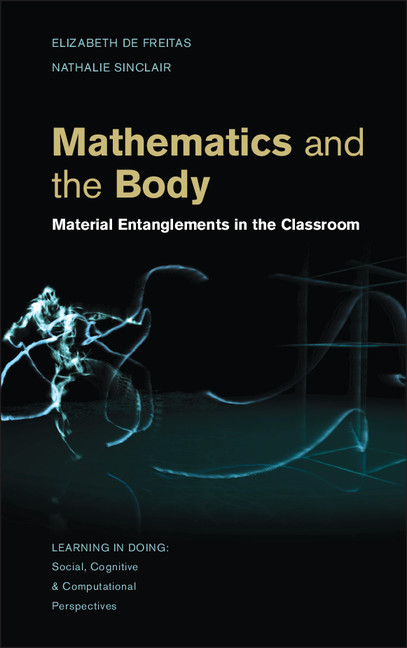
Mathematics and the Body

-
Select format
-
- Publisher:
- Cambridge University Press
- Publication date:
- 05 July 2014
- 02 June 2014
- ISBN:
- 9781139600378
- 9781107039483
- Dimensions:
- (228 x 152 mm)
- Weight & Pages:
- 0.51kg, 284 Pages
- Dimensions:
- Weight & Pages:
You may already have access via personal or institutional login
Show more authors 
You may already have access via personal or institutional login
Book description
This book explores alternative ways to consider the relationship between mathematics and the material world. Drawing on the philosophy of Gilles Châtelet and the post-humanist materialism of Karen Barad, the authors present an 'inclusive materialist' approach to studying mathematics education. This approach offers a fresh perspective on human and nonhuman bodies, challenging current assumptions about the role of the senses, language, and ability in teaching and learning mathematics. Each chapter provides empirical examples from the classroom that demonstrate how inclusive materialism can be applied to a wide range of concerns in the field. The authors analyze recent studies on students' gestures, expressions, and drawings in order to establish a link between mathematical activity and mathematical concepts. Mathematics and the Body expands the landscape of research in mathematics education and will be an essential resource for teachers, students, and researchers alike.
Awards
Honourable Mention for Innovations in Curriculum Studies, 2015 Division B Outstanding Book Award, American Educational Research Association
Reviews
'This book is a fabulous and timely contribution. It is a much-needed and radical critique of current embodied approaches within mathematics education, arguing that such approaches have, in large part, retained the very splits (inner/outer, individual/social) that they hoped to overcome. The scholarship is excellent and the writing is clear and concise.'
Alf Coles - University of Bristol
'This book is challenging and bracingly intellectual, in a field that has not always been so orientated. But it is not only theoretical and sophisticated about its ideas; it is also intellectual and academic in the best sense about practical contexts of mathematics schooling and what I might term ‘everyday’ phenomena of educational interest.'
David Pimm - University of Alberta
'The sense of timing for this work is finely tuned, because some of us have been thinking that too often in mathematics education, in particular, we have been asking the wrong questions in the wrong way. The authors’ response is through a different ‘conceptual space'. Rather than invoking a sociocultural, linguistic, or sociopolitical turn, the authors’ specific approach is to explore the ‘material'. It is an approach that invites dialogue from which new knowledge can be built.'
Margaret Walshaw - Massey University
Contents
Contents
Metrics
Altmetric attention score
Full text views
Full text views helpTotal number of HTML views: 0
Total number of PDF views: 0 *
 Loading metrics...
* Views captured on Cambridge Core between #date#. This data will be updated every 24 hours.
Usage data cannot currently be displayed.
Accessibility standard: Unknown
Why this information is here
This section outlines the accessibility features of this content - including support for screen readers, full keyboard navigation and high-contrast display options. This may not be relevant for you.
Accessibility Information
Accessibility compliance for the HTML of this book is currently unknown and may be updated in the future.