Medicine and the Workhouse

-
Select format
-
- Publisher:
- Boydell & Brewer
- Publication date:
- 05 December 2013
- 01 October 2013
- ISBN:
- 9781580468022
- 9781580464482
- Dimensions:
- Weight & Pages:
- 00kg,
- Dimensions:
- Weight & Pages:
- Subjects:
- Infectious Disease, British History after 1450, Medicine, History
You may already have access via personal or institutional login- Subjects:
- Infectious Disease, British History after 1450, Medicine, History
Show more authors 
You may already have access via personal or institutional login
Book description
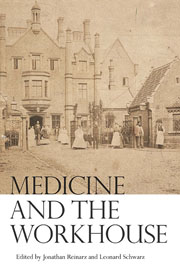
While the welfare functions of the workhouse have been well researched, its medical services have been comparatively neglected. Throughout the eighteenth and nineteenth centuries, and despite much administrative reform, workhouse medicine remained central to the medical experiences of the poor. Workhouse beds in Britain, for example, far outnumbered beds provided by charitable hospitals, which have often been the subject of historical study, and, by the 1830s, most parishes possessed their own workhouses. A high percentage of entries to workhouses consisted of the sick of all ages. In those communities where the elderly comprised the majority of workhouse inmates, most required medical relief. Perhaps inevitably, the position of workhouse doctor, or medical officer, became progressively more central to the management of these institutions, though we know very little about these overworked and undervalued practitioners. Historians of welfare, the English poor laws, and medicine have been aware of the importance of workhouse-based medical relief in the past, but the topic has not bee studied in depth. This is the first book to examine the history of the medical services provided by these welfare institutions, both in Britain and its former colonies, over the period covered by the Old and New Poor Laws. Jonathan Reinarz is Director of the History of Medicine Unit at the University of Birmingham, UK. He has published extensively on the history of English medical institutions, 1750-1950. Leonard Schwarz has recently retired as a Reader in Urban History at the University of Birmingham, where he founded the Birmingham Eighteenth Century Centre.
Contents
Contents
Metrics
Altmetric attention score
Full text views
Full text views helpTotal number of HTML views: 0
Total number of PDF views: 0 *
 Loading metrics...
* Views captured on Cambridge Core between #date#. This data will be updated every 24 hours.
Usage data cannot currently be displayed.
Accessibility standard: Unknown
Why this information is here
This section outlines the accessibility features of this content - including support for screen readers, full keyboard navigation and high-contrast display options. This may not be relevant for you.
Accessibility Information
Accessibility compliance for the PDF of this book is currently unknown and may be updated in the future.