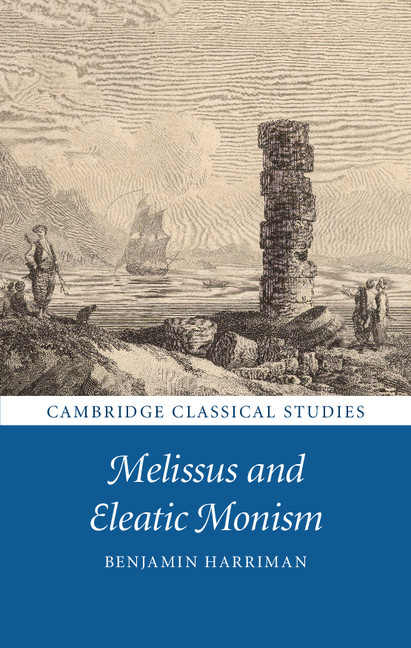
Melissus and Eleatic Monism

-
Select format
-
- Publisher:
- Cambridge University Press
- Publication date:
- 16 November 2018
- 06 December 2018
- ISBN:
- 9781108236324
- 9781108416337
- Dimensions:
- (216 x 138 mm)
- Weight & Pages:
- 0.43kg, 254 Pages
- Dimensions:
- Weight & Pages:
You may already have access via personal or institutional login
Show more authors 
You may already have access via personal or institutional login
Book description
In the fifth century BCE, Melissus of Samos developed wildly counterintuitive claims against plurality, change, and the reliability of the senses. This book provides a reconstruction of the preserved textual evidence for his philosophy, along with an interpretation of the form and content of each of his arguments. A close examination of his thought reveals an extraordinary clarity and unity in his method and gives us a unique perspective on how philosophy developed in the fifth century, and how Melissus came to be the most prominent representative of what we now call Eleaticism, the monistic philosophy inaugurated by Parmenides. The rich intellectual climate of Ionian enquiry in which Melissus worked is explored and brought to bear on central questions of the interpretation of his fragments. This volume will appeal to students and scholars of early Greek philosophy, and also those working on historical and medical texts.
Contents
Contents
Metrics
Altmetric attention score
Full text views
Full text views helpTotal number of HTML views: 0
Total number of PDF views: 0 *
 Loading metrics...
* Views captured on Cambridge Core between #date#. This data will be updated every 24 hours.
Usage data cannot currently be displayed.
Accessibility standard: Unknown
Why this information is here
This section outlines the accessibility features of this content - including support for screen readers, full keyboard navigation and high-contrast display options. This may not be relevant for you.
Accessibility Information
Accessibility compliance for the HTML of this book is currently unknown and may be updated in the future.