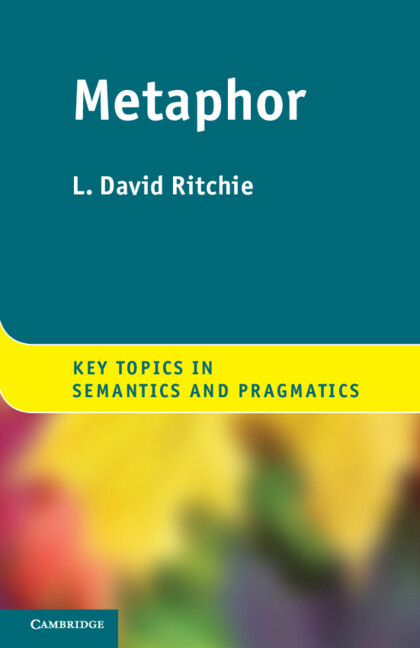
Metaphor

-
Select format
-
- Publisher:
- Cambridge University Press
- Publication date:
- 05 February 2013
- 10 January 2013
- ISBN:
- 9781139136822
- 9781107022546
- 9781107606661
- Dimensions:
- (228 x 152 mm)
- Weight & Pages:
- 0.43kg, 242 Pages
- Dimensions:
- (228 x 152 mm)
- Weight & Pages:
- 0.33kg, 240 Pages
You may already have access via personal or institutional login- Subjects:
- Language and Linguistics, Semantics and Pragmatics
Show more authors 
You may already have access via personal or institutional login
Book description
'Metaphor', a form of figurative language in which one thing or idea is expressed in terms of another, is becoming an increasingly popular area of study, as it is relevant to the work of semanticists, pragmatists, discourse analysts and also those working at the interface of language and literature and in other disciplines such as philosophy and psychology. This book provides a summary, critique and comparison of the most important theories on how metaphors are used and understood, drawing on research from linguistics, psychology and other disciplines. In order to ground the discussion in actual language use, the book uses examples from discourse, including casual conversations, political speeches, literature, humor, religion and science. Written in a non-technical style, the book includes clear definitions, examples, discussion questions and a glossary, making it ideal for graduate-level seminars.
Reviews
‘David Ritchie provides a broad, thought-provoking discussion of metaphor and its applications to the real world. His writing is highly accessible, making Metaphor suitable for a wide audience. Highly recommended!’
Jeannette Littlemore - University of Birmingham
‘David Ritchie's overview of theory and practice in metaphor studies will be really useful to students and others new to the field. It explains and illustrates a range of approaches to this exciting area.’
Lynne Cameron - The Open University
‘There is an amazing bounty of books on metaphor these days, and David Ritchie’s new volume is among the best. He tackles many of the enduring issues in metaphor scholarship, including debates on the functions of metaphor in thought, language, and the social world, by showing how metaphors work, and serve as resources for people, in an amazing array of discourse situations. Along the way, [he] offers important insights on different contemporary theories of metaphor, yet also nicely integrates research from cognitive science, to create a dynamic, context-sensitive account of how metaphorical ideas emerge in everyday life.’
Raymond W. Gibbs, Jr - University of California, Santa Cruz
'Metaphor by Ritchie is a stimulating book that gives an overview of current theories on metaphor and gives interesting insights about a widely studied topic. The book is agreeable to read and can be used both for study and reference. The use of examples taken from actual texts and the specific structure of the book make Ritchie’s work an appealing book in metaphor studies.'
Donatella Resta Source: The Linguist List
Contents
Contents
Metrics
Altmetric attention score
Full text views
Full text views helpTotal number of HTML views: 0
Total number of PDF views: 0 *
 Loading metrics...
* Views captured on Cambridge Core between #date#. This data will be updated every 24 hours.
Usage data cannot currently be displayed.
Accessibility standard: Unknown
Why this information is here
This section outlines the accessibility features of this content - including support for screen readers, full keyboard navigation and high-contrast display options. This may not be relevant for you.
Accessibility Information
Accessibility compliance for the PDF of this book is currently unknown and may be updated in the future.