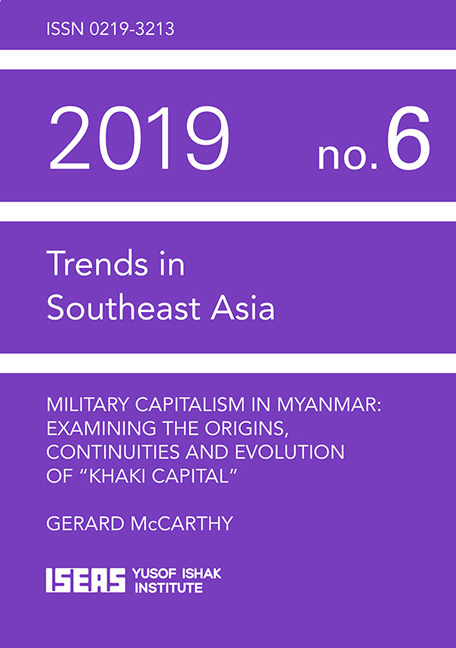
Military Capitalism in Myanmar

-
Select format
-
- Publisher:
- ISEAS–Yusof Ishak Institute
- Publication date:
- 24 January 2020
- 06 March 2019
- ISBN:
- 9789814843560
- 9789814843553
- Dimensions:
- Weight & Pages:
- Dimensions:
- Weight & Pages:
You may already have access via personal or institutional login
Show more authors 
You may already have access via personal or institutional login
Book description
Military enterprises, ostensibly set up to feed and supply soldiers, were some of the earliest and largest Burmese commercial conglomerates, established in the 1950s. Union Myanmar Economic Holdings Limited (UMEHL) and Myanmar Economic Corporation (MEC) are two profit-seeking military enterprises established by the military after the dissolution of the Burma Socialist Programme Party in 1988, which remain central players in Myanmar's post-2011 economy. Military conglomerates are a major source of off-budget revenue for the military and a main employer of retired soldiers. Yet few veterans receive more than a small piece of the profits from UMEHL. The vast bulk of formal dividends instead disproportionately benefit higher ranking officers and institutions within the Tatmadaw. Military capitalism entrenches the autonomy of the Tatmadaw from civilian oversight. Despite this, obligatory or semi-coerced contributions from active-duty soldiers are a source of cash flow for UMEHL, effectively constituting a transfer from the government budget to the military's off-budget entities. The most significant source of livelihoods support for most veterans is the service pension dispersed by the Ministry of Finance and Planning (MoPF). Despite delivering suboptimal welfare outcomes for most soldiers and veterans while eroding the legitimacy of ceasefires, successive governments since 1988, including Aung San Suu Kyi's National League for Democracy (NLD) administration, have entrenched military capitalism by encouraging commercial activities of armed groups that enter into ceasefire agreements. Extending military pensions already paid by the Ministry of Planning and Finance to retired members of armed groups could deliver a far more consistent and tangible "peace dividend" than the commercial extraction of resources from ceasefire areas. More balanced civil-military relations, and fairer social outcomes for military personnel, will rely on civilian-led state institutions delivering effective and substantive welfare support beyond the commercially oriented welfare arrangements of military conglomerates.
Contents
Contents
Metrics
Altmetric attention score
Full text views
Full text views helpTotal number of HTML views: 0
Total number of PDF views: 0 *
 Loading metrics...
* Views captured on Cambridge Core between #date#. This data will be updated every 24 hours.
Usage data cannot currently be displayed.
Accessibility standard: Unknown
Why this information is here
This section outlines the accessibility features of this content - including support for screen readers, full keyboard navigation and high-contrast display options. This may not be relevant for you.
Accessibility Information
Accessibility compliance for the PDF of this book is currently unknown and may be updated in the future.