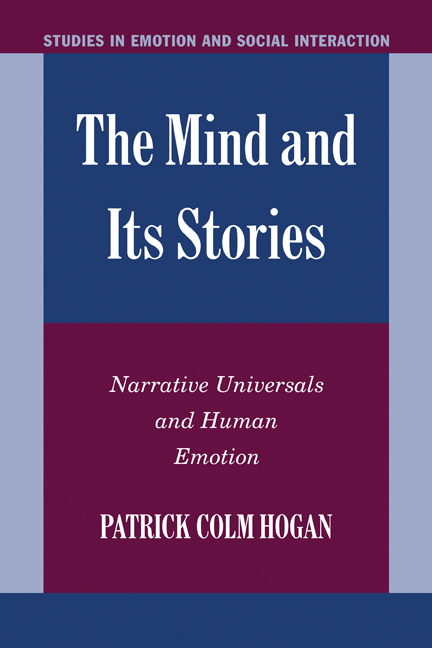
The Mind and its Stories

-
Select format
-
- Publisher:
- Cambridge University Press
- Publication date:
- 11 July 2009
- 29 September 2003
- ISBN:
- 9780511499951
- 9780521825276
- 9780521111416
- Dimensions:
- (228 x 152 mm)
- Weight & Pages:
- 0.64kg, 320 Pages
- Dimensions:
- (229 x 152 mm)
- Weight & Pages:
- 0.47kg, 320 Pages
You may already have access via personal or institutional login
Show more authors 
You may already have access via personal or institutional login
Book description
There are profound, extensive, and surprising universals in literature, which are bound up with universals in emotion. Hogan maintains that debates over the cultural specificity of emotion are misdirected because they have ignored a vast body of data that bear directly on the way different cultures imagine and experience emotion - literature. This is the first empirically and cognitively based discussion of narrative universals. Professor Hogan argues that, to a remarkable degree, the stories people admire in different cultures follow a limited number of patterns and that these patterns are determined by cross-culturally constant ideas about emotion. In formulating his argument, Professor Hogan draws on his extensive reading in world literature, experimental research treating emotion and emotion concepts, and methodological principles from the contemporary linguistics and the philosophy of science. He concludes with a discussion of the relations among narrative, emotion concepts, and the biological and social components of emotion.
Reviews
'Hogan's work usefully compares non-Europeans and 'Euro-American' conceptions of literary universals.'
Source: Year's Work in Critical and Cultural Theory
Contents
Contents
Metrics
Altmetric attention score
Full text views
Full text views helpTotal number of HTML views: 0
Total number of PDF views: 0 *
 Loading metrics...
* Views captured on Cambridge Core between #date#. This data will be updated every 24 hours.
Usage data cannot currently be displayed.
Accessibility standard: Unknown
Why this information is here
This section outlines the accessibility features of this content - including support for screen readers, full keyboard navigation and high-contrast display options. This may not be relevant for you.
Accessibility Information
Accessibility compliance for the PDF of this book is currently unknown and may be updated in the future.