
Skip to main content Accessibility help
×
  • Cited by 16
    • Show more authors
    • You may already have access via personal or institutional login
    • Select format
    • Publisher:
      Cambridge University Press
      Publication date:
      25 November 2016
      13 December 2016
      ISBN:
      9781316145449
      9781107093867
      9781107474857
      Dimensions:
      (228 x 152 mm)
      Weight & Pages:
      0.6kg, 302 Pages
      Dimensions:
      (229 x 152 mm)
      Weight & Pages:
      0.47kg, 304 Pages
    You may already have access via personal or institutional login
  • Selected: Digital
    Add to cart View cart Buy from Cambridge.org

    Book description

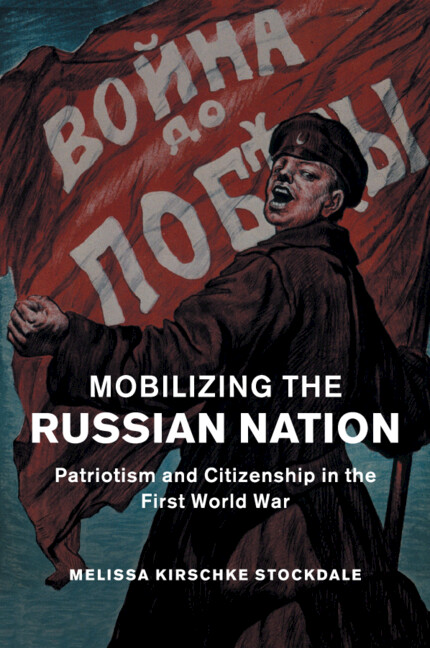
    The First World War had a devastating impact on the Russian state, yet relatively little is known about the ways in which ordinary Russians experienced and viewed this conflict. Melissa Kirschke Stockdale presents the first comprehensive study of the Great War's influence on Russian notions of national identity and citizenship. Drawing on a vast array of sources, the book examines the patriotic and nationalist organizations which emerged during the war, the role of the Russian Orthodox Church, the press and the intelligentsia in mobilizing Russian society, the war's impact on the rights of citizens, and the new, democratized ideas of Russian nationhood which emerged both as a result of the war and of the 1917 revolution. Russia's war experience is revealed as a process that helped consolidate in the Russian population a sense of membership in a great national community, rather than being a test of patriotism which they failed.

    Reviews

    ‘Mobilizing the Russian Nation challenges the notion that Russians had no or insignificant national identity and anything resembling ‘healthy patriotism' and, for most authors who argue this thesis, this ‘failure' left a blank slate for Bolshevik militancy and dictatorship to become the new regime. On the contrary, Professor Stockdale shows Russian elites as very conscious of the importance of such national identity and patriotism, and as willing to devote considerable resources to their various projects even against the backdrop of the urgently competing priorities of munitions, manpower, and the national food supply. Although many of the ‘achievements' of these various projects were undermined by the exhausting, long war - above all any loyalty to the tsar as an embodiment of the nation - other practices were adapted and adjusted by the new Bolshevik leadership. Stockdale offers wonderful institutional histories of several imperial and public associations that played important roles in these multiple wartime nation-building projects.'

    Mark Von Hagen - Arizona State University

    ‘Drawing on a dazzling diversity of original materials, Melissa Kirschke Stockdale upends conventional notions about how Russians experienced the First World War. Through her lucid, nuanced, and compelling analysis, Stockdale has masterfully recast our understanding of wartime patriotism's transformed and transformative role in the shaping of society and politics across a vast imperial state.'

    Aviel Roshwald - Georgetown University, Washington DC

    ‘Mobilizing the Russian Nation examines the powerful crystallization of nationalism, citizenship, and patriotism in Russia in the course of the First World War. She challenges the idea that Russia's war effort was unpopular and that the common people failed to conceive of the war as a patriotic project. Rather, she shows ‘the endurance of soldiers and civilians, and the generosity of the entire population, through years of hardship and staggering losses'. She convincingly argues that the First World War transformed Russian civic life and public structures. In doing so, she is always attentive to comparative developments in other combatant societies. Her treatment is fluidly written and highlights the arc of individual lives - be it the high-born governor of St Petersburg, Count Ivan Tolstoy, or the semi-literatate peasant woman Maria Bochkareva. Readers interested in twentieth-century Russia, the First World War, and the global twentieth century will find much of interest in Melissa Kirschke Stockdale's very fine book.'

    Peter Holquist - University of Pennsylvania

    ‘Stockdale's outstanding book overturns the received wisdom on Russian nationalism by convincing readers that even though the Russian state failed in a spectacular and violent way at the end of the First World War, the war nonetheless ‘played a significant role in the emergence of the modern Russian nation'. She persuasively shows that the attributes of the Russian national community forged during the First World War ‘would outlive the war and civil war, and be worked into Soviet renderings of Russian national identity'.'

    Karen Petrone - University of Kentucky

    ‘How was Russian society mobilized during the Great War? What were the primary forms of patriotic mobilization? How did these efforts influence modern concepts of citizenship and nation in Russia? How has the war ‘sold' to different social, ethnic, and confessional groups? And why did Russian soldiers continue to attack the enemy even after the monarchy had collapsed? In order to answer these questions, Professor Melissa Kirschke Stockdale has studied government propaganda, patriotic discourse, civil society activity and charity, theological debates and national projects, and gender and memory politics. She draws on sources from archives in both Moscow and St Petersburg, and has applied new approaches and methods to interpret them. This innovative book will be important both for historians of Russia and for scholars who study the political and cultural history of the Great War.'

    Boris Kolonitsky - European University, St Petersburg

    'The book is a panoramic tour of war attitudes that crosses boundaries of class, gender, and (to a lesser degree) ethnicity. Her book is arranged thematically, with chapters on patriotic narratives, the place of the press, the role of the church, war relief, support for soldiers, the discourse of treason, and on patriotism in the revolutionary year of 1917.'

    Joshua Sanborn Source: The Journal of Modern History

    'Melissa Stockdale’s richly textured book discusses how Russian - and, by extension, Soviet - identity was fashioned by the war, showing how a variety of very different groups were instrumental in creating a patriotic discourse that had an impact even after the war had ended.'

    Peter Waldron Source: The Slavonic and East European Review

    'Stockdale’s work is highly effective in synthesizing a variety of sources to create a well-rounded picture of the concept of patriotism during the war. The result is a nuanced and balanced assessment of the issue, indicating that concepts of patriotism and citizenship were dynamic and fluid, but certainly present. As such, it is an important contribution to the growing body of literature on Russia’s Great War.’

    Laurie S. Stoff Source: European History Quarterly

    Refine List

    Actions for selected content:

    Select all | Deselect all
    • View selected items
    • Export citations
    • Download PDF (zip)
    • Save to Kindle
    • Save to Dropbox
    • Save to Google Drive

    Save Search

    You can save your searches here and later view and run them again in "My saved searches".

    Please provide a title, maximum of 40 characters.
    ×

    Contents

    Select Bibliography

    Archival Sources

    Bakhmeteff Archive of Russian and East European Culture, Columbia University, New York

    • Mariia Bocharnikova, “V zhenskom batalon’e smerti” (unpublished memoir)

    Gosudarstvennyi Arkhiv Rossiiskoi Federatsii (GARF), Moscow

    • f. 58, Gendarme Administration of Moscow Province

    • f. 63, Moscow Okhrana

    • ff. 102 and 102 OO, Department of Police

    • f. 116, Union of the Russian People

    • f. 117, Union of Archangel Michael

    • f. 523, Constitutional Democratic Party

    • f. 579, P. N. Miliukov

    • f. 601, Nicholas II

    • f. 1467, Extraordinary Investigative Commission

    • f. 1788, Provisional Government, Ministry of Internal Affairs

    • f. 6281, First World War Collection of the Academy of Science

    • f. 6787, Provisional Government, Ministry of State Welfare

    • f. 6834, Special Commission on the Arts

    • f. 9505, Central Committee on Social-Political Enlightenment, 1917

    Hoover Institution Archives on War, Revolution, and Peace, Stanford, CA

    • World War I Poster Collection

    Library of Congress, Photography and Graphics Division, Washington, DC

    • Lot 5452, “Russian War Loan Postcards, 1915–16”

    • Lot 6540, “Red Cross Stamps”

    • Lot 8812, “Red Cross Photographs, Training Camp, First Petrograd Women’s Battalion,” 1917

    Rossiiskii Gosudarstvennyi Istoricheskii Arkhiv (RGIA)

    • f. 560, Ministry of Finance

    • f. 776, Chief Administration for Affairs of the Press

    • f. 796, Chancellery of the Holy Synod

    • f. 797, Chancellery of the Chief Procurator

    • f. 800, Printing Office of the Holy Synod

    • f. 1276, Council of Ministers

    • f. 1405, Ministry of Justice

    • f. 1483, Committee on Fighting German Domination

    Rossiiskii Gosudarstvennyi Voenno-istoricheskii Arkhiv (RGVIA), Moscow

    • f. 29, Chancellery of the War Ministry

    • f. 401, Military-Scientific Committee, General Staff

    • f. 1343, Staff of the Petrograd Military District

    • f. 2000, Chief Administration of the General Staff

    • f. 2003, Staff of the Supreme Commander (Stavka)

    • f. 2005, Military-Political and Civil Administration of the Supreme Command

    • f. 3474, Moscow Women’s Battalion of Death

    • f. 12651, Chief Administration of the Russian Society of the Red Cross

    • f. 16070, Aleksandrovskii Committee for the Wounded

    • f. 16280, Skobelev Committee

    • f. 16325, Alekseevskii Committee, 1905–1917

    Russian Newspapers and Periodicals

    • Den’

    • Derevenskaia gazeta

    • Dobrovolets’

    • Gazeta-kopeika

    • Izvestiia komiteta Vserossiiskogo soiuza gorodov

    • Kievlianin’

    • Letopis’

    • Letopis’ voiny

    • Lukomor’e

    • Narodnoe obrazovanie

    • Niva

    • Novoe vremia

    • Prikhodskii listok

    • Prizrenie i blagotvoritel’nost’ v Rossii

    • Rech’

    • Russkaia mysl’

    • Russkoe bogatstvo

    • Russkoe slovo

    • Russkie vedomosti

    • Russkie zapiski

    • Russkii invalid

    • Sel’skii vestnik

    • Sovremennik

    • Soldat-Grazhdanin

    • Vestnik Krasnogo kresta

    • Voina

    • Voina i evrei

    • Voina i mir

    • Zhenskii vestnik

    • Zhenskoe delo

    Published Primary Sources

    Abramowicz, Hirsz. Profiles of a Lost World: Memoirs of East European Jewish Life before World War II, trans. Dobkin, Eva Zeitlin, eds. Abramowicz, Dina and Shandler, Jeffrey. Detroit: Wayne State University Press, 1999.
    Alekseev, V. P. Svobodnyi grazhdanin i ego prava. Moscow: Narodnaia biblioteka, 1917.
    Aleksinskaia, Tatiana. Zhenshchina v voine i revoliutsii. Petrograd, 1917.
    Alexinsky[Aleksinskaia], Tatiana. With the Russian Wounded, trans. Cannan, Gilbert. London: T. Fischer Unwin, Ltd., 1916.
    Anfimov, A. M., ed. Krest’ianskoe dvizhenie v Rossii v gody Pervoi mirovoi voiny. Iul’ 1914 g.–fevral’ 1917 g. Sbornik dokumentov. Moscow and Leningrad: Izd. “Nauka,” 1965.
    Ansky, S. The Enemy at His Pleasure: A Journey through the Jewish Pale of Settlement in World War I, ed. and trans. Neugroschel, Joachim. New York: Henry Holt and Co., 2002.
    Arsenev, N. S. O svobode i obiazannostiakh grazhdanina. Moscow, 1917.
    Averbakh, O. I. Zakonodatel’nye akty, vyzvannye voinoiu 1914 goda. Vilnius, 1915.
    Baburina, N. I. Russkoi plakat Pervoi mirovoi voiny. Moscow: Firma “Iskusstvo i kul’tura,” 1992.
    Beatty, Bessie. The Red Heart of Russia. New York: Century Co., 1919.
    Belov, Vadim. Evrei i poliaki na voine. Vpechatlenie ofitsera-uchastnika. Petrograd: Izd-o “Biblioteka Velikoi voiny,” 1915.
    Bochkarev, V. N. Chto chitat’ o voine. Moscow: Moskovskoe obshchestvo narodnykh universitetov, 1915.
    Bogdanovich, T. Velikie dni revoliutsii. 23 fevralia–12 marta 1917 g. Petrograd, 1917.
    Bonch-Bruevich, M. D. Vsia vlast’ sovetam. Voennye memuary. Moscow: Voennoe izdatel’stvo ministerstva oborony SSSR, 1964.
    Botchkareva, Maria. Yashka: My Life as Peasant, Soldier, and Exile. As Set Down by Isaac Don Levine. New York: Frederick A. Stokes Co., 1919.
    Britnieva, Mary. One Woman’s Story. London: Arthur Barker, 1934.
    Browder, Robert and Kerensky, Alexander F., eds. The Russian Provisional Government, 1917: Documents. 3 vols. Stanford: Stanford University Press, 1961.
    Brusianin, V. V. Voina, zhenshchiny i deti. Moscow: Mlechnyi put’, 1917.
    Brusilov, A. A Soldier’s Notebook, 1914–1918. London: Macmillan, 1930.
    Buchanan, Meriel. Petrograd: The City of Trouble, 1914–1918. London: C. Scribner’s Sons, 1918.
    Chego zhdet Rossiia ot voiny. Sbornik statei. Petrograd: Kn-vo “Prometei,” 1915.
    Cherniavsky, Michael. Prologue to Revolution: Notes of A. N. Iakhontov on the Secret Meetings of the Council of Ministers, 1915. Englewood Cliffs, NJ: Prentice-Hall, 1967.
    Danilov, Iu. N. Rossiia v mirovoi voine, 1914–1915 gg. Berlin: Slovo, 1924.
    Denikin, A. I. The Russian Turmoil. Memoirs: Military, Social, and Political. London: Hutchinson and Co., n.d.
    Farmborough, Florence. A Nurse at the Russian Front: A Diary 1914–1918. London: Constable, 1974.
    Fedorchenko, Sof’ia. Narod na voine. Kiev: Tip. Vserossiiskogo zemskogo soiuza, 1917.
    Fenomenov, M. Ia. Russkii patriotizm i bratstvo narodov. Moscow: Izd. D. Ia. Makovskogo, 1917.
    Gessen, I. V. V dvukh vekakh. Zhiznennyi put’. Berlin: Speer and Schmidt, 1937.
    Gippius, Z. N. Stikhi. Dnevnik, 1911–1921. Berlin: Slovo, 1924.
    Glinka, Ia. V. Odinnadtsat’ let v gosudarstvennoi dume. 1906–1917. Dnevnik i vospominaniia. Moscow: Novoe literaturnoe obozrenie, 2001.
    Golovine, N. N. The Russian Army in the World War. New Haven: Yale University Press, 1931.
    Gorets, Evgenii. Izmenniki i predateli Rossii. Moscow: Sytina, 1917.
    Gorky, Maxim. Untimely Thoughts: Essays on Revolution, Culture, and the Bolsheviks, 1917–1918, trans. Ermolaev, Herman. New York: P. S. Eriksson, 1968.
    Gosudarstvennaia duma. Stenograficheskie otchety, IV. St. Petersburg, 1914–17.
    Gourko [Gurko], Basil. Memories and Impressions of War and Revolution in Russia, 1914–1917. London: John Murray, 1918.
    Grave, B. B., ed. Burzhuaziia nakanune Fevral’skoi revoliutsii. Moscow, 1927.
    Grigorov, I. Soldatskaia pamiatka. (Chto soldaty dali Rossii i chto oni dolzhny poluchit’). Moscow: Narodopravstvo, 1917.
    Gruzenberg, O. O. Yesterday: Memoirs of a Russian-Jewish Lawyer, trans. Tipton, Tatiana. Berkeley: University of California Press, 1981.
    Gurko, V. I. Features and Figures of the Past: Government and Opinion in the Reign of Nicholas II, trans. by Matveev, Laura. Stanford: Stanford University Press, 1939.
    Episkop, Ioann. Shpiony ot religii. N.p.: Izd. Kubanskogo, vo imia Khrista spasitelia, Otdela Vserossiiskogo Trudovogo Soiuza Khristian-Trezvennikov, 1915.
    “Iz ‘Chernoi knigi’ rossiiskogo evreistva. Materialy dlia istorii voiny 1914–1915 g.” In Evreiskaia starina. Sbornik statei za 1917–1918 gody, vol. X. Petrograd, 1918, 195–296.
    The Jews in the Eastern War Zone. New York: American Jewish Committee, 1916.
    Kerensky, Alexander F. The Catastrophe: Kerensky’s Own Story of the Russian Revolution. New York: D. Appleton and Co., 1927.
    Kir’ianov, Iu. I., ed. Pravye partii. Dokumenty i materialy, vol. II, 1911–1917 gg. Moscow: ROSSPEN, 1998.
    Kornilov, A. A. “Vospominaniia,” Voprosy istorii, nos. 8, 9 and 10 (1994): 112–28, 112–22, 122–34.
    Krasnyi arkhiv, 106 vols. Moscow, 1923–41.
    Kratkyi obzor deiatel’nosti Vse-rossiiskogo zemskogo soiuza na zapadnom fronte, 1915–1977 gg. Moscow, 1918.
    Kratkii otcherk deiatel’nosti Vserossiiskogo zemskogo soiuza. Moscow, 1916.
    Kul’chitskii, Rotmistr. Sovety molodomu ofitseru, 6th edn. Kharkov, 1917.
    Lemke, Mikhail Konstantinovich. 250 dnei v tsarskoi stavke. (25 sent. 1915–2 iulia 1916.) Petrograd: Gos. Izdatel’stvo, 1920.
    Mansyrev, Kn. S. “Moi vospominaniia o gosudarstvennoi dume.” Istorik i sovremennik (Berlin), 3 (1922), 3–44.
    Mansyrev, Kn. S. Nemetskoe zasil’e i pravila 2 fevralia 1915 g. Moscow: Tip. A. I. Mamontova, 1915.
    Martov, Iu. O. Proletariat i natsional’naia oborona. Petrograd, 1917.
    Mikhailov, D. Krasnyi krest i sestry miloserdiia v Rossii i za-granitsei. Petrograd and Kiev: Knigoizdatel’stvo “Sotrudnik,” 1914.
    Miliukov, P. N. Taktika fraktsii narodnoi svobody vo vremia voiny. Petrograd, 1916.
    Miliukov, P. N. “Tseli voiny.” Ezhegodnik gazety Rech’ na 1916 g. Petrograd, 1916.
    Miliukov, P. N. Vospominaniia (1859–1917), reprint. Moscow: Politizdat, 1991.
    Nashi vragi. Obzor deistvii chrezvychainoi sledstvennoi komissii. Petrograd, 1916.
    Nikitin, Evgenii. Velikaia voina i dukhovnoe vozrozhdenie Rossii. Moscow: Izdanie komissii po organizatsii obshche obrazovatel’nykh chtenii dlia fabrichno-zavodskikh rabochikh goroda Moskvy, 1915.
    Nol’de, Baron B. E. Dalekoe i blizkoe. Istoricheskie ocherki. Paris: Izd-vo “Sovremennye zapiski,” 1930.
    Obolenskii, V. A. Moia zhizn’, moi sovremenniki. Paris: YMCA Press, 1988.
    Obzor deiatel’nosti Obshchestva “Samodeiatel’naia Rossiia” za 1915 god. Petrograd, 1916.
    Orlov, A. S. Kooperatsiia v Rossii nakanune i vovremia voiny, 2nd edn. Moscow: Izdanie “Pechat T-va I. N. Kushnerev i Ko.,” 1917.
    Os’kin, D. P. Zapiski soldata. Moscow: Izd. Federatsiia, 1929.
    Osobyi zhurnal soveta ministrov (1914–1916). Moscow: ROSSPEN, 2008.
    Otchet Soveta o deiatel’nosti “Obshchestva 1914 goda” za 1915-i god. Moscow, 1916.
    Paleologue, Maurice. An Ambassador’s Memoirs, trans. Holt, F. A., 3rd edn., 3 vols. London: Hutchinson and Co., 1924.
    Plekhanov, G. V. O voine. Petrograd, 1915.
    Purishkevich, V. M. Tribuna. Rechi V. M. Purishkevicha (stenogrammy) v Gosudarstvennoi dume vo vremia voine. Petrograd, n.d.
    Rabochee dvizhenie v Petrograde v 1912–1917 gg. Dokumenty i materialy. Leningrad: Lenizdat, 1958.
    Razlozhenie armii v 1917 godu, ed. by N. E. Kakurin. Moscow and Leningrad: Gosudarstvennoe izd-vo, 1923.
    Rossiia v mirovoi voine 1914–1918 godov (v tsifrakh). Moscow: Tsentral’noe statisticheskoe upravlenie, 1925.
    Rozanov, Vasilii V. Voina 1914 goda i russkoe vozrozhdenie. Petrograd: Tip. Tv-a A. S. Suvorina, 1915.
    Runin, Sergei. Dve sestry – Rossiia i Pol’sha, “Otkliki,” issue 3. Petrograd, 1915.
    Runin, Sergei. Sim pobedish’ – mobilizatsiia dukha, Otkliki. Politicheskii zhurnal-fel’etony, reprint of article of July 10, 1915. Petrograd, 1916.
    Runkevich, S. G. Velikaia otechestvennaia voina i tserkovnaia zhizn’. Petrograd, 1916.
    Shavel’skii, Otets Georgii. Vospominaniia. Poslednego protopresvitera russkoi armii i flota, 2 vols. New York: Izd. imeni Chekhova, 1954.
    Shchegolev, P. E., ed. Padenie tsarskogo rezhima, 7 vols. Moscow, 1924–27.
    Shelokhaev, V. V., ed. Partiia sotsialistov-revoliutsionerov. Dokumenty i materialy, 1900–1922 gg, 3 vols. Moscow: ROSSPEN, 1996–97.
    Shelokhaev, V. V., ed. Partii demokraticheskikh reform, Mirnogo obnovleniia, Progressistov. Dokumenty i materialy, 1906–1916 gg. Moscow: ROSSPEN, 2002.
    Shklovskii, Viktor. A Sentimental Journey: Memoirs, 1917–1922, trans. Sheldon, Richard. Ithaca: Cornell University Press, 1970.
    Shulgin, V. V. The Years: Memoirs of a Member of the Russian Duma, 1906–1917, trans. Davis, Tanya. New York: Hippocrene Books, 1984.
    Sputnik voiny. Sbornik vozzvanii, rechei i prikazov po voprosov voiny. Kiev: Tip. A. I. Grosman, 1917.
    Steinberg, Mark D., ed. Voices of Revolution, 1917, documents trans. by Schwartz, Marian. New Haven: Yale University Press, 2001.
    Stenograficheskie otchety zasedanii XI S”ezda upolnomochennykh ob”edinennykh dvorianskikh obshchetv. Moscow, 1915.
    Stepun, Fedor A. Iz pisem praporshchika artillerista. Moscow: Zadruga, 1918.
    Struve, Petr. “Istoricheskii smysl’ Russkoi revoliutsii i natsional’nye zadachi.” In Iz glubiny. Sbornik statei o russkoi revoliutsii. Moscow and Petrograd: Kn-va “Russkaia mysl’,” 1918, 235–50.
    Sukhanov, N. Nashi levye gruppy i voina, 3rd edn. Petrograd: Tip. E. M. Malakhovskogo, 1916.
    Sukhanov, N. The Russian Revolution 1917: A Personal Record, ed., abridged, and trans. by Carmichael, Joel. London: Oxford University Press, 1955.
    Thompson, Donald C. Blood Stained Russia. New York: Leslie-Judge Company, 1918.
    Tikhomirov, D. I. Velikaia voina Rossii za svobodu i ob”edinenie slavian. Sbornik statei dlia shkolnik i narodnykh bibliotek. Moscow: Biblioteka dlia semei i shkoly, 1914.
    Trubetskoi, Kn. E. N. Otechestvennaia voina i ee dukhovnaia smysl’. Moscow: Tip. T-va I. D. Sytina, 1915.
    Trubetskoi, Kn. E. N. Velikaia revoliutsiia i krizis patriotizma. N.p., 1919.
    Tyrkova-Williams, Ariadna. From Liberty to Brest-Litovsk: The First Year of the Russian Revolution. London: Macmillan, 1919.
    Velikaia voina v obrazakh i kartinakh, 6th edn, ed. Iv. Lazarevskii. Moscow, 1916.
    Voina i derevnia. Kazan: Tsentral’naia tipografiia, 1915.
    Voina i derevnia. Petrograd: Tip. “Sel’skogo Vestnika,” 1916.
    Vrangel’, N. N. Dni skorbi. Dnevnik 1914–1915 godov, ed. Murashov, A. A.. St. Petersburg: Zhurnal Neva, 2001.
    Vserossiiskii zemskii soiuz. Obzor deiatel’nosti glavnogo komiteta, 1 avgusta 1914 g.–1 fevralia 1915 g. Moscow, 1915.
    Za rodinu, za pravdu Bozhiiu. Petrograd: Synodal’naia tipografiia, 1917.
    Zakhareva, Lidiia. Dnevnik sestry miloserdiia. Na peredovykh pozitsiakh. Petrograd: Izd. Biblioteka “Velikoi voiny,” 1915.
    Zamaraev, A. A. Dnevnik totemskogo krest’ianina A. S. Zamaraeva, 1906–1922 gody, ed. by Morozov, V. V. and Reshetnikov, N. I.. Moscow: Rossiiskaia akademiia nauk, 1995.

    Secondary Sources

    Anderson, Benedict. Imagined Communities: Reflections on the Origin and Spread of Nationalism, 2nd edn. New York: Verso, 1991.
    Apostol, Paul N. “Credit Operations.” In Michelson, Alexander M. et al., Russian Public Finance during the War. New Haven: Yale University Press, 1928, 233–336
    Astashov, A. B. Russkii front v 1914–nachale 1917 goda. Voennyi opyt i sovremennost’. Moscow: Novyi khronograf, 2014.
    Audoin-Rouzeau, Stéphane and Becker, Annette. 14–18: Understanding the Great War, trans. Temerson, Catherine. New York: Hill and Wang, 2000.
    Babkin, M. A. Dukhoventsvo russkoi pravoslavnoi tserkvi i sverzhenie monarkhii. (Nachalo XX v.–konets 1917 g.). Moscow: Gosudarstvennaia publichnaia istoricheskaia biblioteka Rossii, 2007.
    Babkin, M. A. Sviashchenstvo i tsarstvo. (Rossiia, nachalo XX v.–1918 g.) Issledovaniia i materialy. Moscow: Izdatel’stvo “INDRIK,” 2011.
    Badcock, Sarah. “Talking to the People and Shaping Revolution: The Drive for Enlightenment in Revolutionary Russia.” Russian Review 65 (2006): 617–36.
    Badcock, Sarah. “Women, Protest, and Revolution: Soldiers’ Wives in Russia during 1917.” International Review of Social History 49 (2004): 47–70.
    Bakhturina, A. Iu. Okhrainy Rossiiskoi imperii. Gosudarstvennoe upravlenie i natsional’naia politika v gody Pervoi mirovoi voiny (1914–1917 gg.). Moscow: ROSSPEN, 2004.
    Belogurova, T. A. Russkaia periodicheskaia pechat’ i problemy vnutrennei zhizni strany v gody Pervoi mirovoi voiny (1914–fevral’ 1917). Smolensk: Gody, 2005.
    Berezhnoi, A. F. Russkaia legal’naia pechat’ v gody Pervoi mirovoi voiny. Leningrad: Leningradskii gosudarstvennyi universitet, 1975.
    Billing, Michael. Banal Nationalism. London: Sage, 1995.
    Bobroff, Ronald. “Devolution in Wartime: Sergei D. Sazonov and the Future of Poland, 1910–1916.” International History Review (2000): 505–28.
    Bonnell, Victoria. Iconography of Power: Soviet Political Posters under Lenin and Stalin. Berkeley: University of California Press, 1997.
    Bradley, Joseph. “Subjects into Citizens: Societies, Civil Society, and Autocracy in Tsarist Russia.” American Historical Review 107, 4 (October 2002): 1094–1123.
    Brandenberger, David. National Bolshevism: Stalinist Mass Culture and the Formation of Modern Russian National Identity, 1931–1956. Cambridge, MA: Harvard University Press, 2002.
    Brooks, Jeffrey. When Russia Learned to Read: Literacy and Popular Literature, 1861–1917. Princeton: Princeton University Press, 1985.
    Brubaker, Rogers. “In the Name of the Nation: Reflections on Nationalism and Patriotism.” In Abbott, Philip, ed., The Many Faces of Patriotism. Lanham, MD: Rowman & Littlefield, 2007, 37–51.
    Burbank, Jane. “An Imperial Rights Regime: Law and Citizenship in the Russian Empire.” Kritika 7 (2006): 397–431.
    Burbank, Jane. Russian Peasants Go to Court: Legal Culture in the Countryside, 1905–1917. Bloomington: Indiana University Press, 2004.
    Capozzola, Christopher. Uncle Sam Wants You: World War I and the Making of the Modern American Citizen. New York: Oxford University Press, 2008.
    Chermenskii, E. D. IV Gosudarstvennaia duma i sverzhenie tsarizma v Rossii. Moscow: Mysl’, 1976.
    Chulos, Chris J. “Orthodox Identity at Russian Holy Places.” In Chulos, Chris J. and Piirainen, Timo, eds., The Fall of an Empire, the Birth of a Nation: National Identities in Russia. Burlington, VT: Ashgate, 2000, 28–50.
    Cohen, Aaron. Imagining the Unimaginable: World War, Modern Art, and the Politics of Public Culture in Russia, 1914–1917. Lincoln: University of Nebraska Press, 2008.
    Coleman, Heather J. Russian Baptists and Spiritual Revolution, 1905–1929. Bloomington: Indiana University Press, 2005.
    Colley, Linda. Britons: Forging the Nation, 1707–1837. New Haven: Yale University Press, 1992.
    Confino, Alon. The Nation as a Local Metaphor: Wurttemberg, Imperial Germany, and National Memory, 1871–1918. Chapel Hill: University of North Carolina Press, 1997.
    Cornwall, Mark. The Undermining of Austria-Hungary: The Battle for Hearts and Minds. Cambridge: Cambridge University Press, 2000.
    Crews, Robert D. For Prophet and Tsar: Islam and Empire in Russia and Central Asia. Cambridge, MA: Harvard University Press, 2006.
    Cunningham, Hugh. “The Language of Patriotism, 1750–1914.” History Workshop Journal 12 (1981): 8–33.
    Curtiss, John S. Church and State in Russia: The Last Years of the Empire, 1900–1917. New York: Octagon Books, 1965.
    Dagger, Richard. “Republican Citizenship.” In Isin, Engin F. and Turner, Bryan S., eds., Handbook of Citizenship Studies. London: Sage, 2002, 145–58.
    Daly, Jonathan W. The Watchful State: Security Police and Opposition in Russia, 1906–1917. DeKalb: Northern Illinois University Press, 2004.
    Dekel-Chen, Jonathan, Gaunt, David, Meir, Natan M., and Bartal, Israel, eds. Anti-Jewish Violence: Rethinking the Pogrom in East European History. Bloomington: Indiana University Press, 2011.
    Diakin, V. S. Russkaia burzhuaziia i tsarizm v gody Pervoi mirovoi voiny, 1914–1917. Leningrad: Nauka, 1967.
    Diakin, V. S. Natsional’nyi vopros vo vnutrennei politike tsarizma (XIX–nachalo XX vv.). St. Petersburg: LISS, 1998.
    Dumova, N. G. Kadetskaia partiia v period Pervoi mirovoi voiny i Fevral’skoi revoliutsii. Moscow: Nauka, 1988.
    Engel, Barbara Alpern. “Not by Bread Alone: Subsistence Riots in Russia during World War I.” Journal of Modern History 69, 4 (December 1997): 696–721.
    Engelstein, Laura. “‘A Belgium of Our Own’: The Sack of Russian Kalisz, August 1914.” Kritika 10, 3 (Summer 2009): 441–73.
    Fel’shtinskii, Iurii. Krushenie mirovoi revoliutsii. Brestskii mir. Moscow: Terra, 1991.
    Figes, Orlando. A People’s Tragedy: A History of the Russian Revolution. New York: Viking Press, 1996.
    Figes, Orlando and Kolonitskii, Boris. Interpreting the Russian Revolution: The Language and Symbols of 1917. New Haven: Yale University Press, 1999.
    Flood, P. J. France 1914–1918: Public Opinion and the War Effort. New York: St. Martin’s Press, 1990.
    Frame, Murray, Kolonitskii, Boris, Marks, Steven G., and Stockdale, Melissa K., eds. Russian Culture in War and Revolution, 1914–1922, Book 1, Popular Culture, the Arts, and Institutions; Book 2, Political Culture, Identities, Mentalities, and Memory. Bloomington: Slavica, 2014.
    Frankel, Jonathan. Crisis, Revolution, and Russian Jews. Cambridge: Cambridge University Press, 2009.
    Fuller, William C. Jr. The Foe Within: Fantasies of Treason and the End of Imperial Russia. Ithaca: Cornell University Press, 2006.
    Galili i Garcia, Ziva. “Origins of Revolutionary Defensism: I. G. Tseretelli and the ‘Siberian Zimmerwaldists.’” Slavic Review 41 (Sep. 1982): 454–76.
    Gatrell, Peter. Russia’s First World War: A Social and Economic History. Harlow, UK: Pearson Education, 2005.
    Gatrell, Peter. A Whole Empire Walking: Refugees in Russia during World War I. Bloomington: Indiana University Press, 1999.
    Gaudin, Corinne. “Circulation and Production of News and Rumor in Rural Russia during World War I.” In Frame, , Kolonitskii, , Marks, , and Stockdale, , eds., Russian Culture in War and Revolution, 1914–1922, Book 2, Political Culture, Identities, Mentalities, and Memory, 55–72.
    Gillis, John R., ed. Commemorations: The Politics of National Identity. Princeton: Princeton University Press, 1994.
    Gleason, William. “The All-Russian Union of Zemstvos and World War I.” In Emmons, T. and Vucinich, W., eds., The Zemstva in Russia: An Experiment in Local Self-Government. Cambridge, MA: Harvard University Press, 1982, 365–82.
    Grave, B. K istorii klassovoi bor’by v Rossii v gody imperialisticheskoi voiny. Iiul’ 1914–fevral’ 1917 g. Moscow, 1926.
    Gregory, Adrian. The Last Great War: British Society and the First World War. Cambridge: Cambridge University Press, 2008.
    Gronsky, Paul P. and Astrov, Nicholas J., The War and the Russian Government. New Haven: Yale University Press, 1929.
    Gullace, Nicoletta F. “The Blood if Our Sons.” Men, Women, and the Renegotiation of British Citizenship During the Great War. New York: Palgrave Macmillan, 2002.
    Hamm, Michael. “Liberal Politics in Wartime Russia: An Analysis of the Progressive Bloc.” Slavic Review 53 (1974): 453–68.
    Hasegawa, Tsuyoshi. The February Revolution: Petrograd, 1917. Seattle: University of Washington Press, 1981.
    Hedda, Jennifer. His Kingdom Come: Orthodox Pastorship and Social Activism in Revolutionary Russia. DeKalb: Northern Illinois University Press, 2008.
    Heenan, Louise C. Russian Democracy’s Fateful Blunder: The Summer Offensive of 1917. New York: Praeger, 1987.
    Heretz, Leonid. Russia on the Eve of Modernity: Popular Religion and Traditional Culture under the Last Tsars. Cambridge: Cambridge University Press, 2008.
    Herrlinger, Page. Working Souls: Russian Orthodoxy and Factory Labor in St. Petersburg, 1881–1917. Bloomington: Slavica, 2007.
    Hickey, Michael C. “Discourses of Public Identity and Liberalism in the February Revolution: Smolensk, Spring 1917.” Russian Review 55 (1996): 615–37.
    Hirsch, Francine. Empire of Nations: Ethnographic Knowledge and the Making of the Soviet Union. Ithaca: Cornell University Press, 2005.
    Hobsbawm, E. J. Nations and Nationalism since 1780: Programme, Myth, Reality. Cambridge: Cambridge University Press, 1990.
    Hoffmann, David L. Cultivating the Masses: Modern State Practices and Soviet Socialism, 1914–1939. Ithaca: Cornell University Press, 2011.
    Hoffmann, David L. and Kotsonis, Yanni, eds. Russian Modernity: Politics, Knowledge, Practices. New York: St. Martin’s Press, 2000.
    Holquist, Peter. “Anti-Soviet Svodki from the Civil War: Surveillance as a Shared Feature of Russian Political Culture.” Russian Review 56 (Jul. 1997): 445–50.
    Holquist, Peter. “‘Information Is the Alpha and Omega of Our Work’: Bolshevik Surveillance in Its Pan-European Context.” Journal of Modern History 69, 3 (1997): 415–50.
    Holquist, Peter. Making War, Forging Revolution: Russia’s Continuum of Crisis, 1914–1921. Cambridge, MA: Harvard University Press, 2002.
    Horak, Stephen M. The First Treaty of World War I: Ukraine’s Treaty with the Central Powers of February 9, 1918. New York: Columbia University Press, 1988.
    Horne, John, ed. State, Society and Mobilization in Europe during the First World War. Cambridge: Cambridge University Press, 1997.
    Hosking, Geoffrey. Russia: People and Empire, 1552–1917. Cambridge, MA: Harvard University Press, 1997.
    Ivanova, Iu. I. Khrabreishie iz prekrasnykh. Zhenshchiny Rossii v voinakh. Mascow: ROSSPEN, 2002.
    Jahn, Hubertus J. Patriotic Culture in Russia during World War I. Ithaca: Cornell University Press, 1995.
    Kaiser, Robert J. The Geography of Nationalism in Russia and the USSR. Princeton: Princeton University Press, 1994.
    Kandidov, B. Sektanstvo i mirovaia voina. Moscow: Ateist, 1930.
    Kappeler, Andreas. The Russian Empire: A Multiethnic History, trans. Clayton, Alfred. Harlow, UK: Pearson Education, Ltd., 2001.
    Keep, John L. H. The Russian Revolution. A Study in Mass Mobilization. London: Weidenfeld & Nicolson, 1976.
    Kenez, Peter. The Birth of the Propaganda State: Soviet Methods of Mass Mobilization, 1917–1929. Cambridge: Cambridge University Press, 1985.
    Kenworthy, Scott. “The Mobilization of Piety: Monasticism and the Great War in Russia, 1914–1916.” Jahrbucher fur Geschichte Osteuropas 52 (2004): 388–401.
    Khasbulatova, O. A. Opyt i traditsii zhenskogo dvizheniia v Rossii (1860–1917). Ivanovo: Ivanovskii gosudarstvennyi universitet, 1994.
    Kir’ianov, Iu. I. Pravye partii v Rossii, 1906–1917. Moscow: ROSSPEN, 2001.
    Kohn, Stanislas. The Cost of the War to Russia: The Vital Statistics of European Russia during the World War, 1914–1917. New Haven, 1932.
    Kolonitskii, Boris. Simvoly vlasti i bor’ba za vlast’. K izucheniiu politicheskoi kul’tury Rossiiskoi revoliutsii 1917 g. St. Petersburg: Dmitrii Bulanin, 2001.
    Kolonitskii, Boris. Tragicheskaia erotika. Obrazy imperatorskoi sem’i v Pervoi mirovoi voine. St. Petersburg: Novoe literaturnoe obozrenie, 2010.
    Kotkov, V. M. Sotsial’no-kul’turnaia deiatel’nost’ v armii. St. Petersburg, 2000.
    Kotsiubinskii, D. A. Russkii natsionalizm v nachale XX stoletiia. Rozhdenie i gibel’ ideologii Vserossiiskogo natsional’nogo soiuza. Moscow: ROSSPEN, 2001.
    Kotsonis, Yanni. “‘Face-to Face’: The State, the Individual, and the Citizen in Russian Taxation, 1863–1917.” Slavic Review 63 (2004): 221–46.
    Kotsonis, Yanni. States of Obligation: Taxes and Citizenship in the Russian Empire and Early Soviet Republic. Toronto: University of Toronto Press, 2014.
    Lieven, D. C. B. “Dilemmas of Empire, 1850–1918: Power, Territory, Identity.” Journal of Contemporary History 34, 2 (1999): 163–200.
    Lieven, D. C. B. “Pro-Germans and Russian Foreign Policy 1890–1914.” International History Review 2 (1980): 34–53.
    Lieven, D. C. B. Lieven, Dominic. Russia Against Napoleon. New York: Penguin Books, 2009.
    Lih, Lars. Bread and Authority in Russia, 1914–1921. Berkeley: University of California Press, 1990.
    Lincoln, W. Bruce. Passage through Armageddon: The Russians in War and Revolution, 1914–1918. Oxford: Oxford University Press, 1994.
    Lindenmeyr, Adele. Poverty Is Not a Vice: Charity, Society, and the State in Imperial Russia. Princeton: Princeton University Press, 1996.
    Liulevicius, Vejas Gabriel. War Land on the Eastern Front.: Culture, National Identity, and German Occupation in World War I. Cambridge: Cambridge University Press, 2000.
    Lohr, Eric. Nationalizing the Russian Empire: The Campaign against Enemy Aliens during World War I. Cambridge, MA: Harvard University Press, 2003.
    Lohr, Eric. “Patriotic Violence and the State: The Moscow Riots of May 1915.” Kritika 4 (Summer 2003): 607–26.
    Lohr, Eric. “The Russian Army and the Jews: Mass Deportations, Hostages, and Violence during World War I.” Russian Review 60 (2001): 404–19.
    Lohr, Eric. Russian Citizenship: From Empire to Soviet Union. Cambridge, MA: Harvard University Press, 2012.
    Lowe, Heinz-Dietrich. The Tsars and the Jews: Reform, Reaction and Anti-Semitism in Imperial Russia, 1772–1917. Chur, Switzerland: Harwood Academic Publishers, 1993.
    Makhonina, S. Ia. “Russkaia legal’naia zhurnalistika XX v. (1905–fevral’ 1917) (Opyt sistemnogo issledovaniia).” In Esin, B. I., ed., Iz istorii russkoi zhurnalistiki nachala XX veka. Moscow: Izd. Moskovskogo universiteta, 1984, 5–49.
    Malkov, V. L., ed. Pervaia mirovaia voina. Prolog XX veka. Moscow: Nauka, 1998.
    Martin, Terry. The Affirmative Action Empire: Nations and Nationalism in the Soviet Union, 1923–1939. Ithaca: Cornell University Press, 2001.
    McReynolds, Louise. The News under Russia’s Old Regime: The Development of a Mass Circulation Press. Princeton: Princeton University Press, 1991.
    Melancon, Michael. The Socialist Revolutionaries and the Russian Anti-War Movement, 1914–1917. Columbus: Ohio State University Press, 1990.
    Meyer, Alfred G. “The Impact of World War I on Russian Women’s Lives.” In Clements, Barbara Evans, Engel, Barbara Alpern, and Worobec, Christine D., eds., Russia’s Women: Accommodation, Resistance, Transformation. Berkeley: University of California Press, 1991, 208–24.
    Milne, Lesley. “Novyi Satyrikon, 1914–1918: The Patriotic Laughter of the Russian Liberal Intelligentsia during the First World War and the Revolution.” Slavonic and East European Review 84, 4 (2006): 639–65.
    Minakov, V. P. Obshchestvenno-pedagogicheskoe dvizhenie v Rossii v gody Pervoi mirovoi voiny. Voronezh: IMMIF, 2003.
    Monger, David. Patriotism and Propaganda in First World War Britain. Liverpool: Liverpool University Press, 2012.
    Moran, Daniel and Waldron, Arthur, eds. The People in Arms: Military Myth and National Mobilization since the French Revolution. Cambridge: Cambridge University Press, 2003.
    Narskii, I. V. Revoliutsionery “sprava.” Chernosotentsy na Urale v 1905–1916 gg. (Materialy k issledovaniiu “russkosti.”). Ekaterinburg: Cricket, 1994.
    Narskii, I. V. Zhizn’ v katastrofe. Budni naseleniia Urala v 1917–1922 gg. Moscow: ROSSPEN, 2001.
    Nikolaev, A. B. Revoliutsiia i vlast’. IV Gosudarstvennaia duma 27 fevral 3 marta 1917 goda. (St. Petersburg: Izdatel’stvo RGPU im. A. I. Gertsena, 2005.
    Norris, Stephen M. A War of Images: Russian Popular Prints, Wartime Culture, and National Identity, 1812–1945. DeKalb: Northern Illinois University Press, 2006.
    Orlovsky, Daniel. “The Provisional Government and Its Cultural Work.” In Gleason, Abbott, Kenez, Peter, and Stites, Richard, eds., Bolshevik Culture: Experiment and Order in the Russian Revolution. Bloomington: Indiana University Press, 1985, 39–56.
    Pearson, Raymond. The Russian Moderates and the Crisis of Tsarism, 1914–1917. London: Barnes & Noble, 1977.
    Peregudova, Z. I. Politicheskii sysk Rossii (1880–1917). Moscow: ROSSPEN, 2000.
    Petrone, Karen. “Family, Masculinity, and Heroism in Russian War Posters.” In Melman, Billie, ed., Borderlines: Genders and Identities in War and Peace, 1870–1930. New York: Routledge, 1998, 95–119.
    Petrone, Karen. The Great War in Russian Memory. Bloomington: Indiana University Press, 2011.
    Petrovsky-Shtern, Yohanan. Jews in the Russian Army, 1827–1917: Drafted into Modernity. Cambridge: Cambridge University Press, 2009.
    Pipes, Richard. The Russian Revolution. New York: Knopf, 1990.
    Pipes, Richard. Struve: Liberal on the Right, 1905–1944. Cambridge, MA: Harvard University Press, 1980.
    Pisarenko, I. S. et al. Blagotvoritel’nye organizatsii kaluzhskoi gubernii v gody Pervoi mirovoi voiny. Kaluga, 2001.
    Plokhy, Serhii. Ukraine and Russia: Representations of the Past. Toronto: University of Toronto Press, 2008.
    Polner, T. I., Obolenskii, V., and Turn, S., eds. Russian Local Government during the War and the Union of Zemstvos. New Haven: Yale University Press, 1930.
    Porshneva, O. S. Krest’iane, rabochie i soldaty Rossii nakanune i v gody Pervoi mirovoi voiny. Moscow: ROSSPEN, 2004.
    Prusin, Alexander V. The Lands Between: Conflict in the East European Borderlands, 1870–1992. Oxford: Oxford University Press, 2010.
    Pyle, Emily E. “Village Social Relations and the Reception of Soldiers’ Family Aid Policies in Russia, 1912–1921,” Ph.D. diss., University of Chicago, 1997.
    Rabinowitch, Alexander. The Bolsheviks Come to Power. New York: W. W. Norton, 1976.
    Rabinowitch, Alexander. The Bolsheviks in Power: The First Year of Soviet Power in Petrograd. Bloomington: Indiana University Press, 2007.
    Rabinowitch, Alexander. Prelude to Revolution. The Petrograd Bolsheviks and the July 1917 Uprising.Bloomington: Indiana University Press, 1991.
    Read, Christopher. From Tsar to Soviets: The Russian People and Their Revolution, 1917–1921. Oxford: Oxford University Press, 1996.
    Rendle, Matthew. Defenders of the Motherland: The Tsarist Elite in Revolutionary Russia. Oxford: Oxford University Press, 2010.
    Retish, Aaron B. Russia’s Peasants in Revolution and Civil War: Citizenship, Identity, and the Creation of the Soviet State, 1914–1922. Cambridge: Cambridge University Press, 2008.
    Reynolds, Michael A. Shattering Empires. The Clash and Collapse of the Ottoman and Russian Empires, 1908–1918. Cambridge: Cambridge University Press, 2011.
    Rosenberg, William G. Liberals in the Russian Revolution, 1917–1921. Princeton: Princeton University Press, 1974.
    Rosenberg, William G. “Reading Soldiers’ Moods: Russian Military Censorship and the Configuration of Feeling in World War.” American Historical Review 119(June 2014): 714–40.
    Roshwald, Aviel. The Endurance of Nationalism: Ancient Roots and Modern Dilemmas. Cambridge: Cambridge University Press, 2006.
    Roshwald, Aviel. Ethnic Nationalism and the Fall of Empires: Central Europe, Russia, and the Middle East, 1914–1923. London: Routledge, 2001.
    Ruthchild, Rochelle Goldberg. Equality and Revolution: Women’s Rights in the Russian Empire, 1905–1917. Pittsburgh: University of Pittsburgh Press, 2010.
    Rutman, R. E. Rossiia v period Pervoi mirovoi voiny i Fevral’skoi burzhuazno-demokraticheskoi revoliutsii. Leningrad, 1975.
    Sanborn, Joshua. Drafting the Russian Nation: Military Conscription, Total War, and Mass Politics, 1905–1925. DeKalb: Northern Illinois University Press, 2003.
    Sanborn, Joshua. Imperial Apocalypse: The Great War and the Destruction of the Russian Empire. New York: Oxford University Press, 2014.
    Sanborn, Joshua. “The Mobilization of 1914 and the Question of the Russian Nation: A Re-examination,” Slavic Review 59, 2 (Summer 2000): 267–89.
    Senin, A. S. “Armeiskoe dukhovenstvo Rossii v Pervuiu mirovuiu voinu.” Voprosy istorii no. 10 (1990): 159–65.
    Seregny, Scott. J. “Zemstvos, Peasants, and Citizenship: The Russian Adult Education Movement and World War I.” Slavic Review 59, 2 (Summer 2000): 290–315.
    Shevzov, Vera. Russian Orthodoxy on the Eve of the Revolution. Oxford: Oxford University Press, 2004.
    Siegelbaum, Lewis H. The Politics of Industrial Mobilization in Russia, 1914–1917: A Study of the War-Industry Committees. London: Macmillan, 1983.
    Smirnov, N. et al. Rossiia i Pervaia mirovaia voina. (Materialy mezhdunarodnogo nauchnogo kollokviuma). St. Petersburg: Izd. “Dmitrii Bulanin,” 1999.
    Smith, C. Jay Jr. The Russian Struggle for Power, 1914–1917: A Study of Russian Foreign Policy during the First World War. New York: Philosophical Library, 1957.
    Smith, Jeremy. Red Nations: The Nationalities Experience in and after the USSR. Cambridge: Cambridge University Press, 2013.
    Smith, John T. “Russian Military Censorship during the First World War.” Revolutionary Russia 14 (June 2001): 71–95.
    Smith, Leonard V., Audoin-Rouzeau, Stephane, and Becker, Annette. France and the Great War, 1914–1918, French sections trans. McPhail, Helen. Cambridge: Cambridge University Press, 2003.
    Smith, S. A. “Citizenship and the Russian Nation during World War I: A Comment.” Slavic Review 59, 2 (2000):316–29.
    Smith, S. A. Red Petrograd: Revolution in the Factories, 1917–1918. Cambridge: Cambridge University Press, 1983.
    Startsev, V. Vnutrenniaia politika Vremennogo pravitel’stva. Pervogo sostava. Leningrad, “Nauka,” 1980.
    Steinberg, Mark D. Proletarian Imagination: Self, Modernity, and the Sacred in Russia, 1900–1925. Ithaca: Cornell University Press, 2002.
    Steinwedel, Charles. “To Make a Difference: The Category of Ethnicity in Late Imperial Russian Politics, 1861–1917.” In Hoffmann, and Kotsonis, , eds., Russian Modernity, 67–86.
    Stepanov, A. E. “Obshchie demograficheskie poteri naseleniia Rossii v period Pervoi mirovoi voiny.” In Malkov, V., ed., Pervaia mirovaia voina. Prolog XX veka. Moscow: Nauka, 1998, 474–84.
    Stites, Richard. “Days and Nights in Wartime Russia: Cultural Life, 1914–1917.” In Roshwald, Aviel and Stites, Richard, eds., European Culture in the Great War: The Arts, Entertainment, and Propaganda, 1914–1918. Cambridge: Cambridge University Press, 1999, 8–31.
    Stites, Richard. Revolutionary Dreams: Utopian Vision and Experimental Life in the Russian Revolution. New York: Oxford University Press, 1989.
    Stockdale, Melissa K. “‘My Death for the Motherland Is Happiness’: Women, Patriotism, and Soldiering in Russia’s Great War, 1914–1917.” American Historical Review 109 (February 2004): 78–116.
    Stockdale, Melissa K. Paul Miliukov and the Quest for a Liberal Russia, 1880–1918. Ithaca: Cornell University Press, 1997.
    Stockdale, Melissa K. “Russian Liberals and the Contours of Patriotism in the Great War.” In Shelokhaev, V. V., ed., Russkii liberalizm. Istoricheskie sud’by i perspektivy. Moscow: ROSSPEN, 1999, 283–92.
    Stockdale, Melissa K. “United in Gratitude: Honoring Soldiers and Defining the Nation in World War I Russia.” Kritika 7, 3 (Summer 2006): 459–85.
    Stockdale, Melissa K. “What Is a Fatherland? Changing Notions of Duties, Rights, and Belonging in Russia.” In Bassin, Mark, Ely, Christopher, and Stockdale, Melissa K., eds., Space, Place, and Power in Russia: Essays in the New Spatial History. DeKalb: Northern Illinois University Press, 2010, 23–48.
    Stoff, Laurie S. They Fought for the Motherland. Russia’s Women Soldiers in World War I and Revolution. Lawrence: University Press of Kansas, 2006.
    Stone, Norman. The Eastern Front, 1914–1917. London: Penguin, 1975.
    Sudavtsov, N. A. “Zemstvo v gody Pervoi mirovoi voiny.” In Korelin, A. P., Koroleva, N. G., and Pisar’kova, L. F., eds., Zemskoe samoupravlenie v Rossii, 1864–1918, Book 2, 1905–1918. Moscow: Nauka, 2005, 237–316.
    Suny, Ronald Grigor and Martin, Terry, eds. A State of Nations: Empire and Nation Making in the Age of Lenin and Stalin. New York: Oxford University Press, 2001.
    Tiutiukin, S. V. Voina, mir, revoliutsiia. Ideinaia bor’ba v rabochem dvizhenii Rossii 1914–1917 gg. Moscow: Izd. “Mysl’,” 1972.
    Tsimbaev, K. N. “Pravoslavnaia tserkov’ i gosudarstvennye iubilei imperatorskoi Rossii.” Otechestvennaia istoriia no. 6 (2005): 42–51.
    Tumanova, A. S. Obshchestvennye organizatsii i russkaia publika v nachale XX veka. Moscow: Novyi khronograf, 2008.
    Tumanova, A. S. Obshchestvennye orgnizatsii Rossii v gody Pervoi mirovoi voiny (1914–fevral’ 1917 g.). Moscow: ROSSPEN, 2014.
    Tuminez, Astrid S. Russian Nationalism since 1856: Ideology and the Making of Foreign Policy. Lanham, MD: Rowman & Littlefield, 2000.
    Ul’ianova, G. N. Blagotvoritel’nost’ v Rossiiskoi imperii. XIX–nachalo XX veka. Moscow: Nauka, 2005.
    Verhey, Jeffrey. The Spirit of 1914: Militarism, Myth and Mobilization in Germany. Cambridge: Cambridge University Press, 2000.
    von Hagen, Mark. “The Great War and the Mobilization of Ethnicity.” In Rubin, Barnett R. and Snyder, Jack, eds., Post-Soviet Political Order: Conflict and State-Building. London and New York: Routledge, 1998, 34–57.
    von Hagen, Mark. War in a European Borderland: Occupations and Occupation Plans in Galicia and Ukraine, 1914–1918. Seattle and London: University of Washington Press, 2007.
    Wade, Rex. The Russian Revolution, 1917, 2nd edn. Cambridge: Cambridge University Press, 2005.
    Wade, Rex. The Russian Search for Peace: February–October, 1917. Stanford: Stanford University Press, 1969.
    Weeks, Theodore R. From Assimilation to Antisemitism: The “Jewish Question” in Poland, 1850–1914. DeKalb: Northern Illinois University Press, 2006.
    Weeks, Theodore R. Nation and State in Late Imperial Russia: Nationalism and Russification on the Western Frontier, 1863–1914. DeKalb: Northern Illinois University Press, 1996.
    Welch, David. Germany, Propaganda and Total War, 1914–1918: The Sins of Omission. New Brunswick, NJ: Rutgers University Press, 2000.
    Werth, Paul W. The Tsar’s Foreign Faiths: Toleration and the Fate of Religious Freedom in Imperial Russia. Oxford: Oxford University Press, 2014.
    Wheeler-Bennett, John W. Brest-Litovsk: The Forgotten Peace, March 1918. New York: W. Morrow, 1939.
    Wildman, Allan K. The End of the Russian Imperial Army, 2 vols. Princeton: Princeton University Press, 1980, 1987.
    Winter, Jay. Sites of Memory, Sites of Mourning: The Great War in European Cultural History. Cambridge: Cambridge University Press, 1995.
    Winter, Jay and Robert, Jean-Louis, eds. Capital Cities at War: Paris, London, Berlin, 1914–1919, vol. I. Cambridge: Cambridge University Press, 1997.
    Wood, Elizabeth A. The Baba and the Comrade: Gender and Politics in Revolutionary Russia. Bloomington: Indiana University Press, 1997.
    Wortman, Richard. Scenarios of Power: Myth and Ceremony in Russian Monarchy, vol. II, From Alexander II to the Abdication of Nicholas II. Princeton: Princeton University Press, 2000.
    Yekelchyk, Serhy. Ukraine: Birth of a Modern Nation. Oxford: Oxford University Press, 2007.
    Youngblood, Denise. Russian War Films: On the Cinema Front, 1914–2005. Lawrence: University of Kansas Press, 2007.
    Zhuravlev, V. A. Bez very, tsaria i otechestva. Rossiiskaia periodicheskaia pechat’ i armiia v marte–oktiabre 1917 g. St. Petersburg: Ministerstvo obrazovanniia Rossiiskoi federatsii, 1999.

    Metrics

    Altmetric attention score

    Full text views

    Total number of HTML views: 0
    Total number of PDF views: 0 *
    Loading metrics...

    Book summary page views

    Total views: 0 *
    Loading metrics...

    * Views captured on Cambridge Core between #date#. This data will be updated every 24 hours.

    Usage data cannot currently be displayed.

    Accessibility standard: Unknown

    Why this information is here

    This section outlines the accessibility features of this content - including support for screen readers, full keyboard navigation and high-contrast display options. This may not be relevant for you.

    Accessibility Information

    Accessibility compliance for the HTML of this book is currently unknown and may be updated in the future.
