The Mulfuzat Timury, or, Autobiographical Memoirs of the Moghul Emperor Timur

-
Select format
-
- Publisher:
- Cambridge University Press
- Publication date:
- 05 September 2014
- 18 April 2013
- ISBN:
- 9781139507325
- 9781108056021
- Dimensions:
- Weight & Pages:
- Dimensions:
- (297 x 210 mm)
- Weight & Pages:
- 0.47kg, 190 Pages
You may already have access via personal or institutional login
Show more authors 
You may already have access via personal or institutional login
Book description
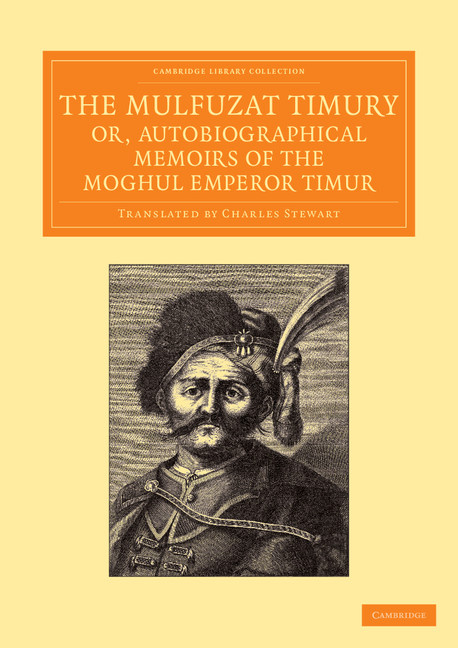
The Mughal emperor Timur (1336–1405), known also as Tamerlane, conquered large parts of central Asia in the fourteenth and early fifteenth centuries. He was renowned for being an exceptionally good military strategist, but also for being a ruthless conqueror. His purported autobiography was not published in English until 1830, when it was translated by the orientalist Charles Stewart (1764–1837) from a Persian version of the Chagatai original. This reissue offers an insight into Timur's motives and the detail of his strategy. The book begins with a statement of the principles that he ruled by, along with an account of certain events which led him to believe he was receiving divine aid. The narrative then becomes chronological and covers the period of his life up to 1375, when Timur was in his forties.
Contents
Contents
Metrics
Altmetric attention score
Full text views
Full text views helpTotal number of HTML views: 0
Total number of PDF views: 0 *
 Loading metrics...
* Views captured on Cambridge Core between #date#. This data will be updated every 24 hours.
Usage data cannot currently be displayed.
Accessibility standard: Unknown
Why this information is here
This section outlines the accessibility features of this content - including support for screen readers, full keyboard navigation and high-contrast display options. This may not be relevant for you.
Accessibility Information
Accessibility compliance for the PDF of this book is currently unknown and may be updated in the future.