Multilingualism and History

-
Select format
-
- Publisher:
- Cambridge University Press
- Publication date:
- 20 April 2023
- 27 April 2023
- ISBN:
- 9781009236287
- 9781009236256
- 9781009236263
- Dimensions:
- (229 x 152 mm)
- Weight & Pages:
- 0.6kg, 312 Pages
- Dimensions:
- (229 x 152 mm)
- Weight & Pages:
- 0.436kg, 312 Pages
You may already have access via personal or institutional login
Show more authors 
You may already have access via personal or institutional login
Book description
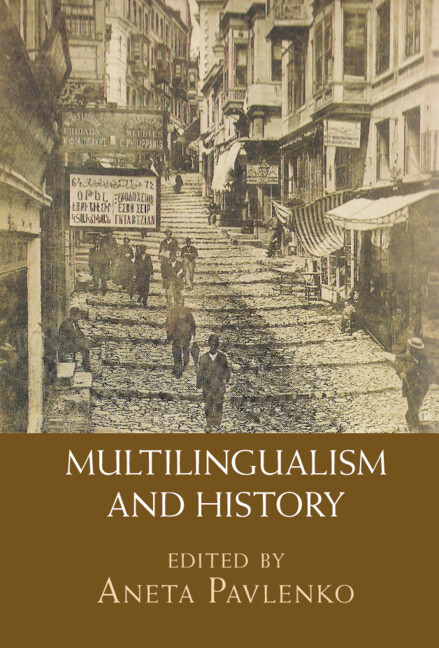
We often hear that our world 'is more multilingual than ever before', but is it true? This book shatters that cliché. It is the first volume to shine light on the millennia-long history of multilingualism as a social, institutional and demographic phenomenon. Its fifteen chapters, written in clear, accessible language by prominent historians, classicists, and sociolinguists, span the period from the third century BC to the present day, and range from ancient Rome and Egypt to medieval London and Jerusalem, from Russian, Ottoman and Austro-Hungarian empires to modern Norway, Ukraine, and Spain. Going against the grain of traditional language histories, these thought-provoking case studies challenge stereotypical beliefs, foreground historic normativity of institutional multilingualism and language mixing, examine the transformation of polyglot societies into monolingual ones, and bring out the cognitive and affective dissonance in present-day orientations to multilingualism, where 'celebrations of linguistic diversity' coexist uneasily with creation of 'language police'.
Awards
Honorable Mention, 2026 Prize for an Edited Collection, Modern Language Association
Reviews
‘The book decisively puts to rest any idea that the present is more multilingual than the past, while encouraging historians and linguists to reckon with the methodologies, challenges, and tools of each other’s disciplines. Pavlenko has produced a volume that is instructive for historians, demonstrating how sociolinguistic approaches to historic sources can offer new insights into past societies, especially in accessing the lived realities of non-elite communities. At the same time, the book will surely be of interest to linguists, as the collected chapters definitively prove how rewarding the study of written sources can be in sociolinguistic analysis.’
Alison John Source: Language in Society
Contents
Contents
Metrics
Altmetric attention score
Full text views
Full text views helpTotal number of HTML views: 0
Total number of PDF views: 0 *
 Loading metrics...
* Views captured on Cambridge Core between #date#. This data will be updated every 24 hours.
Usage data cannot currently be displayed.
Accessibility standard: Unknown
Why this information is here
This section outlines the accessibility features of this content - including support for screen readers, full keyboard navigation and high-contrast display options. This may not be relevant for you.
Accessibility Information
Accessibility compliance for the HTML of this book is currently unknown and may be updated in the future.