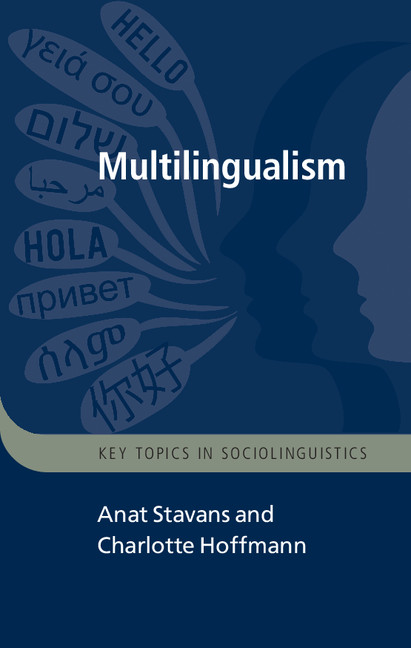
Multilingualism

-
Select format
-
- Publisher:
- Cambridge University Press
- Publication date:
- 05 February 2015
- 12 January 2015
- ISBN:
- 9781316144534
- 9781107092990
- 9781107471481
- Dimensions:
- (216 x 138 mm)
- Weight & Pages:
- 0.54kg, 319 Pages
- Dimensions:
- (216 x 138 mm)
- Weight & Pages:
- 0.44kg, 319 Pages
- Series:
- Key Topics in Sociolinguistics
- Subjects:
- Sociology: General Interest, Sociolinguistics, Applied Linguistics, Language and Linguistics
You may already have access via personal or institutional login- Series:
- Key Topics in Sociolinguistics
- Subjects:
- Sociology: General Interest, Sociolinguistics, Applied Linguistics, Language and Linguistics
Show more authors 
You may already have access via personal or institutional login
Book description
How do children and adults become multilingual? How do they use their languages? What influence does being multilingual have on their identities? What is the social impact of multilingualism today and how do societies accommodate it? These are among the fascinating questions examined by this book. Exploring multilingualism in individuals and in society at large, Stavans and Hoffmann argue that it evolves not from one factor in particular, but from a vast range of environmental and personal influences and circumstances: from migration to globalisation, from the spread of English to a revived interest in minority languages, from social mobility to intermarriage. The book shows the important role of education in helping to promote or maintain pupils' multilingual language competence and multilingual literacy, and in helping to challenge traditional monolingual attitudes. A clear and incisive account of this growing phenomenon, it is essential reading for students, teachers and policy-makers alike.
Reviews
‘The authors of this book demonstrate that multilingualism is as old as humanity itself. Language and politics have always been intertwined, creating amazing and conflictual complexity … This is a very clear and highly informative book.'
Jean-Marc Dewaele - Birkbeck, University of London
Contents
Contents
Metrics
Full text views
Full text views helpTotal number of HTML views: 0
Total number of PDF views: 0 *
 Loading metrics...
* Views captured on Cambridge Core between #date#. This data will be updated every 24 hours.
Usage data cannot currently be displayed.
Accessibility standard: Unknown
Why this information is here
This section outlines the accessibility features of this content - including support for screen readers, full keyboard navigation and high-contrast display options. This may not be relevant for you.
Accessibility Information
Accessibility compliance for the PDF of this book is currently unknown and may be updated in the future.