
Skip to main content Accessibility help
×
  • Cited by 1
    • Show more authors
    • Open Access
      You have digital access to this book
    • Select format
    • Publisher:
      Cambridge University Press
      Publication date:
      04 January 2024
      11 January 2024
      ISBN:
      9781009441483
      9781009441469
      Creative Commons:
      Creative Common License - CC Creative Common License - BY Creative Common License - NC
      This content is Open Access and distributed under the terms of the Creative Commons Attribution licence CC-BY-NC 4.0.
      https://creativecommons.org/creativelicenses
      Dimensions:
      (216 x 140 mm)
      Weight & Pages:
      0.48kg, 280 Pages
      Dimensions:
      Weight & Pages:
    Open Access
    You have digital access to this book
    Selected: Digital
    View content
    Add to cart View cart Buy from Cambridge.org

    Book description

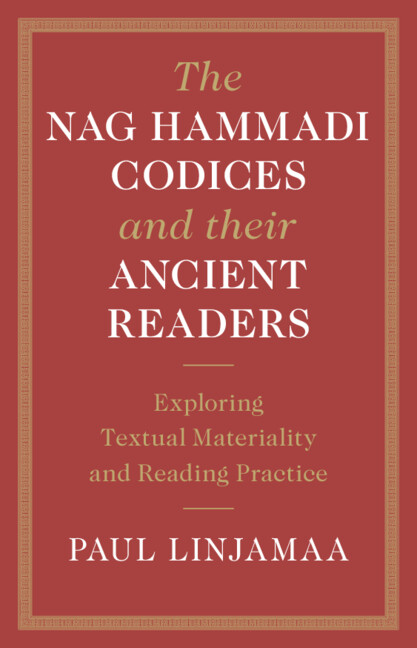
    Since their discovery in 1945, the Nag Hammadi Codices have generated questions and scholarly debate as to their date and function. Paul Linjamaa contributes to the discussion by offering insights into previously uncharted aspects pertinent to the materiality of the manuscripts. He explores the practical implementation of the texts in their ancient setting through analyses of codicological aspects, paratextual elements, and scribal features. Linjamaa's research supports the hypothesis that the Nag Hammadi texts had their origins in Pachomian monasticism. He shows how Pachomian monks used the texts for textual edification, spiritual development and pedagogical practices. He also demonstrates that the texts were used for perfecting scribal and editorial practice, and that they were used as protective artefacts containing sacred symbols in the continuous monastic warfare against evil spirits. Linjamaa's application of new material methods provides clues to the origins and use of ancient texts, and challenges preconceptions about ancient orthodoxy. This title is also available as Open Access on Cambridge Core.

    Refine List

    Actions for selected content:

    Select all | Deselect all
    • View selected items
    • Export citations
    • Download PDF (zip)
    • Save to Kindle
    • Save to Dropbox
    • Save to Google Drive

    Save Search

    You can save your searches here and later view and run them again in "My saved searches".

    Please provide a title, maximum of 40 characters.
    ×

    Contents

    Full book PDF
    • The Nag Hammadi Codices and their Ancient Readers
      pp i-ii
    • Copyright page
      pp iv-iv
    • Contents
      pp v-vii
    • Figures
      pp viii-viii
    • Acknowledgements
      pp ix-x
    • Note on Transcription and Translation
      pp xi-xii
    • Abbreviations
      pp xiii-xiv
    • Introduction
      pp 1-22
    • The Provenance Controversy
    • 1 - Christian Book Culture, New Philology and Gnosticism
      pp 23-48
    • 2 - The Find Story and the Ethics of Postmodern Manuscript Archaeology
      pp 49-67
    • 3 - The Construction of Codex I: Scribal Errors as Clues to Context
      pp 68-84
    • 4 - Notes Made by Monks: The Marginal Markings in Codex I and Codex VIII
      pp 85-119
    • 5 - Vowel Constellations and Secret Language
      pp 120-167
    • 6 - The Sacred Symbols in the Nag Hammadi Codices: Books as Weapons in Demonic War
      pp 168-186
    • 7 - Textual Fluidity and Multiple Versions in Monastic Textual Practice
      pp 187-223
    • Conclusion: The Nag Hammadi Codices from a ‘Textual Community’ Perspective
      pp 224-233
    • Bibliography
      pp 234-260
    • Index
      pp 261-266

    Metrics

    Altmetric attention score

    Full text views

    Total number of HTML views: 0
    Total number of PDF views: 0 *
    Loading metrics...

    Book summary page views

    Total views: 0 *
    Loading metrics...

    * Views captured on Cambridge Core between #date#. This data will be updated every 24 hours.

    Usage data cannot currently be displayed.

    Accessibility standard: Unknown

    Why this information is here

    This section outlines the accessibility features of this content - including support for screen readers, full keyboard navigation and high-contrast display options. This may not be relevant for you.

    Accessibility Information

    Accessibility compliance for the HTML of this book is currently unknown and may be updated in the future.
