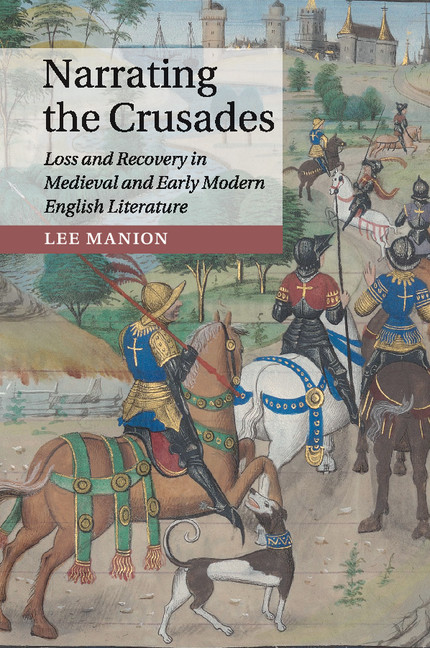
Narrating the Crusades

-
Select format
-
- Publisher:
- Cambridge University Press
- Publication date:
- 05 June 2014
- 24 April 2014
- ISBN:
- 9781107415218
- 9781107057814
- 9781107664715
- Dimensions:
- (228 x 152 mm)
- Weight & Pages:
- 0.58kg, 320 Pages
- Dimensions:
- (229 x 152 mm)
- Weight & Pages:
- 0.46kg, 322 Pages
You may already have access via personal or institutional login
Show more authors 
You may already have access via personal or institutional login
Book description
In Narrating the Crusades, Lee Manion examines crusading's narrative-generating power as it is reflected in English literature from c.1300 to 1604. By synthesizing key features of crusade discourse into one paradigm, this book identifies and analyzes the kinds of stories crusading produced in England, uncovering new evidence for literary and historical research as well as genre studies. Surveying medieval romances including Richard Cœur de Lion, Sir Isumbras, Octavian, and The Sowdone of Babylone alongside historical practices, chronicles, and treatises, this study shows how different forms of crusading literature address cultural concerns about collective and private action. These insights extend to early modern writing, including Spenser's Faerie Queene, Marlowe's Tamburlaine, and Shakespeare's Othello, providing a richer understanding of how crusading's narrative shaped the beginning of the modern era. This first full-length examination of English crusading literature will be an essential resource for the study of crusading in literary and historical contexts.
Reviews
'… a timely, impressively argued, and carefully researched intervention in the field. … Narrating the Crusades is an immaculately organized and interconnected argument that engaged a wide variety of texts, draws compelling parallels between historical and literary works, and demonstrates both the necessity - and benefit - of an interdisciplinary approach to the crusading romance subgenre. Balancing previous scholarly treatments while calling for changes in perspective and method, Manion provides a model for insightful intervention.'
Leila K. Norako Source: Journal of British Studies
'Lee Manion provides a valuable study of the evolution and impact of English crusading literature on English society during the period from ca.1300 to 1604 … Manion has succeeded in providing a thoughtful and careful consideration of these issues that will be of use to scholars in the fields of both history and literature, particularly for those who consider the cultural implications of the evolution of crusading in England from the medieval to early modern period.'
Andrew Holt Source: Renaissance Quarterly
'Manion’s key interventions are twofold: a rearticulation of the 'subgenre' of Middle English romance commonly referred to as 'crusading romance', and the demonstration that the long history of crusading ideology troubles our traditional period boundaries between medieval and early modern … Narrating the Crusades is a book that will be of great interest to both scholars of romance and crusade historians.'
Heather Blurton Source: Speculum
'Of obvious interest to historians and literary scholars, medievalists and early modernists, Manion’s book demonstrates the value of using literary texts, and especially romance, in the study of the crusades, and of viewing the crusades as a fruitful context for cultural production … Overall, Narrating the Crusades demonstrates the topical potential of the romance, a genre whose utility is often seen to lie in its entertainment value.'
Mimi Ensley Source: Studies in the Age of Chaucer
Contents
Contents
References
Bibliography
Primary sources
, Continuatio chronicarum, ed. . London, 1889.
, Chronicon, ed. and trans. , 2nd edn. London, 1904.
, The History of the Holy War: Ambroise’s “Estoire de la Guerre Sainte,” ed. and , trans. , 2 vols. Woodbridge: Boydell Press, 2003.
, An Advertisement Touching a Holy War, introduction by . Prospect Heights, IL: Waveland Press, 2000.
, Advertisement Touching an Holy Warre, in The Works of Francis Bacon, ed. , , and . London, 1859, vol. vii, pp. 1–36.
, Essayes or Counsels, Civill and Morall, ed. , 3rd edn. London, 1899.
, Godeffroy of Boloyne, ed. , EETS e.s. 64. London, 1893.
The “Chanson d’Antioche”:An Old French Account of the First Crusade, trans. and . Burlington, VT: Ashgate, 2011.
, The Riverside Chaucer, 3rd edn., ed. . Boston: Houghton Mifflin, 1987.
Christopher Marlowe: The Plays and Their Sources, ed. and . New York: Routledge, 1994.
Chronicle of the Third Crusade: A Translation of the “Itinerarium peregrinorum et gesta Regis Ricardi,” ed. and trans. . Aldershot: Ashgate, 1997.
Chronicles and Memorials of the Reign of Richard I, ed. . London, 1864.
, The Works of Sir John Clanvowe, ed. . Cambridge: D. S. Brewer, 1965.
The Conquest of Jerusalem and the Third Crusade: Sources in Translation, trans. . Aldershot: Ashgate, 1998.
The Crusade of Frederick Barbarossa: The History of the Expedition of the Emperor Frederick and Related Texts, trans. . Burlington, VT: Ashgate, 2010.
, A Notable Historie of the Saracens, trans. . London, 1575.
Cursor mundi, ed. , EETS o.s. 57. London, 1874.
De expugnatione Lyxbonensi: The Conquest of Lisbon, ed. and trans. . New York: Columbia University Press, 1936.
Decrees of the Ecumenical Councils, ed. , 2 vols. Washington, DC: Georgetown University Press, 1990.
The Defective Version of Mandeville’s Travels, ed. , EETS o.s. 319. Oxford University Press, 2002.
Directorium ad passagium faciendum, in Recueil des historiens des croisades: documents arméniens, 2 vols. Paris, 1869–1906, vol. ii, pp. 367–517.
, De recuperatione Terre Sancte, ed. . Florence: Leo S. Olschki, 1977.
, The Recovery of the Holy Land, trans. . New York: Columbia University Press, 1956.
Excidii Aconis gestorum collectio; Ystoria de desolatione et conculcatione civitatis Acconensis et tocius Terre Sancte, ed. , CCCM 202. Turnhout: Brepols, 2004.
A Famous Victorie, Atchiued in August last 1613 by the Christian Gallies of Sicilia, against the Turkes. London, 1613.
, Liber recuperationis Terrae Sanctae, in Biblioteca bio-bibliografia della Terra Sancta e dell’ Oriente francescano, ed. , 5 vols. Quaracchi, 1906–27, vol. ii, pp. 9–60.
The First Crusade: The Chronicle of Fulcher of Chartres and Other Source Materials, ed. , 2nd edn. Philadelphia: University of Pennsylvania Press, 1998.
Four Middle English Romances: Sir Isumbras, Octavian, Sir Eglamour of Artois, Sir Tryamour, ed. . Kalamazoo, MI: Medieval Institute Publications, 1996.
, The Unabridged Acts and Monuments Online. Sheffield: HRI Online Publications, 2011. www.johnfoxe.org, accessed 15 August 2012.
Fulcher of Chartres, A History of the Expedition to Jerusalem, 1095–1127, ed. , trans. . Knoxville: University of Tennessee Press, 1969.
Fulcheri Carnotensis Historia Hierosolymitana (1095–1127), ed. . Heidelberg, 1913.
, The Historie of the Holy Warre. London, 1639.
, The Posies, ed. . Cambridge University Press, 1907.
, A Shorte Treatise vpon the Turkes Chronicles, trans. . London, 1546.
, Vox clamantis, in The Complete Works of John Gower: The Latin Works, ed. , vol. iv. Oxford, 1902.
, The Chronicle of Henry of Livonia, trans. , 2nd edn. New York: Columbia University Press, 2003.
Henslowe’s Diary, ed. , 2 vols. London, 1904–8.
, Thomas Heywood’s “The Four Prentices of London”: A Critical, Old-Spelling Edition, ed. . New York: Garland Publishing, 1980.
, The Golden Legend, trans. , 2 vols. Princeton University Press, 1993.
, The Historie of George Castriot, surnamed Scanderbeg, King of Albanie, trans. . London, 1596.
The Jews and the Crusaders: The Hebrew Chronicles of the First and Second Crusades, ed. and trans. . Hoboken, NJ: KTAV Publishing, 1996.
Johannis de Trokelowe et Henrici de Blaneforde: Chronica et annales, ed. . London, 1866.
, The Nine Worthies of London. London, 1592.
, The Generall Historie of the Turkes. London, 1603.
Laud Troy Book, ed. , EETS o.s. 121–2, 2 vols. London, 1902–3.
Libellus de vita et miraculis S. Godrici, heremitae de Finchale, ed. . London, 1847.
Liber Ioannis Mandevil, ed. , in The Principall Navigations, Voiages and Discoveries of the English Nation (London, 1589), Hakluyt Society e.s. 39, 2 vols. Cambridge University Press, 1965, vol. i, pp. 23–79.
Liturgies and Occasional Forms of Prayer Set Forth in the Reign of Queen Elizabeth, ed. . Cambridge, 1847.
, Liber de fine, ed. , Raimundi Lulli opera latina 9, CCCM 35. Turnhout: Brepols, 1981, pp. 250–91.
, Crusade Propaganda and Ideology: Model Sermons for the Preaching of the Cross. Cambridge University Press, 2000.
, Tamburlaine the Great, ed. . Baltimore: The Johns Hopkins University Press, 1981.
, Chronica majora, ed. , 7 vols. London, 1872–83.
, Matthew Paris’s English History, trans. , 3 vols. London, 1852–54.
Middle English Romances, ed. . New York: W. W. Norton & Co., 1995.
Monumenta Germaniae Historica: Scriptorum, ed. et al., 32 vols. Hanover: 1826–1934.
, The Chronicle of Prussia by Nicolaus von Jeroschin: A History of the Teutonic Knights in Prussia, 1190–1331, trans. . Burlington, VT: Ashgate, 2010.
Octovian, ed. , EETS o.s. 289. London: Oxford University Press, 1986.
Octovian Imperator: Ed. from MS BL Cotton Caligula A.ii, ed. . Heidelberg: Carl Winter, 1979.
Ordinacio de predicacione Sancti Crucis in Anglia, in Quinti belli sacri scriptores minores, ed. , Société de l’Orient Latin 2. Geneva, 1879, pp. 1–26.
Original Letters Illustrative of English History, ed. , 3rd series. London, 1846, vol. i.
, Letter to King Richard II: A Plea Made in 1395 for Peace between England and France, ed. and trans. . New York: Barnes & Noble Books, 1976.
Piracy, Slavery, and Redemption: Barbary Captivity Narratives from Early Modern England, ed. , introduction by . New York: Columbia University Press, 2001.
The Poems of James VI of Scotland, ed. . Edinburgh: William Blackwood & Sons, 1955, vol. i.
Political, Religious, and Love Poems, ed. , EETS o.s. 15. London, 1866.
Recueil des historiens des croisades: historiens occidentaux, ed. et al., 5 vols. Paris, 1844–95.
Richard Cœur de Lion: Der Mittelenglische Versroman über Richard Löwenherz, ed. . Vienna: Wilhelm Braumüller, 1913.
, Gesta Philippi Augusti, in Oeuvres de Rigord et de Guillaume le Breton: historiens de Philippe-Auguste, ed. , 2 vols. Paris, 1882.
, The Metrical Chronicle of Robert of Gloucester, ed. , 2 vols. London, 1887.
Robert the Monk’s History of the First Crusade: “Historia Iherosolimitana,” trans. . Burlington, VT: Ashgate, 2005.
, The Annals of Roger de Hoveden, trans. , 2 vols. London, 1853.
, Chronica, ed. , 4 vols. London, 1868–71.
, Gesta regis Henrici secundi, ed. , 2 vols. London, 1867.
The Romaunce of the Sowdone of Babylone, ed. , EETS e.s. 38. London, 1881.
, Liber secretorum fidelium crucis, in Gesta Dei per Francos, ed. , 2 vols. Hanover, 1611, vol. ii, pp. 1–288. Reprinted with introduction by Joshua Prawer, Jerusalem, 1972.
, Marino Sanudo Torsello, The Book of the Secrets of the Faithful of the Cross, trans. . Burlington, VT: Ashgate, 2011.
, Othello, the Moor of Venice, ed. . New York: Oxford University Press, 2006.
Sir Ysumbras, ed. and , Palaestra 15. Berlin: Mayer & Muller, 1901, pp. 1–128.
Six Middle English Romances, ed. . London: J. M. Dent & Sons, 1973.
, The Ottoman of Lazaro Soranzo, trans. . London, 1603.
, The Faerie Queene, ed. , rev. 2nd edn. New York: Longman, 2007.
, The Works of Edmund Spenser: The Minor Poems, ed. and , with ., 2 vols. Baltimore: The Johns Hopkins Press, 1947.
The Thornton Romances, ed. , Camden Society 30. London, 1844.
Three Middle English Charlemagne Romances, ed. . Kalamazoo, MI: Medieval Institute Publications, 1990.
Three Turk Plays from Early Modern England, ed. . New York: Columbia University Press, 2000.
Turpines Story: A Middle English Translation of the “Pseudo-Turpin Chronicle,” ed. , EETS, o.s. 322. New York: Oxford University Press, 2004.
Vitae paparum Avenionensium, ed. , rev. , 2 vols. Paris: Librairie Letouzey et Ané, 1914–27.
, The Chronica maiora of Thomas Walsingham, 1376–1422, ed. , trans. . Woodbridge: Boydell Press, 2005.
, Chronica monasterii s. Albani: historia Anglicana, ed. , 2 vols. London, 1863–4.
The Westminster Chronicle, 1381–1394, ed. and trans. and . Oxford: Clarendon Press, 1982.
, The English Mirror. London, 1586.
, Gesta regum Anglorum: The History of the English Kings, ed. and trans. , , and , 2 vols. Oxford: Clarendon Press, 1998.
Secondary sources
, Sanctifying Signs: Making Christian Tradition in Late Medieval England. University of Notre Dame Press, 2004.
, and , “How English are the English Charlemagne Romances?” in Boundaries in Medieval Romance, ed. . Cambridge: D. S. Brewer, 2008, pp. 43–55.
, “The Hunger for National Identity in Richard Coer de Lion,” in Reading Medieval Culture: Essays in Honor of Robert W. Hanning, ed. and . University of Notre Dame Press, 2005, pp. 198–227.
, Idols in the East: European Representations of Islam and the Orient, 1100–1450. Ithaca, NY: Cornell University Press, 2009.
, “Cannibalism and Cultural Encounters in Richard Coeur de Lion,” Journal of Medieval and Early Modern Studies 29(3) (1999): 499–528.
, Imagined Communities: Reflections on the Origin and Spread of Nationalism, 2nd edn. New York: Verso, 1991.
, “War and Peace in ‘The Lepanto’ of James VI and I,” Modern Philology 97(3) (2000): 333–63.
, “The Shrine as Mediator: England, Castile, and the Pilgrimage to Compostela,” in England and Iberia in the Middle Ages, 12th–15th Century: Cultural, Literary, and Political Exchanges, ed. . New York: Palgrave Macmillan, 2007, pp. 47–65.
, “‘Exile-and-return’ and English Law: The Anglo-Saxon Inheritance of Insular Romance,” Literature Compass 3 (2006): 300–17.
, The Crusade in the Later Middle Ages, 2nd edn. New York: Kraus Reprint Corporation, 1965.
, “Evolution of the Popular Hero in the English Octavian Romances,” Modern Language Quarterly 51 (1990): 363–88.
, “The Pastoureaux of 1320,” Journal of Ecclesiastical History 32 (1981): 143–66.
, Before Orientialism: London’s Theatre of the East, 1576–1626. Cambridge University Press, 2003.
, English Medieval Romance. New York: Longman, 1987.
, “Making More of the Moor: Aaron, Othello, and Renaissance Refashionings of Race,” Shakespeare Quarterly 41(4) (1990): 433–54.
, Speaking of the Moor: From “Alcazar” to “Othello.”Philadelphia: University of Pennsylvania Press, 2008.
, Spectacles of Strangeness: Imperialism, Alienation, and Marlowe. Philadelphia: University of Pennsylvania Press, 1993.
, “Shakespeare’s Islands,” in Shakespeare and the Mediterranean, ed. , , and . Newark: University of Delaware Press, 2004, pp. 289–307.
, “Parallel Passages in Bacon and Fuller,” Review of English Studies 13(52) (1937): 449–53.
, “Saint George and the Formation of English Nationalism,” Journal of Medieval and Early Modern Studies 27(2) (1997): 317–40.
, “Military Aspects of the Siege of Lisbon,” in The Second Crusade: Scope and Consequences, ed. and . New York: Palgrave Macmillan, 2001, pp. 71–89.
, “‘Are we turned Turks?’: English Pageants and the Stuart Court,” Comparative Drama 44(3) (2010): 255–75.
, “Affective Vengeance in Titus and Vespasian,” Chaucer Review 43(3) (2009): 330–44.
, Creating East and West: Renaissance Humanists and the Ottoman Turks. Philadelphia: University of Pennsylvania Press, 2004.
, Guilds and Civil Society in European Political Thought from the Twelfth Century to the Present. Ithaca, NY: Cornell University Press, 1984.
, “The Formation of the ‘Crusade Idea’,” Journal of Ecclesiastical History 21(1) (1970): 11–31.
, Poets, Saints, and Visionaries of the Great Schism, 1378–1417. University Park, PA: Penn State University Press, 2006.
, , and , eds., The Vernacular Spirit: Essays on Medieval Religious Literature. New York: Palgrave Macmillan, 2002.
, “‘Sir Isumbras’ and the Legend of Saint Eustace,” Mediaeval Studies 27 (1965): 128–51.
, The Friend. University of Chicago Press, 2003.
, Chaucer and His World. Cambridge: D. S Brewer, 1978.
, “The Myth of Shah Ismail Safavi: Political Rhetoric and ‘Divine’ Kingship,” in Medieval Christian Perceptions of Islam, ed. . New York: Garland, 1996, pp. 331–60.
, “‘Cruce Signari’: The Rite for Taking the Cross in England,” Traditio 22 (1966): 289–310.
, Medieval Canon Law and the Crusader. Madison: University of Wisconsin Press, 1969.
, “Origins,” in The Oxford Illustrated History of the Crusades, ed. . Oxford University Press, 1995, pp. 13–33.
, “Overlapping and Competing Identities in the Frankish First Crusade,” in Le Concile de Clermont de 1095 et l’appel à la croisade: Actes du Colloque Universitaire International de Clermont-Ferrand, 23–25 juin 1995. Rome: Collection de l’École Française de Rome, 1997, pp. 195–211.
, “Wars of Religion and Royalist Political Thought,” in England’s Wars of Religion, Revisited, ed. and . Burlington, VT: Ashgate, 2011, pp. 169–92.
, “Marlovian Imitation and Interpretation in Heywood’s The Four Prentices of London,” Cahiers Élisabéthains 32 (1987): 75–8.
, “Tamburlaine the Great, Parts One and Two,” in The Cambridge Companion to Christopher Marlowe, ed. . Cambridge University Press, 2004, pp. 127–43.
, Traffic and Turning: Islam and English Drama, 1579–1624. Newark: University of Delaware Press, 2005.
, The Familiar Enemy: Chaucer, Language, and Nation in the Hundred Years War. Oxford University Press, 2010.
, Holy Feast and Holy Fast: The Religious Significance of Food to Medieval Women. Berkeley: University of California Press, 1987.
, Saracens and the Making of English Identity: The Auchinleck Manuscript. New York: Routledge, 2005.
, European Jewry and the First Crusade. Berkeley: University of California Press, 1987.
, God, Humanity, and History: The Hebrew First Crusade Narratives. Berkeley: University of California Press, 2000.
, “‘A Crusade from the First’: The Norman Conquest of Islamic Sicily, 1060–1091,” Al-Masãq 22(2) (2010): 191–225.
, “Between Romance and Legend: ‘Secular Hagiography’ in Middle English Literature,” Philological Quarterly 57 (1978): 311–22.
, The Northern Crusades: The Baltic and the Catholic Frontier, 1100–1525, 2nd edn. London: Penguin, 1997.
, From Memory to Written Record: England 1066–1307, 2nd edn. Malden, MA: Blackwell, 1993.
, A Knight of Great Renown: The Life and Times of Othon de Grandson. University of Chicago Press, 1961.
, Sanctifying the Name of God: Jewish Martyrs and Jewish Memories of the First Crusade. Philadelphia: University of Pennsylvania Press, 2004.
, The Preaching of the Crusades to the Holy Land, 1095–1270. Cambridge, MA: Medieval Academy of America, 1991.
, “Philippa of Lancaster, Queen of Portugal – and Patron of the Gower Translations?” in England and Iberia in the Middle Ages, 12th–15th Century: Cultural, Literary, and Political Exchanges, ed. . New York: Palgrave Macmillan, 2007, pp. 135–65.
, “Guy of Warwick, Godfrey of Bouillon, and Elizabethan Repertory,” Early Theatre 12(2) (2009): 207–22.
, “The Historiography of the Crusades,” in The Crusades from the Perspective of Byzantium and the Muslim World, ed. and . Washington, DC: Dumbarton Oaks, 2001, pp. 1–22.
, The English Romance in Time: Transforming Motifs from Geoffrey of Monmouth to the Death of Shakespeare. Oxford University Press, 2004.
, “Romance after 1400,” in The Cambridge History of Medieval English Literature, ed. . Cambridge University Press, 2002, pp. 690–719.
, “A Letter from Babylon: Henry VI and the Sultan of Syria,” Al-Masãq 14(1) (2002): 17–24.
, “The English Charlemagne Romances,” in Roland and Charlemagne in Europe: Essays on the Reception and Transformation of a Legend, ed. . London: King’s College Centre for Late Antique and Medieval Studies, 1996, pp. 149–68.
, “Pope Urban II and the Idea of Crusade,” Studi Medievali, 3rd series, 36 (1995): 721–42.
, Insular Romance: Politics, Faith, and Culture in Anglo-Norman and Middle English Literature. Berkeley: University of California Press, 1986.
, and , “Middle English Popular Romance and National Identity,” in A Companion to Medieval Popular Romance, ed. and . Cambridge: D. S. Brewer, 2009, pp. 79–95.
, “War or Peace? Philippe de Mézières, Richard II and Anglo-French Diplomacy,” in Philippe de Mézières and His Age: Piety and Politics in the Fourteenth Century, ed. and . Leiden: Brill, 2011, pp. 295–319.
, The Arabs and Mediaeval Europe. London: Longman, 1975.
, Chivalry and Romance in the English Renaissance. Cambridge: D. S. Brewer, 2003.
and , eds., Placing the Plays of Christopher Marlowe: Fresh Cultural Contexts. Burlington, VT: Ashgate, 2008.
, Columbus and the Quest for Jerusalem. New York: Free Press, 2011.
, “Columbus’s Ultimate Goal: Jerusalem,” Comparative Studies in Society and History 48 (2006): 260–92.
, “‘Tamburlaine’ Sources Once More,” Studies in Philology 46(2) (1949): 154–66.
, The English Reformation, 2nd edn. University Park, PA: Penn State University Press, 1991.
, The Children’s Crusade: Medieval History, Modern Mythistory. New York: Palgrave Macmillan, 2008.
, and , “Poetic Fiction and Poetic Reality: The Case of the Romance Crusade Lyrics,” Neophilologus 79 (1995): 13–24.
, “‘Captive to the Turke’: Responses to the Anglo-Ottoman Capitulations of 1580,” in Cultural Encounters between East and West, 1453–1699, ed. and . Newcastle-upon-Tyne: Cambridge Scholars Press, 2005, pp. 43–63.
, “‘Machomet dyd before as Luther doth nowe’: Islam, the Ottomans and the English Reformation,” Reformation 9 (2004): 99–130.
, New Turkes: Dramatizing Islam and the Ottomans in Early Modern England. Burlington, VT: Ashgate, 2005.
, The Medieval Lyric, 2nd edn. London: Hutchinson, 1978.
, The Stripping of the Altars: Traditional Religion in England 1400–1580, 2nd edn. New Haven: Yale University Press, 2005.
, , and , “Faithful unto Death: The Tomb Slab of Sir William Neville and Sir John Clanvowe, Constantinople 1391,” Antiquaries Journal 71 (1991): 174–90.
, “The Destruction d’Acre and its Epistolary Prologue (BNF FR.24430),” Viator 42(1) (2011): 139–78.
, “Catalina of Lancaster, the Castilian Monarchy and Coexistence,” in Medieval Spain: Culture, Conflict, and Coexistence: Studies in Honour of Angus MacKay, ed. and . New York: Palgrave Macmillan, 2002, pp. 79–122.
, “The Crusade of the Teutonic Knights against Lithuania Reconsidered,” in Crusade and Conversion on the Baltic Frontier, 1150–1500, ed. . Burlington, VT: Ashgate, 2001, pp. 21–44.
, Beautiful Death: Jewish Poetry and Martyrdom in Medieval France. Princeton University Press, 2002.
, “‘Tu es pélérin en la sainte cité’: Chaucer’s Knight and Philippe de Mézières,” Studies in Philology 106(4) (2009): 379–401.
, Reform and Reformation: England, 1509–1558. Cambridge, MA: Harvard University Press, 1977.
, The Origin of the Idea of Crusade, trans. and . Princeton University Press, 1977.
, “Marriage As a Means of Conversion in Pierre Dubois’ De recuperatione Terre Sancte,” in Christianizing Peoples and Converting Individuals, ed. and . Turnhout: Brepols, 2000, pp. 195–202.
, Rereading Middle English Romance: Manuscript Layout, Decoration, and the Rhetoric of Composite Structure. London: McGill-Queen’s University Press, 1995.
, “Rereading Clement in Thomas Chestre’s Octavian and in BL Cotton Caligula A.ii,” Essays in Medieval Studies 26 (2010): 85–99.
, “St George as Romance Hero,” Reading Medieval Studies 19 (1993): 27–54.
, “Caxton’s Concept of ‘Historical Romance’ within the Context of the Crusades: Conviction, Rhetoric and Sales Strategy,” in Tradition and Transformation in Medieval Romance, ed. . Cambridge: D. S. Brewer, 1999, pp. 101–13.
, “The King over the Water: Exile-and-Return Revisited,” in Cultural Encounters in the Romance of Medieval England, ed. . Cambridge: D. S. Brewer, 2005, pp. 41–53.
, “Definitions of Middle English Romance,” Chaucer Review 15 (1980–1): 44–62, 168–81.
, “Legendary Ancestors and the Expansion of Romance in Richard, Coer de Lyon,” English Studies 79 (1998): 299–308.
, “Richard, Coer de Lyon: Romance, History or Something in Between?” Studies in Philology 87 (1990): 156–80.
, “‘Like a Mercenary Poet’: The Politics and Poetics of James VI’s Lepanto,” in Older Scots Literature, ed. . Edinburgh: John Donald Publishers, 2005, pp. 540–59.
, “Women’s Secrets: Childbirth, Pollution, and Purification in Northern Octavian,” Studies in the Age of Chaucer 30 (2008): 235–68.
, Literary Character: The Human Figure in Early English Writing. Ithaca, NY: Cornell University Press, 2003.
, “The Romance Hypothetical: Lordship and the Saracens in Sir Isumbras,” in The Spirit of Medieval English Popular Romance, ed. and . London: Longman, 2000, pp. 97–121.
, The Crusades and the Expansion of Catholic Christendom, 1000–1714. New York: Routledge, 2005.
, Victory in the East: A Military History of the First Crusade. New York: Cambridge University Press, 1994.
, Anatomy of Criticism: Four Essays. Princeton University Press, 1957.
, “Chanson de geste as Romance in Medieval England,” in The Exploitations of Medieval Romance, ed. , , and . Cambridge: D. S. Brewer, 2010, pp. 57–72.
, An Empire of Memory: The Legend of Charlemagne, the Franks, and Jerusalem before the First Crusade. Oxford University Press, 2011.
, “2 Tamburlaine, Marlowe’s ‘War against the Gods,’” English Studies in Canada 11(2) (1985): 178–92.
, Image, Text, and Religious Reform in Fifteenth-Century England. Cambridge University Press, 2010.
, Parliament and Literature in Late Medieval England. Cambridge University Press, 2010.
, Richard I. New Haven: Yale University Press, 1999.
, John of Gaunt: The Exercise of Princely Power in Fourteenth-Century Europe. New York: St. Martin’s Press, 1992.
, Chivalry and Exploration, 1298–1630. Woodbridge: Boydell Press, 1998.
, Renaissance Self-Fashioning: From More to Shakespeare. University of Chicago Press, 1980.
, Renaissance Revivals: City Comedy and Revenge Tragedy in the London Theatre, 1576–1980. University of Chicago Press, 1986.
, “‘A warre … commodious’: Dramatizing Islamic Schism in and after Tamburlaine,” Texas Studies in Literature and Language 54(1) (2012): 45–78.
, “Othello, Otuel, and the English Charlemagne Romances,” Review of English Studies, n.s. 38(149) (1987): 50–5.
, “Spenser and Religion – Yet Again,” Studies in English Literature 51(1) (2011): 21–46.
, English Reformations: Religion, Politics, and Society under the Tudors. Oxford: Clarendon Press, 1993.
, “The Siege of Jerusalem as a Crusading Poem,” in Journeys toward God: Pilgrimage and Crusade, ed. . Kalamazoo: Western Michigan University Press, 1992, pp. 177–94.
, , , , and , eds., The Spenser Encyclopedia. University of Toronto Press, 1990.
, “Renaissance Crusaders: Humanist Crusade Literature in the Age of Mehmed II,” Dumbarton Oaks Papers 49 (1995): 111–207.
, and , “Crusading, Chivalry and the Saracen World in Insular Romance,” in Christianity and Romance in Medieval England, ed. , , and . Cambridge: D. S. Brewer, 2010, pp. 45–65.
, “Publicising the Crusade: English Bishops and the Jubilee Indulgence of 1455,” Journal of Ecclesiastical History 50(1) (1999): 23–37.
, “Chaucer’s Crusading Knight, a Slanted Ideal,” Chaucer Review 3(2) (1968): 77–87.
, Empire of Magic: Medieval Romance and the Politics of Cultural Fantasy. New York: Columbia University Press, 2003.
, Royal Poetrie: Monarchic Verse and the Political Imaginary of Early Modern England. Ithaca, NY: Cornell University Press, 2010.
, “The Battle of Lepanto and its Place in Mediterranean History,” Past and Present 57(1) (1972): 53–73.
, Writing East: The “Travels” of Sir John Mandeville. Philadelphia: University of Pennsylvania Press, 1997.
, The Crusades: Islamic Perspectives. New York: Routledge, 2000.
, “Making Arthur Protestant: Translating Malory’s Grail Quest into Spenser’s Book of Holiness,” Review of English Studies 62(254) (2011): 193–211.
, “Reformed Dragons: Bevis of Hampton, Sir Thomas Malory’s Le Morte Darthur, and Spenser’s Faerie Queene,” Texas Studies in Literature and Language 54(1) (2012): 110–31.
, “‘Strangers … with vs in Venice’,” in Visions of Venice in Shakespeare, ed. and . Burlington, VT: Ashgate, 2011, pp. 125–41.
, Neomedievalism, Neoconservatism, and the War on Terror. Chicago: Prickly Paradigm Press, 2007.
, The Sinful Knights: A Study of Middle English Penitential Romance. Oxford: Clarendon Press, 1990.
, The Avignon Papacy and the Crusades, 1305–1378. Oxford University Press, 1986.
, “‘The Common Corps of Christendom’: Thomas More and the Crusading Cause,” in Knighthoods of Christ: Essays on the History of the Crusades and the Knights Templar, ed. . Burlington, VT: Ashgate, 2007, pp. 109–22.
, Contesting the Crusades. Malden, MA: Blackwell Publishing, 2006.
, “The Crusading Movement, 1274–1700,” in The Oxford Illustrated History of the Crusades, ed. . Oxford University Press, 1995, pp. 260–93.
, The Later Crusades, 1274–1580: From Lyons to Alcazar. Oxford University Press, 1992.
, “Perceptions of Crusading in the Mid-Fourteenth Century: The Evidence of Three Texts,” Viator 36 (2005): 415–33.
, Religious Warfare in Europe, 1400–1536. Oxford University Press, 2002.
, “Middle English Popular Romances: The Manuscript Evidence,” Manuscripta 28 (1984): 67–78.
, Family, Commerce, and Religion in London and Cologne: Anglo-German Emigrants, c. 1000–c.1300. Cambridge University Press, 1998.
, “‘Os Doze de Inglaterra’: A Romance of Anglo-Portguese Relations in the Later Middle Ages?” in England and Iberia in the Middle Ages, 12th–15th Century: Cultural, Literary, and Political Exchanges, ed. . New York: Palgrave Macmillan, 2007, pp. 167–87.
, and , Global Interests: Renaissance Art between East and West. Ithaca, NY: Cornell University Press, 2000.
, and , Hostage to Fortune: The Troubled Life of Francis Bacon. New York: Hill and Wang, 1999.
, The Holy War Idea in Western and Islamic Traditions. University Park, PA: Penn State University Press, 1997.
, “‘Othello,’ ‘Lepanto’ and the Cyprus Wars,” Shakespeare Survey 21 (1968): 47–52.
, “The Jerusalem Massacre of July 1099 in the Western Historiography of the Crusades,” Crusades 3 (2004): 15–75.
, “Chaucer’s Knight, the English Aristocracy and the Crusades,” in English Court Culture in the Later Middle Ages, ed. and . New York: St. Martin’s Press, 1983, pp. 45–61.
, “Chaucer’s Knight and the Northern ‘Crusades’: The Example of Henry Bolingbroke,” in Medieval Cultural Studies: Essays in Honour of Stephen Knight, ed. , , and . Cardiff: University of Wales Press, 2006, pp. 152–65.
, “The Faerie Queene” and Middle English Romance: The Matter of Just Memory. Oxford: Clarendon Press, 2000.
, “Holy Wars, Empires, and the Portability of the Past: The Modern Uses of Medieval Crusades,” Comparative Studies in Society and History 48(2) (2006): 293–325.
, “Pseudo-Conversions and Patchwork Pedigrees: The Christianization of Muslim Princes and the Diplomacy of Holy War,” Journal of World History 7(2) (1996): 181–97.
, “Timur the (Terrible/Tartar) Trope: A Case of Repositioning in Popular Literature and History,” Medieval Encounters: Jewish, Christian and Muslim Culture in Confluence and Dialogue 7(1) (2001): 101–12.
, “Elizabethan Documents, Captivity Narratives, and the Market for Foreign History Plays,” English Literary Renaissance 26(1) (1996): 75–110.
, Playing Companies and Commerce in Shakespeare’s Time. Cambridge University Press, 2001.
, and , “The Lost Plays Database: A Wiki for Lost Plays,” Medieval and Renaissance Drama in England 24 (2011): 46–57.
, “‘In th’armor of a Pagan knight’: Romance and Anachronism East of England in Book V of The Faerie Queene and Tamburlaine,” Early Theatre 12(2) (2009): 194–207.
, The Social Structure of the First Crusade. Leiden: Brill, 2008.
, “The Middle English Amis and Amiloun: Chivalric Romance or Secular Hagiography,” PMLA 81(5) (1966): 347–54.
, “The Contrast of Class Customs as Humor in a Middle English Romance: Clement and Florent in Octavian,” Fifteenth-Century Studies 9 (1984): 115–24.
, “Interpretative Essay,” in An Advertisement Touching a Holy War, introduction by . Prospect Heights, IL: Waveland Press, 2000, pp. 41–82.
, “The Conception of Christendom in Renaissance England,” Journal of the History of Ideas 6(2) (1945): 131–56.
, “The Church of England and the Common Corps of Christendom,” Journal of Modern History 16(1) (1944): 1–21.
, How to Recover the Holy Land: The Crusade Proposals of the Late Thirteenth and Early Fourteenth Centuries. Burlington, VT: Ashgate, 2000.
, “The ‘Jihad’ of St Alban,” Review of Politics 64(1) (2002): 5–26.
, “The Contemporary Perception of Marlowe’s Tamburlaine,” Medieval and Renaissance Drama in England 1 (1984): 51–70.
, “History, Mission, and Crusade in the Canterbury Tales,” Chaucer Review 42(4) (2008): 353–82.
and , eds., A Greek–English Lexicon, rev. . Oxford: Clarendon Press, 1940.
, “Middle English Romance as Prototype Genre,” Chaucer Review 40(4) (2006): 335–53.
, “‘The Conquest of Lisbon’ and its Author,” Portuguese Studies 6 (1990): 1–16.
, “The Crusading Movement, 1096–1274,” in The Oxford Illustrated History of the Crusades, ed. . Oxford University Press, 1995, pp. 34–65.
, “Reviews and Notes,” Journal of English and Germanic Philology 15 (1916): 455–66.
, “Richard Coeur de Lion and the Pas Saladin in Medieval Art,” PMLA 30 (1915): 509–28.
, Lollardy and Orthodox Religion in Pre-Reformation England: Reconstructing Piety. Woodbridge: Boydell Press, 2011.
, “A Polemical Introduction,” in Pulp Fictions of Medieval England: Essays in Popular Romance, ed. . New York: Manchester University Press, 2004, pp. 1–17.
, The Crusades and the Christian World of the East: Rough Tolerance. Philadelphia: University of Pennsylvania Press, 2008.
, “To ‘Try What London Prentices Can Do’: Merchant Chivalry as Representational Strategy in Thomas Heywood’s The Four Prentices of London,” Medieval and Renaissance Drama in England 13 (2001): 136–64.
, Lancastrian Kings and Lollard Knights. Oxford: Clarendon Press, 1972.
, The Flowering of Mysticism: Men and Women in the New Mysticism (1200–1350). New York: Crossroad, 1998.
, “Bringing in a Persian,” Medieval and Renaissance Drama in England 12 (1999): 236–67.
, The Sultan Speaks: Dialogue in English Plays and Histories about the Ottoman Turks. New York: Palgrave Macmillan, 2006.
, Dekker and Heywood: Professional Dramatists. New York: St. Martin’s Press, 1994.
, The New Concise History of the Crusades. Lanham: Rowman & Littlefield, 2005.
, Preaching the Crusades: Mendicant Friars and the Cross in the Thirteenth Century. Cambridge University Press, 1994.
, “The Loss of the Holy Land and Sir Isumbras: Literary Contributions to Fourteenth-Century Crusade Discourse,” Speculum 85(1) (2010): 65–90.
, “Sovereign Recognition: Contesting Political Claims in the Alliterative Morte Arthure and The Awntyrs off Arthur,” in Law and Sovereignty in the Middle Ages and the Renaissance, ed. . Turnhout: Brepols, 2011, pp. 69–91.
, “Crucesignatus: Its Origins and Early Usage,” Journal of Medieval History 10 (1984): 157–65.
, Reformation England 1480–1642, 2nd edn. New York: Bloomsbury, 2012.
, “The Crusade Lyrics: Old Provencal, Old French and Middle High German, 1100–1280.” Dissertation, University of Michigan, 1984.
, “Marlowe’s Tamburlaine and the Language of Romance,” PMLA 93(2) (1978): 248–64.
, Turks, Moors and Englishmen in the Age of Discovery. New York: Columbia University Press, 1999.
, The Middle English Romances of the Thirteenth and Fourteenth Centuries. London: Routledge, 1968.
, “Jones’s Pen and Marlowe’s Socks: Richard Jones, Print Culture, and the Beginnings of English Dramatic Literature,” Studies in Philology 102(2) (2005): 184–209.
, Empires of Islam in Renaissance Historical Thought. Cambridge, MA: Harvard University Press, 2008.
, “Sanctity, Savagery and Saracens in Capystranus: Fifteenth Century Christian–Ottoman Relations,” Al-Masãq 14(2) (2002): 113–21.
, “The Composition and Style of the ‘Southern’ Octavian, Sir Launfal and Libeaus Desconus,” Medium Aevum 31 (1962): 88–109.
, “‘What’s in a Name’: Tragicomedy, Romance, or Late Comedy,” in A Companion to Shakespeare’s Works, ed. and , 4 vols. Malden, MA: Blackwell, 2004, vol. iv, pp. 129–49.
, “The Speech of Pope Urban II at Clermont, 1095,” American Historical Review 11 (1906): 231–42.
“Questions of Nationality in the First Crusade,” Medieval History 1 (1991): 61–73.
, “The Audience of The Faerie Queene,” Explorations in Renaissance Culture 23 (1997): 1–21.
, “Spenser and the Search for Asian Silk,” Arthuriana 21(1) (2011): 7–19.
, “Just Wars and Evil Empires: Erasmus and the Turks,” in Renaissance Society and Culture, ed. and . New York: Italica Press, 1991, pp. 197–216.
, “‘Mulattos,’ ‘Blacks,’ and ‘Indian Moors’: Othello and Early Modern Constructions of Human Difference,” Shakespeare Quarterly 49(4) (1998): 361–74.
, Sister of Wisdom: St. Hildegard’s Theology of the Feminine. Berkeley: University of California Press, 1987.
, The Crusades. Westport, CT: Greenwood Press, 2004.
, “Conquest, Crusade and Pilgrimage: The AlliterativeMorte Arthure in its Late Ricardian Crusading Context,” Arthuriana 20(2) (2010): 89–116.
, Communities of Violence: Persecution of Minorities in the Middle Ages. Princeton University Press, 1996.
, “Terwin, Trevisan, and Spenser’s Historical Allegory,” Studies in Philology 87(3) (1990): 328–40.
, Richard Knolles’ History of the Turks, ed. . Istanbul: Economic and Social Foundation of Turkey, 2003.
, “Hawk versus Dove: Francis Bacon’s Advocacy of a Holy War by James I against the Turks,” Studies in the Literary Imagination 4(1) (1971): 159–72.
, King James VI and I and the Reunion of Christendom. Cambridge University Press, 1997.
, and , “Introduction: Crusading and the Work of Memory, Past and Present,” in Remembering the Crusades: Myth, Image, and Identity, ed. and . Baltimore: The Johns Hopkins University Press, 2012, pp. 1–25.
, “The Development of Middle English Romance,” Mediaeval Studies 27 (1965): 91–116.
, “The Idea of Englishness in the Fifteenth Century,” in Nation, Court and Culture: New Essays on Fifteenth-Century English Poetry, ed. . Dublin: Four Courts Press, 2001, pp. 15–27.
, “Middle English Romance and its Audiences,” in Historical and Editorial Studies in Medieval and Early Modern English for Johan Gerritsen, ed. and . Groningen: Wolters-Noordhoff, 1985, pp. 37–47.
, “The Rite for Taking the Cross in the Twelfth Century,” Traditio 30 (1974): 429–35.
, Reformation and the Culture of Persuasion. New York: Cambridge University Press, 2005.
, The Second Crusade: Extending the Frontiers of Christendom. New Haven: Yale University Press, 2008.
, “The Latin East, 1098–1291,” in The Oxford Illustrated History of the Crusades, ed. . Oxford University Press, 1995, pp. 112–40.
, “Generic Identity and the Origins of Sir Isumbras” in The Matter of Identity in Medieval Romance, ed. . Cambridge: D. S. Brewer, 2002, pp. 113–24.
, Chivalric Romances: Popular Literature in Medieval England. Bloomington: Indiana University Press, 1983.
, “Middle English Romance: Family, Marriage, Intimacy,” in The Cambridge Companion to Medieval Romance, ed. . Cambridge University Press, 2000, pp. 235–52.
, The World of Christopher Marlowe. London: Faber and Faber, Ltd., 2004.
, The Crusades: A History, 2nd edn. New Haven: Yale University Press, 2005.
, The Crusades, Christianity, and Islam. New York: Columbia University Press, 2008.
, “The Crusading Movement and Historians,” in The Oxford Illustrated History of the Crusades, ed. . Oxford University Press, 1995, pp. 1–12.
, The First Crusade and the Idea of Crusading, rev. edn. Philadelphia: University of Pennsylvania Press, 2009.
, The First Crusaders, 1095–1131. Cambridge University Press, 1997.
, “The State of Mind of Crusaders to the East, 1095–1300,” in The Oxford Illustrated History of the Crusades, ed. . Oxford University Press, 1995, pp. 66–90.
, What Were the Crusades?, 3rd edn. New York: Ignatius Press, 2002.
, Islam and Early Modern English Literature: The Politics of Romance from Spenser to Milton. New York: Palgrave Macmillan, 2007.
, “God Wants It!”: The Ideology of Martyrdom in the Hebrew Crusade Chronicles and its Jewish and Christian Background. Turnhout: Brepols, 2006.
, “Going to the Fraternity Feast: Commensality and Social Relations in Late Medieval England,” Journal of British Studies 33(4) (1994): 430–46.
, “Songs,” in The Oxford Illustrated History of the Crusades, ed. . Oxford University Press, 1995, pp. 91–111.
, A History of the Crusades, 3 vols. Cambridge University Press, 1951–4.
, “The Printed History of the Middle English Verse Romances,” Modern Philology 107(1) (2009): 1–31.
, Fideles Crucis: The Papacy, the West, and the Recovery of the Holy Land 1274–1314. Oxford: Clarendon Press, 1991.
, “Coexistence, Conversion, and the Crusade against the Turks,” Studies in the Renaissance 12 (1965): 164–87.
, ed., A History of the Crusades, 2nd edn., 6 vols. Milwaukee: University of Wisconsin Press, 1969–89.
, ed., A Manual of Writings in Middle English, 1050–1500, vol. i, Romances. New Haven: Connecticut Academy of Arts and Sciences, 1967.
, “‘This grete journee’: The Sege of Melayne,” in Romance in Medieval England, ed. , , and . Cambridge: D. S. Brewer, 1991, pp. 113–31.
, “Tam Angli quam Franci: Self-Definition in Anglo-Norman England,” Anglo-Norman Studies 18 (1996): 153–75.
, “Criticism of Crusading in Fourteenth-Century England,” in Crusade and Settlement: Papers Read at the First Conference of the Society for the Study of Crusades and the Latin East and Presented to R. C. Smail, ed. . Cardiff: University College Press, 1985, pp. 127–34.
, “Northern Octavian and the Question of Class,” in Romance in Medieval England, ed. , , and . Cambridge: D. S. Brewer, 1991, pp. 105–11.
, The Oxford English Literary History, vol. ii, 1350–1547: Reform and Cultural Revolution, general editor Jonathan Bate. New York: Oxford University Press, 2002.
, “The Sowdon of Babylon and its Author,” Harvard Studies and Notes in Philology and Literature 13 (1931): 185–218.
, , and , eds., Lollards and their Influence in Late Medieval England. Rochester, NY: Boydell Press, 2009.
, Papacy, Councils and Canon Law in the 11th–12th Centuries. Aldershot: Ashgate, 1993.
, “The Construction of the Nation in Medieval English Romance,” in Readings in Medieval English Romance, ed. . Cambridge: D. S. Brewer, 1994, pp. 135–59.
, The Sovereign State and its Competitors: An Analysis of Systems Change. Princeton University Press, 1994.
. Languages of Power in the Age of Richard II. University Park, PA: Penn State University Press, 2005.
, “The Battle of Lepanto: The Introduction of James VI of Scotland to the Dutch,” in James VI and I: Ideas, Authority, and Government, ed. . Burlington, VT: Ashgate, 2006, pp. 9–24.
, “Middle English Narrative Genres,” Genre 13 (1980): 379–88.
, “The Origin and Meaning of Middle English Romaunce,” Genre 10 (1977): 1–28.
, “Singing the Second Crusade,” in The Second Crusade and the Cistercians, ed. . New York: St. Martin’s Press, 1992, pp. 67–75.
, “Material Examples: Philippe de Mézières’ Order of the Passion,” Yale French Studies 110 (2006): 163–75.
, The Life and Times of Thomas Stukeley (c. 1525–78). Burlington, VT: Ashgate, 2003.
, “Jaussian Expectation and the Production of Medieval Narrative: The Case of “Saint Eustace” and Sir Isumbras,” Exemplaria 5(2) (1993): 387–407.
, “Knightly Piety and the Margins of Lollardy,” in Lollardy and the Gentry in the Later Middle Ages, ed. and . New York: St. Martin’s Press, 1997, pp. 95–111.
, Saracens: Islam in the Medieval European Imagination. New York: Columbia University Press, 2002.
, “Islam, England, and Identity in the Early Modern Period: A Review of Recent Scholarship,” Mediterranean Studies 18 (2009): 114–30.
, “Carthusian Monks and Lollard Knights: Religious Attitude at the Court of Richard II,” in Studies in the Age of Chaucer, Proceedings i, 1984: Reconstructing Chaucer, ed. and . Knoxville: New Chaucer Society, 1984, pp. 149–61.
, Chaucerian Conflict: Languages of Antagonism in Late Fourteenth-Century London. Oxford University Press, 2007.
, England the Nation: Language, Literature, and National Identity, 1290–1340. Clarendon Press, 1996.
, England and the Crusades, 1095–1588. University of Chicago Press, 1988.
, God’s War: A New History of the Crusades. Cambridge, MA: Belknap Press, 2006.
, The Invention of the Crusades. University of Toronto Press, 1998.
, “Marino Sanudo Torsello and the Lost Crusade: Lobbying in the Fourteenth Century,” Transactions of the Royal Historical Society 32 (1982): 57–73.
, “Some English Evidence of Attitudes to Crusading in the Thirteenth Century,” in Thirteenth Century England 1, ed. and . Woodbridge: Boydell Press, 1986, pp. 168–74.
, The Baltic Crusade, 2nd edn. Chicago: Lithuanian Research and Studies Center, 1994.
, “When Was Chaucer’s Knight in ‘Ruce’?” Chaucer Review 18(4) (1984): 347–53.
, “Supersubtle Venetians: Richard Knolles and the Geopolitics of Shakespeare’s Othello,” in Visions of Venice in Shakespeare, ed. and . Burlington, VT: Ashgate, 2011, pp. 19–32.
, Turning Turk: English Theater and the Multicultural Mediterranean, 1570–1630. New York: Palgrave Macmillan, 2003.
, “Turning Turk in Othello: The Conversion and Damnation of the Moor,” Shakespeare Quarterly 48(2) (1997): 145–76.
, “When Did ‘the Medieval’ End? Retrospection, Foresight, and the End(s) of the English Middle Ages,” in The Oxford Handbook of Medieval Literature in English, ed. and . New York: Oxford University Press, 2010, pp. 725–38.
, Chaucerian Polity: Absolutist Lineages and Associational Forms in England and Italy. Stanford University Press, 1997.
, “Identity, Narrative and Participation: Defining a Context for the Middle English Charlemagne Romances,” in Tradition and Transformation in Medieval Romance, ed. . Cambridge: D. S. Brewer, 1999, pp. 87–100.
, The Embodied Word: Female Spiritualities, Contested Orthodoxies, and English Religious Cultures, 1350–1700. University of Notre Dame Press, 2010.
, Richard Rolle and the Invention of Authority. Cambridge University Press, 1991.
, Cheap Print and Popular Piety, 1550–1640. New York: Cambridge University Press, 1991.
, “Prophecy and Discovery: On the Spiritual Origins of Christopher Columbus’s ‘Enterprise of the Indies’,” American Historical Review 90(1) (1985): 73–102.
, Mirrors of Celestial Grace: Patristic Theology in Spenser’s Allegory. University of Toronto Press, 1994.
, “The True Saint George,” English Literary Renaissance 17 (1987): 119–41.
, “The Negotium Terrae Sanctae in the Political Discourse of Latin Christendom, 1215–1311,” International History Review 25(1) (2003): 1–36.
, “On Bacon’s Advertisement Touching a Holy War,” Interpretation: A Journal of Political Philosophy 9 (1981): 191–206.
, “Ineffectual Monarchs: Portrayals of Regal and Imperial Power in Ipomedon, Robert le Diable and Octavian,” in Cultural Encounters in the Romance of Medieval England, ed. . Cambridge: D. S. Brewer, 2005, pp. 55–68.
, “On ‘Momtanish Inhumanyty’ in Sir Thomas More,” Studies in Philology 103(2) (2006): 178–85.
, Understanding Genre and Medieval Romance. Burlington, VT: Ashgate, 2008.
, “Marlowe and the Politics of Religion,” in The Cambridge Companion to Christopher Marlowe, ed. . Cambridge University Press, 2004, pp. 70–89.
, “Romancing the East: Greeks and Saracens in Guy of Warwick,” in Pulp Fictions of Medieval England: Essays in Popular Romance, ed. . New York: Manchester University Press, 2004, pp. 217–40.
, “Medieval England and Iberia: A Chivalric Relationship,” in England and Iberia in the Middle Ages, 12th–15th Century: Cultural, Literary, and Political Exchanges, ed. . New York: Palgrave Macmillan, 2007, pp. 11–28.
, The Vengeance of Our Lord: Medieval Dramatizations of the Destruction of Jerusalem. Toronto: Pontifical Institute of Mediaeval Studies, 1989.
, “Chaucer Translates the Matter of Spain,” in England and Iberia in the Middle Ages, 12th–15th Century: Cultural, Literary, and Political Exchanges, ed. . New York: Palgrave Macmillan, 2007, pp. 189–214.
, Jerusalem in Medieval Narrative. Cambridge University Press, 2008.
Metrics
Altmetric attention score
Full text views
Full text views helpTotal number of HTML views: 0
Total number of PDF views: 0 *
 Loading metrics...
* Views captured on Cambridge Core between #date#. This data will be updated every 24 hours.
Usage data cannot currently be displayed.
Accessibility standard: Unknown
Why this information is here
This section outlines the accessibility features of this content - including support for screen readers, full keyboard navigation and high-contrast display options. This may not be relevant for you.
Accessibility Information
Accessibility compliance for the HTML of this book is currently unknown and may be updated in the future.