
Skip to main content Accessibility help
×
  • Cited by 26
    • Show more authors
    • Open Access
      You have digital access to this book
    • Select format
    • Publisher:
      Cambridge University Press
      Publication date:
      18 December 2013
      09 January 2014
      ISBN:
      9781139026987
      9780521196987
      9781107595750
      Creative Commons:
      Creative Common License - CC Creative Common License - BY Creative Common License - NC Creative Common License - ND
      This content is Open Access and distributed under the terms of the Creative Commons Attribution licence CC-BY-NC-ND 4.0.
      https://creativecommons.org/creativelicenses
      Dimensions:
      (228 x 152 mm)
      Weight & Pages:
      0.57kg, 304 Pages
      Dimensions:
      (229 x 152 mm)
      Weight & Pages:
      0.46kg, 308 Pages
    Open Access
    You have digital access to this book
    Selected: Digital
    View content
    Add to cart View cart Buy from Cambridge.org

    Book description

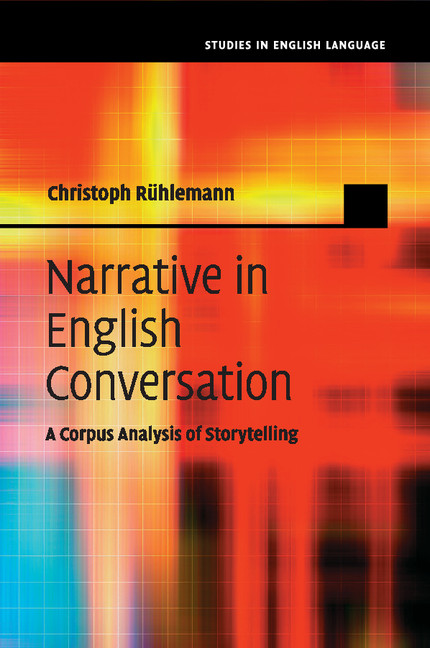
    Storytelling is a fundamental mode of everyday interaction. This book is based upon the Narrative Corpus (NC), a specialized corpus of naturally occurring narratives, and provides new paths for its study. Christoph Rühlemann uses the NC's narrative-specific annotation and XPath and XQuery, query languages that allow the retrieval of complex data structures, to facilitate large-scale quantitative investigations into how narrators and recipients collaborate in storytelling. Empirical analyses are validated using R, a programming language and environment for statistical computing and graphics. Using this unique data and methodological base, Rühlemann reveals new insights, including the discovery of turntaking patterns specific to narrative, the first investigation of textual colligation in spoken data, the unearthing of how speech reports, as discourse units, form striking patterns at utterance level, and the identification of the story climax as the sequential context in which recipient dialogue is preferentially positioned. This title is also available as open access on Cambridge Core.

    Reviews

    ‘Rühlemann's book is a rare gem in the study of conversational narrative. It is based on a corpus specifically compiled for this study, breaks new ground with sophisticated computational and statistical tools, and is full of astute observations and qualitative interpretation. No scholar of narratives will want to miss this.'

    Stefan Th. Gries - University of California, Santa Barbara

    ‘This book offers an excellent example of how to do significant original work on conversational narrative through the inventive development and use of corpus data. It demonstrates how sophisticated computer methods combine with intelligent hypothesis formulation to yield significant insights on conversational storytelling as an interactional achievement.'

    Neal Norrick - Saarland University

    ‘Rühlemann's work brings together in a timely fashion the best of discourse analysis and corpus linguistics. Exploiting the explanatory power of a large, carefully annotated specialised corpus, it breaks new ground in spoken corpus analysis by uncovering the delicate interweaving of speakers and listeners as they jointly construct their worlds.'

    Mike McCarthy - University of Nottingham

    Refine List

    Actions for selected content:

    Select all | Deselect all
    • View selected items
    • Export citations
    • Download PDF (zip)
    • Save to Kindle
    • Save to Dropbox
    • Save to Google Drive

    Save Search

    You can save your searches here and later view and run them again in "My saved searches".

    Please provide a title, maximum of 40 characters.
    ×

    Contents

    Full book PDF
    • Frontmatter
      pp i-iv
    • Dedication
      pp v-vi
    • Contents
      pp vii-ix
    • Figures
      pp x-xi
    • Tables
      pp xii-xiii
    • Acknowledgements
      pp xiv-xv
    • List of tags
      pp xvi-xviii
    • Introduction
      pp 1-3
    • 1 - Towards a working definition of conversational narrative
      pp 4-39
    • 2 - Data, methods, and tools
      pp 40-75
    • 3 - How do narrators and recipients co-construct turntaking?
      pp 76-109
    • 4 - Recipient design I: How do narrators mark quotation?
      pp 110-154
    • 5 - Recipient design II: How do narrators use discourse presentation for dramatization?
      pp 155-172
    • 6 - How do recipients co-author stories?
      pp 173-217
    • 7 - Conclusions and implications
      pp 218-231
    • Appendix 1
      pp 232-236
    • Appendix 2
      pp 237-238
    • Appendix 3
      pp 239-241
    • Appendix 4
      pp 242-245
    • Notes to the text
      pp 246-273
    • References
      pp 274-286
    • Index
      pp 287-288

    Metrics

    Altmetric attention score

    Full text views

    Total number of HTML views: 0
    Total number of PDF views: 0 *
    Loading metrics...

    Book summary page views

    Total views: 0 *
    Loading metrics...

    * Views captured on Cambridge Core between #date#. This data will be updated every 24 hours.

    Usage data cannot currently be displayed.

    Accessibility standard: Unknown

    Why this information is here

    This section outlines the accessibility features of this content - including support for screen readers, full keyboard navigation and high-contrast display options. This may not be relevant for you.

    Accessibility Information

    Accessibility compliance for the PDF of this book is currently unknown and may be updated in the future.
