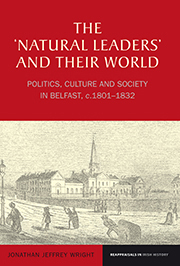
The 'Natural Leaders' and their World

-
The digital format of this book is no longer available to purchase from Cambridge Core. Other formats may be available.
-
Select format
-
- Publisher:
- Liverpool University Press
- Publication date:
- 05 May 2013
- 03 January 2013
- ISBN:
- 9781846317903
- 9781846318481
- Dimensions:
- Weight & Pages:
- 00kg,
- Dimensions:
- Weight & Pages:
You may already have access via personal or institutional login
Show more authors 
You may already have access via personal or institutional login
Book description
This book is a richly detailed exploration of the complex and cosmopolitan urban culture inhabited by the Presbyterian elite of late-Georgian Belfast, which will prove to be of interest to a wide range of scholars working on the political, cultural and intellectual histories of both Ireland and Britain during the age of reform. Employing both biographical and thematic approaches, the book begins by examining the story of the Tennents, one of the most prominent Presbyterian families in early-nineteenth-century Belfast, before turning to reconstruct their milieu. Challenging existing narratives, the study provides a major re-assessment of the political life of late-Georgian Belfast, highlighting the activities of a close-knit group of advanced reformer the natural leaders of the books title who sought to promote the cause of reform and engage with British and European political events. In addition, the book contains the first serious scholarly examination of the cultural and intellectual life of the town in the early-nineteenth century, and the first major treatment of the middle classes philanthropic activities. The interplay of politics and culture is discussed, as is the accuracy of Belfasts reputation as the Athens of the North and the religious underpinnings of the towns charitable societies. In examining these areas, attention is paid to the influence of trends such as romanticism and evangelicalism and of writers such as Lord Byron, Walter Scott, Robert Owen and Thomas Chalmers, and it is argued that, both culturally and politically, the Presbyterian middle classes of Belfast inhabited a British world.
Contents
Contents
Metrics
Full text views
Full text views helpTotal number of HTML views: 0
Total number of PDF views: 0 *
 Loading metrics...
* Views captured on Cambridge Core between #date#. This data will be updated every 24 hours.
Usage data cannot currently be displayed.
Accessibility standard: Unknown
Why this information is here
This section outlines the accessibility features of this content - including support for screen readers, full keyboard navigation and high-contrast display options. This may not be relevant for you.
Accessibility Information
Accessibility compliance for the PDF of this book is currently unknown and may be updated in the future.